JEE Main Chemistry — Physical Chemistry previous year questions with solutions.
The correct reaction profile diagram for a positive catalyst reaction.
At equilibrium, the rate of forward reaction is
When ${\mathrm{Fe}}_{0.93}O$ is heated in presence of oxygen, it converts to ${\mathrm{Fe}}_{2}{O}_{3}$. The number of correct statement/s from the following is ______ . A. The equivalent weight of ${\mathrm{Fe}}_{0.93}O$ is $\frac{\mathrm{Molecular}\mathrm{weight}}{0.79}$ B. The number of moles of ${\mathrm{Fe}}^{2+}$ and ${\mathrm{Fe}}^{3+}$ in $1$ mole of ${\mathrm{Fe}}_{0.93}O$ is $0.79$ and $0.14$ respectively. C. ${\mathrm{Fe}}_{0.93}O$ is metal deficient with lattice comprising of cubic closed packed arrangement of ${O}^{2-}$ ions. D. The $%$ composition of ${\mathrm{Fe}}^{2+}$ and ${\mathrm{Fe}}^{3+}$ in ${\mathrm{Fe}}_{0.93}O$ is $85%$ and $15%$ respectively.
$80$ mole percent of ${\mathrm{MgCl}}_{2}$ is dissociated in aqueous solution. The vapour pressure of $1.0$ molal aqueous solution of ${\mathrm{MgCl}}_{2}$ at ${38}^{o}C$ is _____ $\mathrm{mm}\mathrm{Hg}$. (Nearest integer) Given: Vapour pressure of water at ${38}^{o}C$ is $50\mathrm{mm}\mathrm{Hg}$
${t}_{87.5}$ is the time required for the reaction to undergo $87.5%$ completion and ${t}_{50}$ is the time required for the reaction to undergo $50%$ completion. The relation between ${t}_{87.5}$ and ${t}_{50}$ for a first order reaction is ${t}_{87.5}=x\times {t}_{50}$ The value of $x$ is $_________.$ (Nearest integer)
A mixture of one mole of ${H}_{2}O$ and 1 mole of $\mathrm{CO}$ is taken in a $10\mathrm{litre}$ container and heated to $725K$. At equilibrium $40%$ of water by mass reacts with carbon monoxide according to the equation: $\mathrm{CO}(g)+{H}_{2}O(g)\overset{}{\rightleftharpoons }{\mathrm{CO}}_{2}(g)+{H}_{2}(g)$. The equilibrium constant ${K}_{C}\times {10}^{2}$ for the reaction is ________ (Nearest integer)
What happens when methane undergoes combustion in systems A and B respectively? 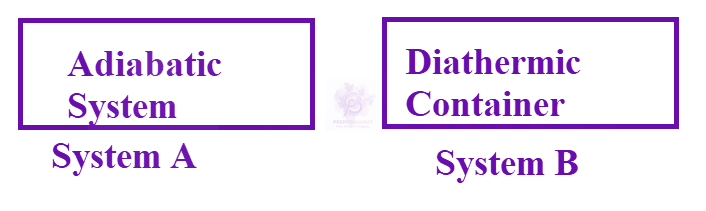
Strong reducing and oxidizing agents among the following , respectively, are
Given below are two statements : one is labelled as Assertion A and the other is labelled as Reason R : Assertion A: In the photoelectric effect, the electrons are ejected from the metal surface as soon as the beam of light of frequency greater than threshold frequency strikes the surface. Reason R : When the photon of any energy strikes an electron in the atom, transfer of energy from the photon to the electron takes place. In the light of the above statements, choose the most appropriate answer from the options given below :
For complete combustion of ethene, ${C}_{2}{H}_{4}(g)+3{O}_{2}(g)\rightarrow 2{\mathrm{CO}}_{2}(g)+2{H}_{2}O(l)$ the amount of heat produced as measured in bomb calorimeter is $1406\mathrm{kJ}{\mathrm{mol}}^{-1}$ at $300K$. The minimum value of $T\Delta S$ needed to reach equilibrium is $(-)$ $\mathrm{kJ}$. (Nearest integer) Given: $R=8.3J{K}^{-1}{\mathrm{mol}}^{-1}$
Gibbs energy vs $T$ plot for the formation of oxides is given below. 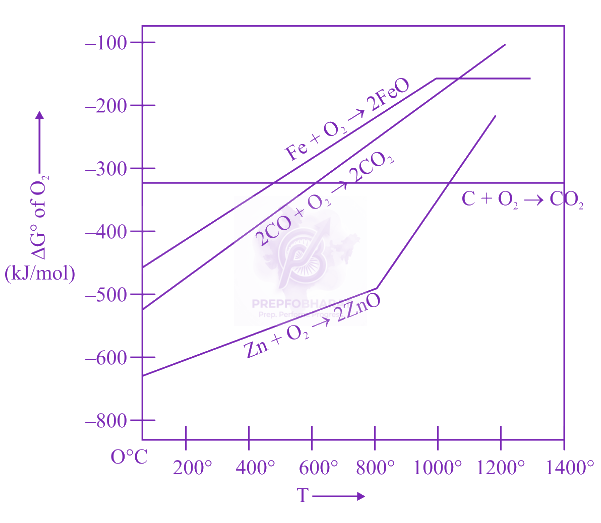 For the given diagram, the correct statement is-
The standard reduction potentials at $295K$ for the following half cells are given below: <table class="pyq-table"><tbody><tr><td>${{\mathrm{NO}}_{3}}^{-}+4{H}^{+}+3{e}^{-}\rightarrow \mathrm{NO}(g)+2{H}_{2}O$</td><td>${E}^{o}=0.97V$</td></tr><tr><td>${V}^{2+}(\mathrm{aq})+2{e}^{-}\rightarrow V(s)$</td><td>${E}^{o}=-1.19V$</td></tr><tr><td>${\mathrm{Fe}}^{3+}(\mathrm{aq})+3{e}^{-}\rightarrow \mathrm{Fe}(s)$</td><td>${E}^{o}=-0.04V$</td></tr><tr><td>${\mathrm{Ag}}^{+}(\mathrm{aq})+{e}^{-}\rightarrow \mathrm{Ag}(s)$</td><td>${E}^{o}=0.80V$</td></tr><tr><td>${\mathrm{Au}}^{3+}(\mathrm{aq})+3{e}^{-}\rightarrow \mathrm{Au}(s)$</td><td>${E}^{o}=1.40V$</td></tr></tbody></table>The number of metal(s) which will be oxidised by ${{\mathrm{NO}}_{3}}^{-}$ in aqueous solution is _____.
$Pt(s){H}_{2}(g)(1\mathrm{bar})|{H}^{+}(\mathrm{aq})(1M)||{M}^{3+}(\mathrm{aq}),{M}^{+}(\mathrm{aq})|\mathrm{Pt}(s)$ The ${E}_{\text{cell }}$ for the given cell is $0.1115V$ at $298K$ When $\frac{[{M}^{+}(\mathrm{aq})]}{[{M}^{3+}(\mathrm{aq})]}={10}^{a}$ The value of a is ___________ Given : ${E}^{\theta }={M}^{3+}/{M}^{+}0.2V$ $\frac{2.303\mathrm{RT}}{F}=0.059V$
Sea water contains $29.25%\mathrm{NaCl}$ and $19%{\mathrm{MgCl}}_{2}$ by weight of solution. The normal boiling point of the sea water is $C\circ$ (Nearest integer) Assume $100%$ ionization for both $\mathrm{NaCl}$ and ${\mathrm{MgCl}}_{2}$ Given: ${K}_{b}({H}_{2}O=0.52K\mathrm{kg}{\mathrm{mol}}^{-1})$ Molar mass of $\mathrm{NaCl}$ and ${\mathrm{MgCl}}_{2}$ is $58.5$ and $95g$ ${\mathrm{mol}}^{-1}$ respectively.
The product, which is not obtained during the electrolysis of brine solution is
Consider the cell ${\mathrm{Pt}}_{(s)}|{H}_{2}(g,1\mathrm{atm})|{H}^{+}(\mathrm{aq},1M)||{\mathrm{Fe}}^{3+}(\mathrm{aq}),{\mathrm{Fe}}^{2+}(\mathrm{aq})|Pt(s)$ When the potential of the cell is $0.712V$ at $298K$, the ratio $[{\mathrm{Fe}}^{2+}]/[{\mathrm{Fe}}^{3+}]$ is (Nearest integer) Given: ${\mathrm{Fe}}^{3+}+{e}^{-}={\mathrm{Fe}}^{2+},E^{\circ}{\mathrm{Fe}}^{3+},{\mathrm{Fe}}^{2+}\mathrm{Pt}=0.771\frac{2.303\mathrm{RT}}{F}=0.06V$
$25.0\mathrm{mL}$ of $0.050M\mathrm{Ba}{({\mathrm{NO}}_{3})}_{2}$ is mixed with $25.0\mathrm{mL}$ of $0.020M\mathrm{NaF}.{K}_{\mathrm{sp}}$ of ${\mathrm{BaF}}_{2}$ is $0.5\times 10–6$ at $298K.$ The ratio of $[{\mathrm{Ba}}^{2+}]{[{F}^{-}]}^{2}$ and ${K}_{\mathrm{sp}}$ is $______.$
The number of given statement/s which is/are correct is_____ (A) The stronger the temperature dependence of the rate constant, the higher is the activation energy. (B) If a reaction has zero activation energy, its rate is independent of temperature. (C) The stronger the temperature dependence of the rate constant, the smaller is the activation energy. (D) If there is no correlation between the temperature and the rate constant then it means that the reaction has negative activation energy.
During the reaction of permanganate with thiosulphate, the change in oxidation of manganese occurs by value of $3$. Identify which of the below medium will favour the reaction.
$A\rightarrow B$ The above reaction is of zero order. Half life of this reaction is $50\mathrm{min}$. The time taken for the concentration of $A$ to reduce to one-fourth of its initial value is min . (Nearest integer)
The Total pressure observed by mixing two liquid $A\text{and}B$ is $350\mathrm{mm}\mathrm{Hg}$ when their mole fractions are $0.7\text{and}0.3$ respectively. The Total pressure becomes$410\mathrm{mm}\mathrm{Hg}$ if the mole fractions are changed to$0.2\text{and}0.8$ respectively for $A\text{and}B$. The vapour pressure of pure $A$ is ______ $\mathrm{mm}\mathrm{Hg}$. (Nearest integer) Consider the liquids and solutions behave ideally
(i) $X(g)\rightleftharpoons Y(g)+Z(g){K}_{p1}=3$ (ii) $A(g)\rightleftharpoons 2B(g){K}_{p2}=1$ If the degree of dissociation and initial concentration of both the reactants $X(g)$ and $A(g)$ are equal, then the ratio of the total pressure at equilibrium $(\frac{{p}_{1}}{{p}_{2}})$ is equal to $x:1$. The value of $x$ is (Nearest integer)
The value of $\mathrm{log}K$ for the reaction $A\rightleftharpoons B$ at $298K$ is $_______.$ (Nearest integer) Given: $\Delta H^{\circ}=-54.07\mathrm{kJ}{\mathrm{mol}}^{-1}$ $\Delta S^{\circ}=10{\mathrm{JK}}^{-1}{\mathrm{mol}}^{-1}$ (Taken $2.303\times 8.314\times 298=5705$ )
A $300\mathrm{mL}$ bottle of soft drink has $0.2{\mathrm{MCO}}_{2}$ dissolved in it. Assuming ${\mathrm{CO}}_{2}$ behaves as an ideal gas, the volume of the dissolved ${\mathrm{CO}}_{2}$ at STP is _____ $\mathrm{mL}$. (Nearest integer) Given: At STP, molar volume of an ideal gas is $22.7L{\mathrm{mol}}^{-1}$