JEE Main Chemistry — Physical Chemistry previous year questions with solutions.
An organic compound gives $0.220g$ of ${\mathrm{CO}}_{2}$ and $0.126g$ of ${H}_{2}O$ on complete combustion. If the $%$ of carbon is $24$ then the $%$ of hydrogen is $_________\times {10}^{–1}.$ (Nearest integer)
The number of correct statement/s involving equilibria in physical processes from the following is ________ (A) Equilibrium is possible only in a closed system at a given temperature. (B) Both the opposing processes occur at the same rate. (C) When equilibrium is attained at a given temperature, the value of all its parameters became equal (D) For dissolution of solids in liquids, the solubility is constant at a given temperature.
An organic compound undergoes first order decomposition. If the time taken for the $60%$ decomposition is $540s$, then the time required for $90%$ decomposition will be is _____ s. (Nearest integer). Given : $\mathrm{ln}10=2.3;\mathrm{log}2=0.3$
Solution of $12g$ of non-electrolyte (A) prepared by dissolving it in $1000\mathrm{mL}$ of water exerts the same osmotic pressure as that of $0.05M$ glucose solution at the same temperature. The empirical formula of $A$ is ${\mathrm{CH}}_{2}O.$ The molecular mass of $A$ is $________g.$ (Nearest integer)
The vapour pressure vs. temperature curve for a solution solvent system is shown below. 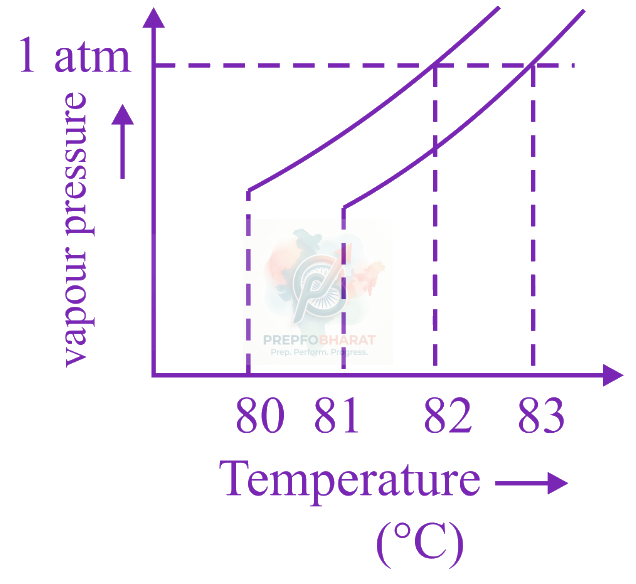 The boiling point of the solvent is _____°C.
A solution containing $2g$ of a non-volatile solute in $20g$ of water boils at $373.52K$. The molecular mass of the solute is _____ ${\mathrm{gmol}}^{-1}$. (Nearest integer) Given, water boils at $373K,{K}_{b}$ for water $=0.52K\mathrm{kg}{\mathrm{mol}}^{-1}$
The total pressure of a mixture of non-reacting gases $X(0.6g)$ and $Y(0.45g)$ in a vessel is $740\mathrm{mm}$ of $\mathrm{Hg}$. The partial pressure of the gas $X$ is $\mathrm{mm}$ of $\mathrm{Hg}.$ (Nearest Integer) (Given : molar mass $X=20$ and $Y=45g{\mathrm{mol}}^{-1}$ )
The number of pairs of the solution having the same value of the osmotic pressure from the following is (Assume $100%$ ionization) A. $0.500M{C}_{2}{H}_{5}\mathrm{OH}(\mathrm{aq})$ and $0.25M\mathrm{KBr}(\mathrm{aq})$ B. $0.100{M}_{}{K}_{4}[\mathrm{Fe}(\mathrm{CN}{)}_{6}](\mathrm{aq})$ and $0.100M$ ${\mathrm{FeSO}}_{4}{({\mathrm{NH}}_{4})}_{2}{\mathrm{SO}}_{4}(\mathrm{aq})$ C. $0.05M{K}_{4}[\mathrm{Fe}(\mathrm{CN}{)}_{6}]$ (aq) and $0.25M\mathrm{NaCl}$ $(\mathrm{aq})$ D. $0.15M\mathrm{NaCl}(\mathrm{aq})$ and $0.1M{\mathrm{BaCl}}_{2}(\mathrm{aq})$ E. $0.02M\mathrm{KCl}.{\mathrm{MgCl}}_{2}.6{H}_{2}O(\mathrm{aq})$ and $0.05M$ $\mathrm{KCl}(\mathrm{aq})$
What is the mass ratio of ethylene glycol (${C}_{2}{H}_{6}{O}_{2}$, molar mass $=62g/\mathrm{mol}$) required for making $500g$ of $0.25$ molal aqueous solution and $250\mathrm{mL}$ of $0.25$ molar aqueous solution?
A and B are two substances undergoing radioactive decay in a container. The half life of A is $15\mathrm{min}$ and that of B is $5\mathrm{min}$. If the initial concentration of B is $4$ times that of A and they both start decaying at the same time, how much time will it take for the concentration of both of them to be same? ________min.
A first order reaction has the rate constant, $k=4.6\times {10}^{-3}{s}^{-1}$. The number of correct statement/s from the following is/are Given: $\mathrm{log}3=0.48$. A. Reaction completes in $1000s$. B. The reaction has a half-life of $500s$. C. The time required for $10%$ completion is 25 times the time required for 90% completion. D. The degree of dissociation is equal to $(1-{e}^{-\mathrm{kt}})$. E. The rate and the rate constant have the same unit.
The number of correct statements from the following is........... A. ${E}_{\mathrm{cell}}$ is an intensive parameter B. A negative ${E}^{o}$ means that the redox couple is a stronger reducing agent than the ${H}^{+}/{H}_{2}$ couple. C. The amount of electricity required for oxidation or reduction depends on the stoichiometry of the electrode reaction. D. The amount of chemical reaction which occurs at any electrode during electrolysis by a current is proportional to the quantity of electricity passed through the electrolyte.
At $298K$, the standard reduction potential for ${\mathrm{Cu}}^{2+}/\mathrm{Cu}$ electrode is $0.34V$. Given : ${K}_{\mathrm{sp}}\mathrm{Cu}(\mathrm{OH}{)}_{2}=1\times {10}^{-20}$ Take $\frac{2.303\mathrm{RT}}{F}=0.059V$ The reduction potential at $\mathrm{pH}=14$ for the above couple is $(-)x\times {10}^{-2}V$. The value of x is
The reaction occurs in which of the given galvanic cell? $\frac{1}{2}{H}_{2}(g)+\mathrm{AgCl}(s)\rightleftharpoons {H}^{+}(\mathrm{aq})+{\mathrm{Cl}}^{-}(\mathrm{aq})+\mathrm{Ag}(s)$
The standard electrode potential of ${M}^{+}/M$ in aqueous solution does not depend on
Following figure shows dependence of molar conductance of two electrolytes on concentration. ${\Lambda }_{m}^{0}$ is the limiting molar conductivity. 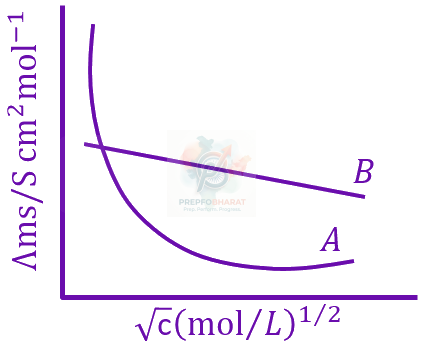 The number of Incorrect statement(s) from the following is _____ (A) ${\Lambda }_{m}^{0}$ for electrolyte $A$ is obtained by extrapolation (B) For electrolyte $B,{\Lambda }_{m}\mathrm{Vs}\sqrt{c}$ graph is a straight line with intercept equal to ${\Lambda }_{m}^{0}$ (C) At infinite dilution, the value of degree of dissociation approach zero for electrolyte $B$. (D) ${\Lambda }_{m}$ for any electrolyte $A$ or $B$ can be calculated using $\lambda ^{\circ}$ for individual ions.
Match List-I with List-II<table class="pyq-table"><tbody><tr><td></td><td>List-I</td><td></td><td>List-II</td></tr><tr><td>A</td><td>$16g$ of ${\mathrm{CH}}_{4}(g)$</td><td>I</td><td>Weighs $28g$</td></tr><tr><td>B</td><td>$1g$ of ${H}_{2}(g)$</td><td>II</td><td>$60.2\times {10}^{23}$ electrons</td></tr><tr><td>C</td><td>$1\mathrm{mole}$ of ${N}_{2}(g)$</td><td>III</td><td>Weighs $32g$</td></tr><tr><td>D</td><td>$0.5\mathrm{mol}$of ${\mathrm{SO}}_{2}(g)$</td><td>IV</td><td>Occupies$11.4L$ volume at STP</td></tr></tbody></table>Choose the correct answer from the options given below:
The effect of addition of helium gas to the following reaction in equilibrium state at constant volume, is : ${\mathrm{PCI}}_{5}(g)\rightleftharpoons {\mathrm{PCl}}_{3}(g)+{\mathrm{Cl}}_{2}(g)$
For conversion of compound $A\rightarrow B$, the rate constant of the reaction was found to be $4.6\times {10}^{-5}\mathrm{Lmol}-1{s}^{-1}$. The order of the reaction is _____ .
The number of correct statements from the following is ........... A. For $1s$ orbital, the probability density is maximum at the nucleus B. For $2s$ orbital, the probability density first increases to maximum and then decreases sharply to zero. C. Boundary surface diagrams of the orbitals encloses a region of $100%$ probability of finding the electron. D. $p$ and $d$-orbitals have $1$ and $2$ angular nodes respectively E. probability density of $p$-orbital is zero at the nucleus
Given below are two statements: one is labelled as Assertion (A) and the other is labelled as Reason (R). Assertion (A) : An aqueous solution of $\mathrm{KOH}$ when for volumetric analysis, its concentration should be checked before the use. Reason (R) : On aging,$\mathrm{KOH}$ solution absorbs atmospheric ${\mathrm{CO}}_{2}$. In the light of the above statements, choose the correct answer from the options given below.
Solid Lead nitrate is dissolved in $1$ litre of water. The solution was found to boil at $100.15^{\circ}C$. When $0.2\mathrm{mol}$ of $\mathrm{NaCl}$ is added to the resulting solution, it was observed that the solution froze at $-0.8^{\circ}C$. The solutbility product of ${\mathrm{PbCl}}_{2}$ formed is _____ $\times {10}^{-6}$ at $298K$. (Nearest integer) Given : ${K}_{b}=0.5K\mathrm{kg}{\mathrm{mol}}^{-1}$ and ${K}_{f}=1.8\mathrm{kg}{\mathrm{mol}}^{-1}$. Assume molality to be equal to molarity in all cases.
The incorrect statements from the following is: A. The electrical work that a reaction can perform at constant pressure and temperature is equal to the reaction Gibbs energy. B. ${E}_{\mathrm{cell}}^{\circ }$ is dependent on the pressure. C. $\frac{{\mathrm{dE}}_{\mathrm{cell}}^{^{\circ}}}{\mathrm{dT}}=\frac{{\Delta }_{r}{S}^{^{\circ}}}{\mathrm{nF}}$ D. A cell is operating reversibly if the cell potential is exactly balanced by an opposing source of potential difference.
Assume carbon burns according to following equation : $2C(s)+{O}_{2}(g)\rightarrow 2\mathrm{CO}\text{ (s) }$ when $12g$ carbon is burnt in $48g$ of oxygen, the volume of carbon monoxide produced is $______\times {10}^{-1}L$ at STP [nearest integer] [Given : Assume $\mathrm{CO}$ as ideal gas, Mass of $C$ is $12g{\mathrm{mol}}^{-1}$, mass of $O$ is $16g{\mathrm{mol}}^{-1}$ and molar volume of an idal gas at STP is $22.7L{\mathrm{mol}}^{-1}$ ]