Biotechnology - Principles and Processes PYQ — Page 2
NEET UG Zoology — Biotechnology - Principles and Processes previous year questions with solutions.
All Biotechnology - Principles and Processes Questions (127)
In gene gun method used to introduce alien DNA into host cells, microparticles of ____ metals are used.
Which of the following is not a cloning vector?
Main steps in the formation of Recombinant DNA are given below. Arrange these steps in a correct sequence. A. Insertion of recombinant DNA into the host cell. B. Cutting of DNA at specific location by restriction enzyme. C. Isolation of desired DNA fragment. D. Amplification of gene of interest using PCR. Choose the correct answer from the options given below:
In the following palindromic base sequences of DNA, which one can be cut easily by particular restriction enzyme?
Which of the following is not a desirable feature of a cloning vector?
Match List-I with List-II : 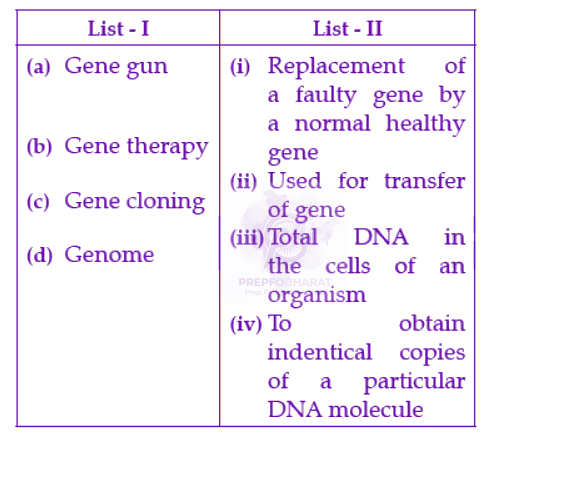 Choose the correct answer from the options given below :
Separation of DNA, fragments is done by a technique known as :
Given below are two statements: one is labelled as Assertion (A) and the other is labelled as Reason (R). Assertion (A): Polymerase chain reaction is used in DNA amplification Reason (R): The ampicillin resistant gene is used as a selectable marker to check transformation In the light of the above statements, choose the correct answer from the options given below :
Refer to the following statements for agarose-gel electrophoresis : (a) Agarose is a natural polymer obtained from sea-weed. (b) The separation of DNA molecules in agarosegel electrophoresis depends on the size of DNA. (c) The DNA migrates from negatively-charged electrode to the positively-charged electrode (d) The DNA migrates from positively-charged electrode to the negatively-charged electrode. Choose the most appropriate answer from the options given below :
Given below are two statements : one is labelled as Assertion (A) and the other is labelled as Reason (R). Assertion (A) : When a particular restriction enzyme cuts strand of DNA, overhanging stretches or sticky ends are formed. Reason (R) : Some restriction enzymes cut the strand of DNA a little away from the centre of palindromic site. In the light of the above statements, choose the correct answer from the options given below :
The enzyme (a) is needed for isolating genetic material from plant cells and enzyme (b) for isolating genetic material from fungus. Choose the correct pair of options from the following:
Which one of the following statement is not true regarding gel electrophoresis technique?
Which of the following methods is not commonly used for introducing foreign DNA into the plant cell?
Given below are two statements: Statement $I$: Restriction endonucleases recognise specific sequence to cut DNA known as palindromic nucleotide sequence. Statement $\mathrm{II}$: Restriction endonucleases cut the DNA strand a little away from the centre of the palindromic site. In the light of the above statements, choose the most appropriate answer from the options given below:
Pathogenic bacteria gain resistance to antibiotics due to changes in their :
During the purification process for recombinant DNA technology, addition of chilled ethanol precipitates out:
Plasmid $\mathrm{pBR}322$ has PstI restriction enzyme site within gene ${\mathrm{amp}}^{R}$ that confers ampicillin resistance. If this enzyme is used for inserting a gene for $\beta$-galactoside production and the recombinant plasmid is inserted in an E. coli strain
During the process of gene amplification using PCR, if a very high temperature is not maintained in the beginning, then which of the following steps of PCR will be affected first?
Which of the following is a correct sequence of steps in a PCR (Polymerase Chain Reaction)?
Which of the following is not an application of PCR (Polymerase Chain Reaction)?
DNA strands on a gel stained with ethidium bromide when viewed under UV radiation, appear as:
A specific recognition sequence identified by endonucleases to make cuts at specific positions within the DNA is:
Match the organism with its use in biotechnology. <table class="pyq-table"><tbody><tr><td>(a)</td><td>Bacillus thuringiensis</td><td>(i)</td><td>Cloning vector</td></tr><tr><td>(b)</td><td>Thermus aquaticus</td><td>(ii)</td><td>Construction of first rDNA molecule</td></tr><tr><td>(c)</td><td>Agrobacterium tumefaciens</td><td>(iii)</td><td>DNA polymerase</td></tr><tr><td>(d)</td><td>Salmonella typhimurium</td><td>(iv)</td><td>Cry proteins</td></tr></tbody></table>
The sequence that controls the copy number of the linked DNA in the vector, is termed