NEET UG 2007 — Modern Physics
Physics Modern Physics questions from NEET UG 2007.
Other Years
9 Modern Physics Questions from 2007
A nucleus ${ }^A_Z X$ has mass represented by $M(A, Z)$. If $M_p$ and $M_n$ denote the mass of proton and neutron respectively and B.E. the binding energy in $\mathrm{MeV}$, then
In a radioactive decay process, the negatively charged emitted $\beta$-particles are:
The total energy of electron in the ground state of hydrogen atom is $-13.6 \mathrm{eV}$. The kinetic energy of an electron in the first excited state is:
A 5 watt source emits monochromatic light of wavelength $5000 Å$. When placed $0.5 \mathrm{~m}$ away, it liberates photoclectrons from a photosensitive metallic surface. When the source is moved to a distance of $1.0 \mathrm{~m}$, the number of photoelectrons liberated will be reduced by a factor of :
In the following circuit, the output $\mathrm{Y}$ for all possible inputs $\mathrm{A}$ and $\mathrm{B}$ is expressed by the truth table. 
In the energy band diagram of a material shown below, the open circles and filled circles denote holes and electrons respectively. The material is 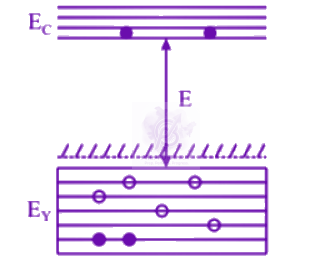
If the nucleus ${ }_{13}^{27} \mathrm{Al}$ has a nuclear radius of about $3.6 \mathrm{fm}$, then ${ }_{32}^{125} \mathrm{Te}$ would have its radius approximately as:
Two radioactive substances $\mathrm{A}$ and $\mathrm{B}$ have decay constants $5 \lambda$ and $\lambda$ respectively. At $t=0$ they have the same number of nuclei. The ratio of number of nuclei of A to those of $\mathrm{B}$ will be $(1 / e)^2$ after a time interval.
Monochromatic light of frequency $6.0 \times$ $10^{14} \mathrm{~Hz}$ is produced by a laser. The power emitted is $2 \times 10^{-3} \mathrm{~W}$. The number of photons emitted, on the average, by the source per second is: