Mechanics PYQ — Page 3
NEET UG Physics — Mechanics previous year questions with solutions.
All Mechanics Questions (512)
A metal wire has mass ($0.4\pm 0.002$) $g$, radius ($0.3\pm 0.001$) $\mathrm{mm}$ and length ($5\pm 0.02$) $\mathrm{cm}$. The maximum possible percentage error in the measurement of density will nearly be:
A bullet of mass $m$ hits a block of mass $M$ elastically. The transfer of energy is the maximum, when
A satellite is orbiting just above the surface of the earth with period $T$. If $d$ is the density of the earth and $G$ is the universal constant of gravitation, the quantity $\frac{3\pi }{Gd}$ represents :
The ratio of radius of gyration of a solid sphere of mass $M$ and radius $R$ about its own axis to the radius of gyration of the thin hollow sphere of same mass and radius about its axis is :
A football player is moving southward and suddenly turns eastward with the same speed to avoid an opponent. The force that acts on the player while turning is :
The mechanical quantity, which has dimensions of reciprocal of mass $\left(\mathrm{M}^{-1}\right)$ is
The angular acceleration of a body, moving along the circumference of a circle, is:
Let a wire be suspended from the ceiling (rigid support) and stretched by a weight $W$ attached at its free end. The longitudinal stress at any point of cross-sectional area $A$of the wire is:
The venturi-meter works on :
The viscous drag acting on a metal sphere of diameter $1 \mathrm{~mm}$, falling through a fluid of viscosity $0.8 \mathrm{~Pa} s$ with a velocity of $2 \mathrm{~m} \mathrm{~s}^{-1}$ is equal to
The amount of energy required to form a soap bubble of radius $2\mathrm{cm}$ from a soap solution is nearly: (surface tension of soap solution = $0.03N{m}^{-1}$)
A particle is executing uniform circular motion with velocity $\vec{v}$ and acceleration $\vec{a}$. Which of the following is true?
The errors in the measurement which arise due to unpredictable fluctuations in temperature and voltage supply are:
The amount of elastic potential energy per unit volume (in SI unit) of a steel wire of length $100 \mathrm{~cm}$ to stretch it by $1 \mathrm{~mm}$ is (if Young's modulus of the wire $=2.0 \times 10^{11} \mathrm{~N} \mathrm{~m}^{-2}$ )
If $R$ is the radius of the earth and $g$ is the acceleration due to gravity on the earth surface. Then the mean density of the earth will be
A vehicle travels half the distance with speed $v$ and the remaining distance with speed $2v$. Its average speed is:
A ball is thrown vertically upward with velocity 20 m/s. The maximum height reached is (g = 10 m/s²)
Two particles $A$ and $B$ initially at rest, move towards each other under mutual force of attraction. At an instance when the speed of $A$ is $v$ and speed of $B$ is $3 v$, the speed of centre of mass is
A bullet is fired from a gun at the speed of$280m{s}^{-1}$ in the direction $30^{\circ}$ above the horizontal. The maximum height attained by the bullet is ($g=9.8m{s}^{-2},$ $\mathrm{sin}30^{\circ}=0.5$):
The diameter of a spherical bob, when measured with vernier callipers yielded the following values: $3.33 \mathrm{~cm}$, $3.32 \mathrm{~cm}, 3.34 \mathrm{~cm}, 3.33 \mathrm{~cm}$ and $3.32 \mathrm{~cm}$. The mean diameter to appropriate significant figures is:
Calculate the maximum acceleration of a moving car so that a body lying on the floor of the car remains stationary. The coefficient of static friction between the body and the floor is $0.15$ $(g=10m{s}^{-2})$
Two bodies of mass $m$ and $9m$ are placed at a distance $R$. The gravitational potential on the line joining the bodies where the gravitational field equals zero, will be ($G=$gravitational constant):
A ball is projected from point $A$ with velocity $20 \mathrm{~m} \mathrm{~s}^{-1}$ at an angle $60^{\circ}$ to the horizontal direction. At the highest point $B$ of the path (as shown in figure), the velocity $v \mathrm{~m} \mathrm{~s}^{-1}$ of the ball will be 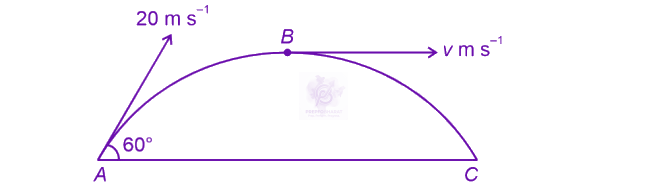
The position of a particle is given by $\vec{r}(t)=4 t \hat{i}+2 t^2 \hat{j}+5 \hat{k}$ where $t$ is in seconds and $r$ in metre. Find the magnitude and direction of velocity $v(t)$, at $t=1 \mathrm{~s}$, with respect to $x$-axis.