Mechanics PYQ — Page 4
NEET UG Physics — Mechanics previous year questions with solutions.
All Mechanics Questions (512)
The SI unit of impulse is
A particle moves with a velocity $(5 \hat{i}-3 \hat{j}+6 \hat{k}) \mathrm{ms}^{-1}$ horizontally under the action of constant force $(10 \hat{i}+10 \hat{j}+20 \hat{k}) \mathrm{N}$. The instantaneous power supplied to the particle is:
A horizontal bridge is built across a river. A student standing on the bridge throws a small ball vertically upwards with a velocity $4m{s}^{-1}$. The ball strikes the water surface after $4s$. The height of bridge above water surface is (Take $g=10m{s}^{-2}$):
A bullet from a gun is fired on a rectangular wooden block with velocity $u$. When bullet travels $24\mathrm{cm}$ through the block along its length horizontally, velocity of bullet becomes $\frac{u}{3}$. Then it further penetrates into the block in the same direction before coming to rest exactly at the other end of the block. The total length of the block is :
A block of mass $2 \mathrm{~kg}$ is placed on an inclined rough surface $\mathrm{AC}$ (as shown in figure) of coefficient of friction $\mu$. If $g=10 \mathrm{~ms}^{-2}$, the net force (in $\mathrm{N}$ ) on the block will be 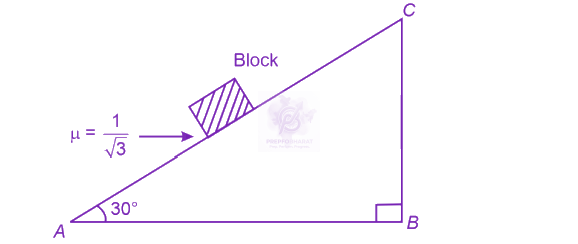
Which of the following statement is not true?
The potential energy of a long spring when stretched by $2\mathrm{cm}$ is $U$. If the spring is stretched by $8\mathrm{cm}$, potential energy stored in it will be:
The escape velocity of a body on the earth surface is $11.2 \mathrm{~km} / \mathrm{s}$. If the same body is projected upward with velocity $22.4 \mathrm{~km} / \mathrm{s}$, the velocity of this body at infinite distance from the centre of the earth will be
An energy of $484 \mathrm{~J}$ is spent in increasing the speed of a flywheel from $60 \mathrm{rpm}$ to $360 \mathrm{rpm}$. The moment of inertia of the flywheel is:
The restoring force of a spring with a block attached to the free end of the spring is represented by:
In a gravitational field, the gravitational potential is given by, $\mathrm{V}=\frac{\mathrm{K}}{x}(\mathrm{~J} / \mathrm{kg})$. The gravitational field intensity at point $(2,0,3) \mathrm{m}$ is:
If the kinetic energy of a body becomes four times, its momentum becomes
The position-time $(x-t)$ graph for positive acceleration is:
A gravitational field is present in a region and a mass is shifted from $A$ to $B$ through different paths as shown. If $W_1, W_2$ and $W_3$ represent the work done by the gravitational force along the respective paths, then 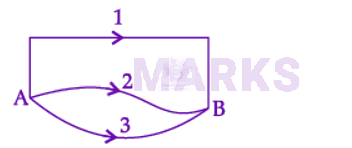
The distance covered by a body of mass $5 \mathrm{~g}$ having linear momentum $0.3 \mathrm{~kg} \mathrm{~m} / \mathrm{s}$ in $5 \mathrm{~s}$ is:
Match List - I with List - II : <table class="pyq-table"><tbody><tr><td colspan="2" rowspan="1">List - I</td><td colspan="2" rowspan="1">List - II</td></tr><tr><td>(a)</td><td>Gravitational constant (G)</td><td>(i)</td><td>$[{L}^{2}{T}^{-2}]$</td></tr><tr><td>(b)</td><td>Gravitational potential energy</td><td>(ii)</td><td>$[{M}^{-1}{L}^{3}{T}^{-2}]$</td></tr><tr><td>(c)</td><td>Gravitational potential</td><td>(iii)</td><td>$[{\mathrm{LT}}^{-2}]$</td></tr><tr><td>(d)</td><td>Gravitational intensity</td><td>(iv)</td><td>$[{\mathrm{ML}}^{2}{T}^{-2}]$</td></tr></tbody></table>Choose the correct answer from the options given below:
The angular speed of a fly wheel moving with uniform angular acceleration changes from $1200\mathrm{rpm}$ to $3120\mathrm{rpm}$ in $16$ seconds. The angular acceleration in $\mathrm{rad}{s}^{-2}$ is:
The percentage error in the measurement of $g$ is $\left(\right.$ Given that $g=\frac{4 \pi^2 \mathrm{~L}}{\mathrm{~T}^2}, \mathrm{~L}=(10 \pm 0.1) \mathrm{cm}$, $\mathrm{T}=(100 \pm 1) \mathrm{s}):$
If $\overrightarrow{\mathrm{F}}=2 \hat{i}+\hat{j}-\hat{k}$ and $\vec{r}=3 \hat{i}+2 \hat{j}-2 \hat{k}$, then the scalar and vector products of $\vec{F}$ and $\vec{r}$ have the magnitudes respectively as:
A ball is projected with a velocity, $10{ms}^{-1}$, at an angle of $60^{\circ}$ with the vertical direction. Its speed at the highest point of its trajectory will be
The ratio of the radius of gyration of a thin uniform disc about an axis passing through its centre and normal to its plane to the radius of gyration of the disc about its diameter is
Two objects of mass $10\mathrm{kg}$ and $20\mathrm{kg}$ respectively are connected to the two ends of a rigid rod of length $10m$ with negligible mass. The distance of the center of mass of the system from the $10\mathrm{kg}$ mass is:
A cricket ball is thrown by a player at a speed of $20 \mathrm{~m} / \mathrm{s}$ in a direction $30^{\circ}$ above the horizontal. The maximum height attained by the ball during its motion is $\left(g=10 \mathrm{~m} / \mathrm{s}^2\right)$ :
The physical quantity that has the same dimensional formula as pressure is: