Physical Chemistry PYQ — Page 8
NEET UG Chemistry — Physical Chemistry previous year questions with solutions.
All Physical Chemistry Questions (571)
Conjugate base for Bronsted acids ${\text{H}}_{2} \text{O}$ and $\text{HF}$ are:
If the rate constant for a first order reaction is $k$, the time $(t)$ required for the completion of $99%$ of the reaction is given by
The standard electrode potential $\left(\mathrm{E}^{-}\right)$values of $\left(\mathrm{Al}^{3+} / \mathrm{Al}, \mathrm{Ag}^{+} / \mathrm{Ag}, \mathrm{K}^{+} / \mathrm{K}\right.$ and $\mathrm{Cr}^{3+} / \mathrm{Cr}$ are $-1.66 \mathrm{~V}, 0.80 \mathrm{~V}, 2.93 \mathrm{~V}$ and $-0.74 \mathrm{~V}$, respectively. The correct decreasing order of reducing power of the metal is
Which of the following series of transitions in the spectrum of hydrogen atom falls in visible region?
For the chemical reaction ${N}_{2}(g)+3{H}_{2}(g)\rightleftharpoons 2N{H}_{3}(g)$, the correct option is:
$4d, 5p, 5f$ and $6p$ orbitals are arranged in the order of decreasing energy. The correct option is:
In hydrogen atom, the de-Broglie wavelength of an electron in the second Bohr orbit is [Given that, Bohr radius, $\mathrm{a}_0=52.9 \mathrm{pm}$ ]
The mixture that forms maximum boiling azeotrope is
pH of a saturated solution of $Ca{(OH)}_{2}$ is $9$ . The solubility product $({K}_{sp})$ of $Ca{(OH)}_{2}$ is:
Reversible expansion of an ideal gas under isothermal and adiabatic conditions are as shown in the figure. 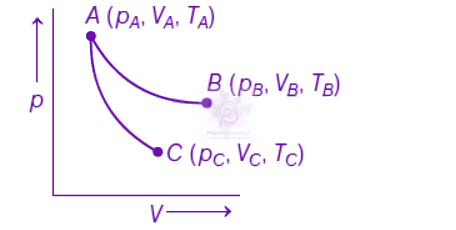 $A B \rightarrow$ Isothermal expansion $A C \rightarrow$ Adiabatic expansion Which of the following option is not correct?
Which will make basic buffer?
The density of $2 \mathrm{M}$ aqueous solution of $\mathrm{NaOH}$ is $1.28 \mathrm{~g} / \mathrm{cm}^3$. The molality of the solution is [Given that molecular mass of $\left.\mathrm{NaOH}=40 \mathrm{~g} \mathrm{~mol}^{-1}\right]$
The $\mathrm{pH}$ of $0.01 \mathrm{M} \mathrm{NaOH}(a q)$ solution will be
The oxidation state of $\mathrm{Cr}$ in $\mathrm{CrO}_5$ is
For an ideal solution, the correct option is:
For a cell involving one electron ${E}_{cell}^{\circleddash }=0.59 V$ at $298 K$, the equilibrium constant for the cell reaction is: $[Given that \frac{2.303 RT}{F}=0.059 V at T=298 K]$
The solubility of ${\mathrm{BaSO}}_{4}$ in water is $2.42\times {10}^{-3}{\mathrm{gL}}^{-1}$ at $298 K.$ The value of its solubility product $({K}_{\mathrm{sp}})$ will be (Given- the molar mass of ${\mathrm{BaSO}}_{4}=233 g {\mathrm{mol}}^{-1}$)
Following solutions were prepared by mixing different volumes of $\mathrm{NaOH}$ and $\mathrm{HCl}$ of different concentrations. (i) $60 \mathrm{mL}\frac{M}{10} \mathrm{HCl}+40\mathrm{mL}\frac{M}{10}\mathrm{NaOH}$ (ii) $55 \mathrm{mL}\frac{M}{10}\mathrm{HCl}+45\mathrm{mL}\frac{M}{10}\mathrm{NaOH}$ (iii) $75 \mathrm{mL}\frac{M}{5}\mathrm{HCl}+25\mathrm{mL}\frac{M}{5}\mathrm{NaOH}$ (iv) $100 \mathrm{mL}\frac{M}{10}\mathrm{HCl}+100 \mathrm{mL}\frac{M}{10}\mathrm{NaOH}$ The $\mathrm{pH}$ of which one of them will be equal to $1$?
Consider the change in oxidation state of Bromine corresponding to different emf values, as shown in the diagram below:  Then, what is the species undergoing disproportionation?
In which case the number of molecules of water maximum?
Which one of the following conditions will favor the maximum formation of the product in the reaction? ${A}_{2}(g)+{B}_{2}(g)\rightleftharpoons {X}_{2}(g){\Delta }_{r}H=-X \mathrm{kJ}$
The bond dissociation energies of ${X}_{2} {Y}_{2}$ and $\mathrm{XY}$ are in the ratio of $1 :0.5 :1.\Delta H$ for the formation of $\mathrm{XY}$ is $-200\mathrm{kJ} {\mathrm{mol}}^{-1}$. What will be the bond dissociation energy of ${X}_{2}$?
When initial concentration of the reactant is doubled, what happens to the half-life period of a zero order reaction?
Which one is a wrong statement?