NEET UG 2005 — Physical Chemistry
Chemistry Physical Chemistry questions from NEET UG 2005.
Other Years
18 Physical Chemistry Questions from 2005
The number of moles of $\mathrm{KMnO}_4$ reduced by one mole of $\mathrm{KI}$ is alkaline medium is:
The absolute enthalpy of neutralisation of the reaction: : $\mathrm{MgO}_{(s)}+2 \mathrm{HCl}_{(a q)}$ $\rightarrow \mathrm{MgCl}_{2(a q)}+\mathrm{H}_2 \mathrm{O}_{(\cap}$ will be:
$\mathrm{H}_2 \mathrm{~S}$ gas when passed through a solution of cations containing $\mathrm{HCl}$ precipitates the cations of second group of qualitative analysis but not those belonging to the fourth group. It is because
The mass of carbon anode consumed (giving only carbon dioxide) in the production of $270 \mathrm{~kg}$ of a aluminium metal from bauxite by the Hall process is: (Atomic mass : A1 = 27)
A solution has a 1 : 4 mole ratio of pentane to hexane. The vapour pressures of the pure hydrocarbons at $20^{\circ} \mathrm{C}$ are 440 $\mathrm{mm} \mathrm{Hg}$ for pentane and $120 \mathrm{~mm} \mathrm{Hg}$ for hexane. the mole fraction of pentane in the vapour phase would be:
A nuclide of an alkaline earth metal under goes radioactive decay by emission of the $\alpha$-particles in succession. The group of the periodic table to which the resulting daughter element would belong is:
The reaction occurs spontaneously if :
The energy of second Bohr orbit of the hydrogen atom is $-328 \mathrm{~kJ} \mathrm{~mol}^{-1}$; hence the energy of fourth Bohr orbit would be
Which of the following pairs of a chemicals reaction is certain to result in a spontaneous reactions?
Equilibrium constants $\mathrm{K}_1$ and $\mathrm{K}_2$ for the following equilibria: 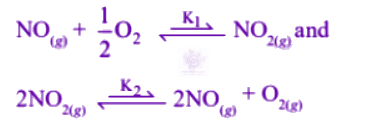 are related as:
The mole friction of the solute in one molal aqueous solution is:
The vapour pressure of two liquids $P$ and $\mathrm{Q}$ are 80 and 60 torr respectively. The total vapour pressure of solution obtained by mixing 3 mole of $\mathrm{P}$ and $2 \mathrm{~mol}$ of $\mathrm{Q}$ would be:
Copper has face centered cubic (fcc) lattice with interatomic spacing equal to $2.54 Å$. The value of lattice constant for this lattice is:
The rate of reaction between two reactants $\mathrm{A}$ and $\mathrm{B}$ decreases by a factor of 4 if the concentration of reactant $B$ is doubled. The order of this reaction iwth respect is reactant $\mathrm{B}$ is:
For a first order reaction $\mathrm{A} \rightarrow \mathrm{B}$ the reaction rate at reactant concentration of $0.01 \mathrm{M}$ is found to be $2.0 \times 10^{-5} \mathrm{~mol} \mathrm{~L}^{-1}$ $\mathrm{s}^{-1}$. The half life period of the reaction is:
A solution of urea (mol. mass $\left.56 \mathrm{~g} \mathrm{~mol}^{-1}\right)$ boils at $100.18^{\circ} \mathrm{C}$ at the atmospheric pressure. If $\mathrm{K}_f$ and $\mathrm{K}_b$ for water for 1.86 and $0.512 \mathrm{Kkmol}^{-1}$ respectively, the above solution will freeze at:
At $25^{\circ} \mathrm{C}$, the dissociation constant of a base, $\mathrm{BOH}$, is $1.0 \times 10^{-12}$. The concentration of hydroxyl ions in $0.01 \mathrm{M}$ aqueous solution of the base would be:
$4.5 \mathrm{~g}$ of aluminium (at mass $27 \mathrm{amu}$ ) is deposited at cathode from $\mathrm{Al}^{3+}$ solution by a certain quality of electric charge. The volume of hydrogen produced at STP from $\mathrm{H}^{+}$ions in solution by the same quantity of electric charge will be: