NEET UG Chemistry — Organic Chemistry previous year questions with solutions.
In a reaction of aniline a coloured product $C$ was obtained. 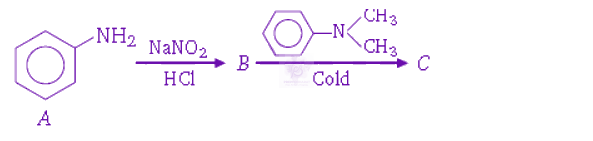 $\ ext {The structure of } C \text { would be}$
A strong base can abstract an $\alpha$-hydrogen from
Base strength of a. $\mathrm{H}_3 \mathrm{CC°H}_2$ b. $\mathrm{H}_2 \mathrm{C}=\mathrm{CH}$ c. $\mathrm{H}-\mathrm{C}=\mathrm{C}^{\circ}$ is in the order of
Which one the following is most reactive towards electrophilic attack?
Which one of the following on reduction with lithium aluminium hydride yields a secondary amine?
Consider the following compounds: $\text { (i) } \mathrm{C}_6 \mathrm{H}_5 \mathrm{COCl}$   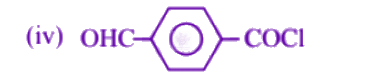 The correct decreasing order of their reactivity towards hydrolysis is:
Which of the following vitamins is water soluble?
Which one of the following on treatment with $50 \%$ aqueous sodium hydroxide yields the corresponding alcohol and acid?
The product formed in aldol condensation is:
RNA and DNA are chiral molecules, their chirality is due to:
In the reaction:  Which of the following compounds will be formed?
If there is no rotation of plane light by a compound in a specific solvent, though to be chiral, it may mean that:
Which of the compounds with molecular formula $\mathrm{C}_5 \mathrm{H}_{10}$ yields acetone on ozonolysis?
Reduction of aldehydes and ketones into hydrocarbons using zinc amalgam and conc. $\mathrm{HCl}$ is called:
Predict the product $\mathrm{C}$ obtained in the following reaction of butyne- 1 : $\mathrm{CH}_3 \mathrm{CH}_2-\mathrm{C} \equiv \mathrm{CH}+\mathrm{HCl} \rightarrow \mathrm{B} \stackrel{\mathrm{HI}}{\longrightarrow} \mathrm{C}$
Which of the following represents the correct order of the acidity in the given compounds?
The order of decreasing reactivity towards an electrophilic reagent, for the following would be: (i) benzene (ii) toluene (iii) chlorobenzene (iv) phenol
$\mathrm{CH}_3-\mathrm{CHCl}-\mathrm{CH}_2-\mathrm{CH}_3$ has a chiral centre. Which one of the following represents its R-configuration?
For (i) $\overline{\mathrm{I}}$, (ii) $\mathrm{Cl}^{-}$, (iii) $\mathrm{B} \overline{\mathrm{r}}$, the increasing order of nucleophilicity would be
Self condensation of two moles of ethyl acetate in presence of sodium ethoxide yields:
Which of the following is more basic than aniline?
Nucleophilic addition reaction will be most favoured in:
In a set of reactions propionic acid yielded a compound 'd'. \(\mathrm{CH}_2 \mathrm{CH}_2 \mathrm{COOH}\xrightarrow{\mathrm{SOCl}_2}{ }^{\prime} b^{\prime} \xrightarrow{\mathrm{NH}_3}{ }^{\prime} c^{\prime} \xrightarrow[\mathrm{Br}_2]{\mathrm{KOH}}{ }^{\prime} \mathrm{d}^{\prime}\) The structure of 'd' would be:
The human body does not produce: