NEET UG Chemistry — Organic Chemistry previous year questions with solutions.
In a protein molecule various amino acids are linked together by:
For the following reactions: a. ${\mathrm{CH}}_{3}{\mathrm{CH}}_{2}{\mathrm{CH}}_{2}\mathrm{Br}+\mathrm{KOH}\rightarrow {\mathrm{CH}}_{3}\mathrm{CH}={\mathrm{CH}}_{2}+\mathrm{KBr}+{H}_{2}O$ b. 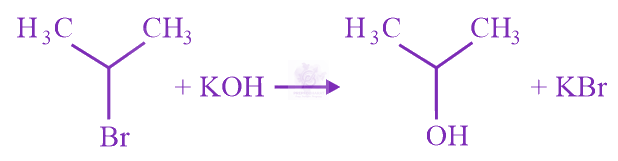 c. 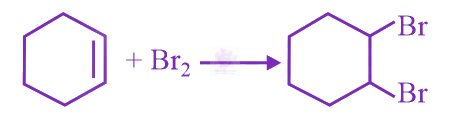 Which of the following statements is correct?
The correct order of strengths of carboxylic acids is 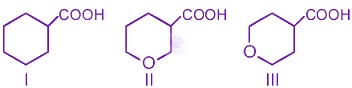
The correct statement regarding the basicity of aryl amines is:
In the given reaction, the product $P$ is 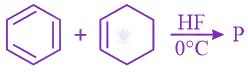
Consider the nitration of benzene using mixed conc. ${H}_{2}S{O}_{4}$ and $HN{O}_{3}$ . If a large amount of $KHS{O}_{4}$ is added to the mixture, the rate of nitration will be:
The correct structure of the product $A$ formed in the reaction is 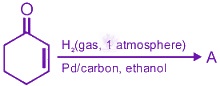
The reaction  Can be classified as:
Which of the following is not the product of dehydration of 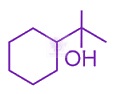 ?
The reaction  is called:
A single compound of the structure 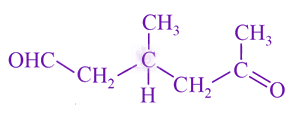 is obtainable from ozonolysis of which of the following cyclic compounds?
In the reaction with $\mathrm{HCl}$, an alkene reacts following the Markovnikov's rule to give the product $1-$chloro$-1-$methylcyclohexane. The possible reaction of the alkene is
The reaction of ${C}_{6}{H}_{5}CH=CHC{H}_{3}$ with HBr produces:
Given, 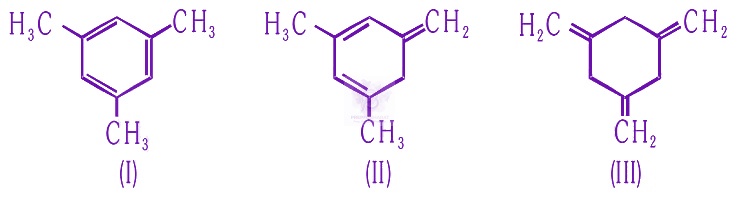 The enthalpy of hydrogenation of these compounds will be in the order as:
Treatment of cyclopentanone 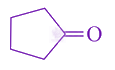 with methyl lithium gives which of the following species?
The oxidation of benzene by ${V}_{2}{O}_{5}$ in the presence of air produces:
In Duma's method for estimation of nitrogen, 0.25 g of an organic compound gave 40 mL of nitrogen collected at 300 K temperature and 725 mm pressure. If the aqueous tension at 300 K is 25 mm, the percentage of nitrogen in the compound is:
In which of the following compounds, the $C-Cl$ bond ionization shall give most stable carbonium ion?
The electrolytic reduction of nitrobenzene in strongly acidic medium produces:
Method by which Aniline cannot be prepared is:
The following reaction 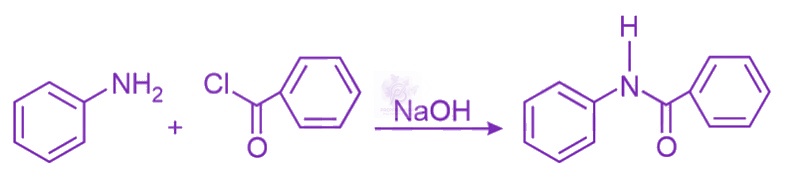 Is known by the name:
Reaction of a carbonyl compound with one of the following reagents involves nucleophilic addition followed by elimination of water. The reagent is:
The number of structural isomers possible from the molecular formula ${C}_{3}{H}_{9}N$ is:
In an ${S}_{N}1$ reaction on chiral centres, there is: