Polyploid cells have a chromosome number that is more than double the haploid number. Polyploidy is common in nature and provides a major mechanism for adaptation and speciation. The cells of these plants do not form cell plate at the end of cell division thus the cells have an extra number of chromosomes as compared to other dividing cells.
A cell at the telophase stage is observed by a student in a plant brought from the field. He tells his teacher that this cell is not like other cells…
NEET UG 2016 — Botany Cell Cycle and Cell Division
2016mcqmedium
A cell at the telophase stage is observed by a student in a plant brought from the field. He tells his teacher that this cell is not like other cells at the telophase stage. There is no formation of the cell plate and thus the cell is containing more chromosomes as compared to other dividing cells. This would result in:
Official previous-year question
Held on 30 Apr 2016 · Verified 9 Jul 2026.
Options
- A
Aneuploidy
- B
Polyploidy
- C
Somaclonal variation
- D
Polyteny
Did you get this right?
Sign in to track your attempts and accuracy.
Your note
Sign in to keep a private note on this question. Nothing you write is ever public.
NEET UG Cell Cycle and Cell Division in other years
Cell Cycle and Cell Division 2025Cell Cycle and Cell Division 2024Cell Cycle and Cell Division 2023Cell Cycle and Cell Division 2022Cell Cycle and Cell Division 2021Cell Cycle and Cell Division 2020Cell Cycle and Cell Division 2019Cell Cycle and Cell Division 2018Cell Cycle and Cell Division 2017Cell Cycle and Cell Division 2015Cell Cycle and Cell Division 2014Cell Cycle and Cell Division 2013
More NEET UG Cell Cycle and Cell Division questions
What is the main function of the spindle fibers during mitosis?
2025easy
Spindle fibers attach to kinetochores of chromosomes during
2024easy
Match List-I with List-II \begin{array}{|l|l|l|l|}\hline & List-I & & List-II \\\hline A. & Cells are metabolically active and proliferate & I. & \mathrm{G}_2 phase \\\hline B. & DNA replication takes place & II. & \mathrm{G}_1 phase \\\hline C. & Proteins are synthesised & III. & \mathrm{G}_0 phase \\\hline D. & Quiescent stage with metabolically active cells & IV. & S phase \\\hline\end{array} Choose the correct answer from the options given below:
2024medium
Match List-I with List-II. $\begin{array}{|l|l|r|l|}\hline & \begin{array}{l} \text{List-I} \\ \text{Event} \end{array} & & \begin{array}{l} \text{List-II} \\ \text{Stage of Prophase-I (Meiosis-I)} \end{array} \\ \hline A. & \text{Chiasmata formation} & I. & \text{Pachytene} \\ \hline B. & \text{Crossing over} & II. & \text{Diakinesis} \\ \hline C. & \text{Synaptonemal complex formation} & III. & \text{Diplotene} \\ \hline D. & \text{Terminalisation of chiasmata} & IV. & \text{Zygotene} \\ \hline \end{array}$ Choose the correct answer from the options given below :
2024medium
Match List I with List II : 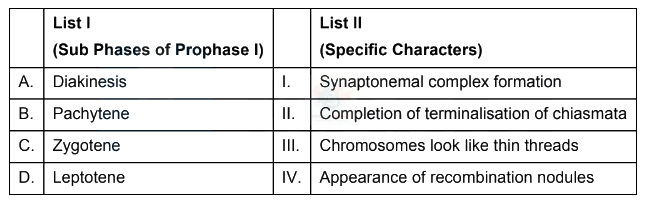 Choose the correct answer from the options given below
2024medium
Other Botany topics for NEET UG
Keep practicing Cell Cycle and Cell Division
Work through every NEET UG Cell Cycle and Cell Division PYQ, year by year.