Explanation for the correct option: 1. At certain points during M-phase, both 4C and 2C DNA is present. 2. The S phase occurs when the amount of DNA in the cell doubles. 3. As a result, the amount of DNA present in the G2 phase is 4 C. 4. The cell's contents have been doubled, preparing it for further mitotic division. 5. Interphase is made up of the G1 phase (cell growth). S phase (DNA synthesis), and G2 phase (cell growth). 6. At the completion of the interphase, the mitotic phase begins, which consists of mitosis and cytokinesis and results in the production of two daughter cells. Explanation for the incorrect option: Option A: 1. The RNA, proteins and other macromolecules essential for the multiplication of cell organelles, spindle formation, and cell development are created during the G2 phase (Gap 2) as the cell prepares to enter the mitotic phase. 2. The G2 phase is characterized by fast cell growth and protein synthesis as the cell prepares for mitosis. 3. Surprisingly, the G2 phase is not required for all cell types, since some (especially immature Xenopus embryos and certain malignancies) progress directly from DNA replication to mitosis. Option B: 1. During the G1 phase, the cell physically expands and increases the volume of both protein and organelles. 2. During the S phase, the cell duplicates its nucleosomes and copies its DNA to form two sister chromatids. 3. The G1/S transition is a step in the cell cycle that occurs at the junction of the G1 phase, during which the cell develops, and the S phase, during which DNA is reproduced. Option C: 1. GO phase: resting state, also known as the gap phase. 2. Many cells spend the majority of their time in this phase, either resting or executing assigned tasks. 3. Chemotherapy is generally ineffective. G1 phase: gap 1 phase, also known as interphase. Final answer: G2 and M phase(s) of the cell cycle, the amount of DNA in a cell remains at 4C level if the initial amount is denoted as 2C.
During which phase(s) of cell cycle, amount of DNA in a cell remains at 4 C level if the initial amount is denoted as 2C?
NEET UG 2014 — Botany Cell Cycle and Cell Division
During which phase(s) of cell cycle, amount of DNA in a cell remains at 4 C level if the initial amount is denoted as 2C?
Held on 30 Apr 2014 · Verified 9 Jul 2026.
Options
- A
G0 and G1
- B
G1 and S
- C
Only G2
- D
G2 and M
Did you get this right?
Sign in to track your attempts and accuracy.
Your note
Sign in to keep a private note on this question. Nothing you write is ever public.
NEET UG Cell Cycle and Cell Division in other years
More NEET UG Cell Cycle and Cell Division questions
What is the main function of the spindle fibers during mitosis?
Spindle fibers attach to kinetochores of chromosomes during
Match List-I with List-II \begin{array}{|l|l|l|l|}\hline & List-I & & List-II \\\hline A. & Cells are metabolically active and proliferate & I. & \mathrm{G}_2 phase \\\hline B. & DNA replication takes place & II. & \mathrm{G}_1 phase \\\hline C. & Proteins are synthesised & III. & \mathrm{G}_0 phase \\\hline D. & Quiescent stage with metabolically active cells & IV. & S phase \\\hline\end{array} Choose the correct answer from the options given below:
Match List-I with List-II. $\begin{array}{|l|l|r|l|}\hline & \begin{array}{l} \text{List-I} \\ \text{Event} \end{array} & & \begin{array}{l} \text{List-II} \\ \text{Stage of Prophase-I (Meiosis-I)} \end{array} \\ \hline A. & \text{Chiasmata formation} & I. & \text{Pachytene} \\ \hline B. & \text{Crossing over} & II. & \text{Diakinesis} \\ \hline C. & \text{Synaptonemal complex formation} & III. & \text{Diplotene} \\ \hline D. & \text{Terminalisation of chiasmata} & IV. & \text{Zygotene} \\ \hline \end{array}$ Choose the correct answer from the options given below :
Match List I with List II : 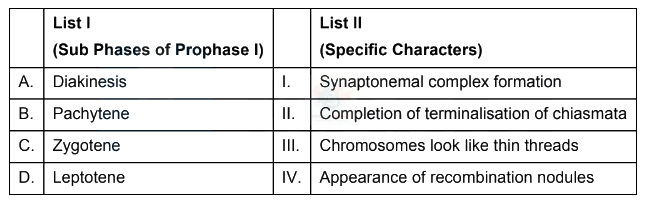 Choose the correct answer from the options given below
Other Botany topics for NEET UG
Keep practicing Cell Cycle and Cell Division
Work through every NEET UG Cell Cycle and Cell Division PYQ, year by year.