Each of the chromatids is capped with the telomere structure on either end of each arm. Therefore, a single chromosome in metaphase would have four total telomeres, two on each sister chromatid. Each chromosome consists of two chromatids and one centromere. Chromomeres form from the local coiling of a continuous DNA thread. There are more than 2000 chromomeres on 20 chromosomes of maize. Related Theory A telomere is the end of a chromosome. Telomeres are made of repetitive sequences of non-coding DNA that protect the chromosome from damage. Each time a cell divides, the telomeres become shorter. In humans the telomere sequence is TTAGGG.
Which of the following occurs more than one and less than five in a chromosome?
NEET UG 2002 — Botany Cell Cycle and Cell Division
2002mcqmedium
Which of the following occurs more than one and less than five in a chromosome?
Official previous-year question
Held on 30 Apr 2002 · Verified 9 Jul 2026.
Options
- A
Chromatid
- B
Chromomere
- C
Centromere
- D
Telomere
Did you get this right?
Sign in to track your attempts and accuracy.
Your note
Sign in to keep a private note on this question. Nothing you write is ever public.
NEET UG Cell Cycle and Cell Division in other years
Cell Cycle and Cell Division 2025Cell Cycle and Cell Division 2024Cell Cycle and Cell Division 2023Cell Cycle and Cell Division 2022Cell Cycle and Cell Division 2021Cell Cycle and Cell Division 2020Cell Cycle and Cell Division 2019Cell Cycle and Cell Division 2018Cell Cycle and Cell Division 2017Cell Cycle and Cell Division 2016Cell Cycle and Cell Division 2015Cell Cycle and Cell Division 2014
More NEET UG Cell Cycle and Cell Division questions
What is the main function of the spindle fibers during mitosis?
2025easy
Spindle fibers attach to kinetochores of chromosomes during
2024easy
Match List-I with List-II \begin{array}{|l|l|l|l|}\hline & List-I & & List-II \\\hline A. & Cells are metabolically active and proliferate & I. & \mathrm{G}_2 phase \\\hline B. & DNA replication takes place & II. & \mathrm{G}_1 phase \\\hline C. & Proteins are synthesised & III. & \mathrm{G}_0 phase \\\hline D. & Quiescent stage with metabolically active cells & IV. & S phase \\\hline\end{array} Choose the correct answer from the options given below:
2024medium
Match List-I with List-II. $\begin{array}{|l|l|r|l|}\hline & \begin{array}{l} \text{List-I} \\ \text{Event} \end{array} & & \begin{array}{l} \text{List-II} \\ \text{Stage of Prophase-I (Meiosis-I)} \end{array} \\ \hline A. & \text{Chiasmata formation} & I. & \text{Pachytene} \\ \hline B. & \text{Crossing over} & II. & \text{Diakinesis} \\ \hline C. & \text{Synaptonemal complex formation} & III. & \text{Diplotene} \\ \hline D. & \text{Terminalisation of chiasmata} & IV. & \text{Zygotene} \\ \hline \end{array}$ Choose the correct answer from the options given below :
2024medium
Match List I with List II : 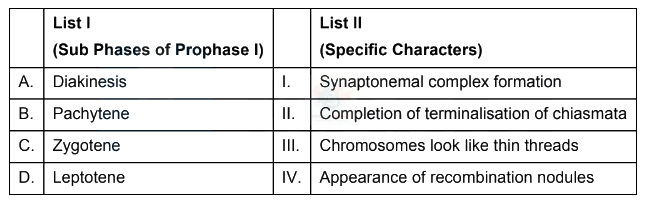 Choose the correct answer from the options given below
2024medium
Other Botany topics for NEET UG
Keep practicing Cell Cycle and Cell Division
Work through every NEET UG Cell Cycle and Cell Division PYQ, year by year.