Waves & Oscillations PYQ — Page 7
JEE Main Physics — Waves & Oscillations previous year questions with solutions.
All Waves & Oscillations Questions (340)
The motion of a simple pendulum executing S.H.M. is represented by the following equation $y=A\mathrm{sin}(\pi t+\phi )$, where time is measured in second. The length of pendulum is
The equation of a particle executing simple harmonic motion is given by $x=\mathrm{sin}\pi (t+\frac{1}{3})m$. At $t=1s$, the speed of particle will be (Given: $\pi =3.14$)
The equations of two waves are given by : ${y}_{1}=5\mathrm{sin}2\pi (x-vt)\mathrm{cm}$ ${y}_{2}=3\mathrm{sin}2\pi (x-vt+1.5)\mathrm{cm}$ These waves are simultaneously passing through a string. The amplitude of the resulting wave is :
If a wave gets refracted into a denser medium, then which of the following is true?
A wire of length $30\mathrm{cm}$, stretched between rigid supports, has it's ${n}^{\mathrm{th}}$ and ${(n+1)}^{\mathrm{th}}$ harmonics at $400\mathrm{Hz}$ and $450\mathrm{Hz}$, respectively. If tension in the string is $2700N$, it's linear mass density is _____ $\mathrm{kg}{m}^{-1}$.
A bob of mass $m$ suspended by a thread of length $\ell$ undergoes simple harmonic oscillations with time period $T.$ If the bob is immersed in a liquid that has density $\frac{1}{4}$ times that of the bob and the length of the thread is increased by ${(\frac{1}{3})}^{rd}$ of the original length, then the time period of the simple harmonic oscillations will be:
Two waves are simultaneously passing through a string and their equations are : ${y}_{1}={A}_{1}\mathrm{sin}k(x-vt),{y}_{2}={A}_{2}\mathrm{sin}k(x-vt+{x}_{0}).$ Given amplitudes ${A}_{1}=12\mathrm{mm}$ and ${A}_{2}=5\mathrm{mm}$, ${x}_{0}=3.5\mathrm{cm}$ and wave number $k=6.28{\mathrm{cm}}^{-1}.$ The amplitude of resulting wave will be _____ $\mathrm{mm}.$
For a body executing S.H.M. : (a) Potential energy is always equal to its $K.E.$ (b) Average potential and kinetic energy over any given time interval are always equal. (c) Sum of the kinetic and potential energy at any point of time is constant. (d) Average $K.E.$ in one time period is equal to average potential energy in one time period. Choose the most appropriate option from the options given below :
The variation of displacement with time of a particle executing free simple harmonic motion is shown in the figure. 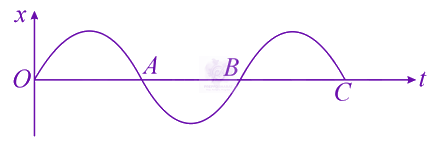 The potential energy $U(x)$ versus time $(t)$ plot of the particle is correctly shown in figure:
An object of mass $0.5\mathrm{kg}$ is executing simple harmonic motion. It amplitude is $5\mathrm{cm}$ and time period (T) is $0.2s$. What will be the potential energy of the object at an instant $t=\frac{T}{4}s$ starting from mean position. Assume that the initial phase of the oscillation is zero.
In the given figure, a body of mass $M$ is held between two massless springs, on a smooth inclined plane. The free ends of the springs are attached to firm supports. If each spring has spring constant $k,$ the frequency of oscillation of given body is: 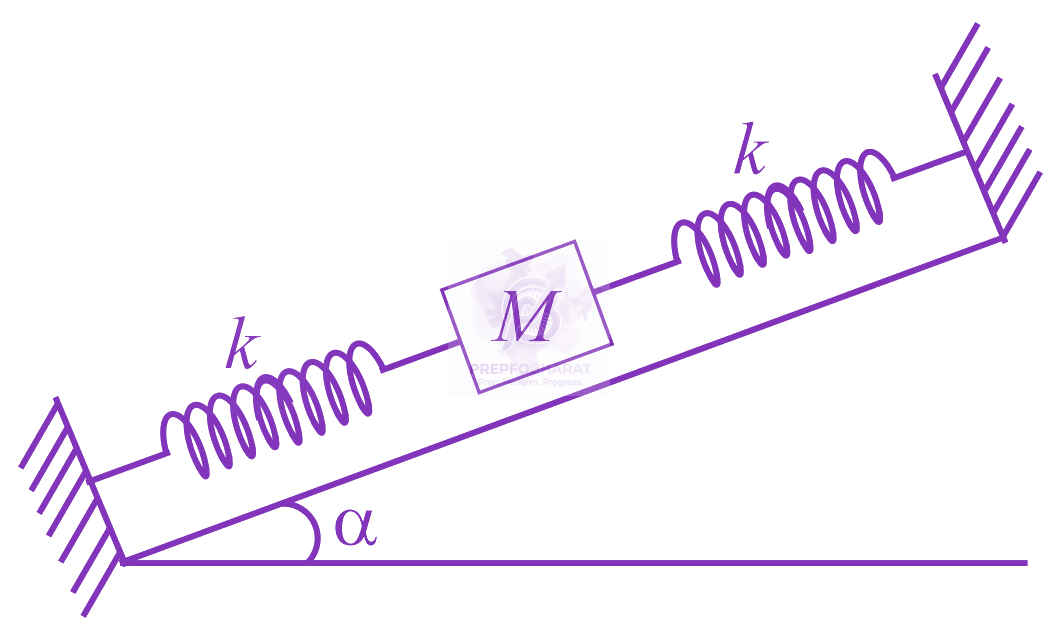
Which of the following equations represents a travelling wave?
The mass per unit length of a uniform wire is $0.135g{\mathrm{cm}}^{-1}$. A transverse wave of the form $y=-0.21\mathrm{sin}(x+30t)$ is produced in it, where $x$ is in meter and $t$ is in second. Then, the expected value of tension in the wire is $x\times {10}^{-2}N$. Value of $x$ is (Round-off to the nearest integer)
A $25m$ long antenna is mounted on an antenna tower. The height of the antenna tower is $75m$. The wavelength (in meter) of the signal transmitted by this antenna would be :
Time period of a simple pendulum is $T$. The time taken to complete $\frac{5}{8}$ oscillations starting from mean position is $\frac{\alpha }{12}T$. The value of $\alpha$ is $______$.
A particle performs simple harmonic motion with a period of $2$ second. The time taken by the particle to cover a displacement equal to half of its amplitude from the mean position is $\frac{1}{a}s.$ The value of $a$ to the nearest integer is
Time period of a simple pendulum is $T$ inside a lift when the lift is stationary. If the lift moves upwards with an acceleration $\frac{g}{2}$, the time period of pendulum will be :
Two particles $A$ and $B$ of equal masses are suspended from two massless springs of spring constants ${K}_{1}$ and ${K}_{2}$ respectively.If the maximum velocities during oscillations are equal, the ratio of the amplitude of $A$ and $B$ is
A pendulum bob has a speed of $3m{s}^{-1}$ at its lowest position. The pendulum is $50\mathrm{cm}$ long. The speed of bob, when the length makes an angle of $60^{\circ}$ to the vertical will be $(g=10m{s}^{-2})$ ______ $m{s}^{-1}$.
A wire having a linear mass density $9.0\times {10}^{-4}\mathrm{kg}{m}^{-1}$ is stretched between two rigid supports with a tension of $900N.$ The wire resonates at a frequency of $500\mathrm{Hz}.$ The next higher frequency at which the same wire resonates is $550\mathrm{Hz}.$ The length of the wire is ___________ $m.$
A tuning fork $A$ of unknown frequency produces $5\mathrm{beats}{s}^{-1}$ with a fork of known frequency $340\mathrm{Hz}$. When fork $A$ is filed, the beat frequency decreases to $2\mathrm{beats}{s}^{-1}$. What is the frequency of fork $A$ ?
In the reported figure, two bodies $A\mathrm{and}B$ of masses $200g$ and $800g$ are attached with the system of springs. Springs are kept in a stretched position with some extension when the system is released. The horizontal surface is assumed to be frictionless. The angular frequency will be _______ $\mathrm{rad}{s}^{-1}$ when $k=20N{m}^{-{1}^{}}$. 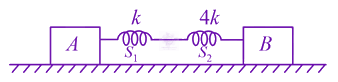
A particle is making simple harmonic motion along the $X$-axis. If at a distances ${x}_{1}$ and ${x}_{2}$ from the mean position the velocities of the particle are ${v}_{1}$ and ${v}_{2}$, respectively. The time period of its oscillation is given as:
The amplitude of wave disturbance propagating in the positive $x$-direction is given by $y=\frac{1}{(1+x{)}^{2}}$ at time $t=0$ and $y=\frac{1}{1+(x-2{)}^{2}}$ at $t=1s$, where $x$ and $y$ are in metres. The shape of wave does not change during the propagation. The velocity of the wave will be $m{s}^{-1}.$