JEE Main 2013 — Thermodynamics
Physics Thermodynamics questions from JEE Main 2013.
Other Years
13 Thermodynamics Questions from 2013
A mass of $50 \mathrm{~g}$ of water in a closed vessel, with surroundings at a constant temperature takes 2 minutes to cool from $30^{\circ} \mathrm{C}$ to $25^{\circ} \mathrm{C}$. A mass of $100 \mathrm{~g}$ of another liquid in an identical vessel with identical surroundings takes the same time to cool from $30^{\circ} \mathrm{C}$ to $25^{\circ} \mathrm{C}$. The specific heat of the liquid is : (The water equivalent of the vessel is $30 \mathrm{~g}$.)
This question has Statement-1 and Statement-2. Of the four choices given after the Statements, choose the one that best describes the two Statements. Statement 1: The internal energy of a perfect gas is entirely kinetic and depends only on absolute temperature of the gas and not on its pressure or volume. Statement 2: A perfect gas is heated keeping pressure constant and later at constant volume. For the same amount of heat the temperature of the gas at constant pressure is lower than that at constant volume.
The ratio of the coefficient of volume expansion of a glass container to that of a viscous liquid kept inside the container is $1: 4$. What fraction of the inner volume of the container should the liquid occupy so that the volume of the remaining vacant space will be same at all temperatures ?
On a linear temperature scale $\mathrm{Y}$, water freezes at $-160^{\circ} \mathrm{Y}$ and boils at $-50^{\circ} \mathrm{Y}$. On this $\mathrm{Y}$ scale, a temperature of $340 \mathrm{~K}$ would be read as : (water freezes at $273 \mathrm{~K}$ and boils at $373 \mathrm{~K}$ )
In the isothermal expansion of $10 \mathrm{~g}$ of gas from volume $\mathrm{V}$ to $2 \mathrm{~V}$ the work done by the gas is $575 \mathrm{~J}$. What is the root mean square speed of the molecules of the gas at that temperature?
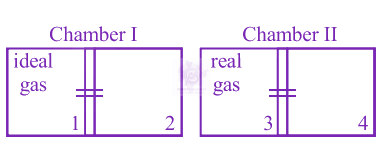 There are two identical chambers, completely thermally insulated from surroundings. Both chambers have a partition wall dividing the chambers in two compartments. Compartment $1$ is filled with an ideal gas and Compartment $3$ is filled with a real gas. Compartments $2$ and $4$ are vacuum. A small hole (orifice) is made in the partition walls and the gases are allowed to expand in vacuum. $\mathrm{Statement-1:}$ No change in the temperature of the gas takes place when ideal gas expands in vacuum. However, the temperature of real gas goes down (cooling) when it expands in vacuum. $\mathrm{Statement-2:}$ The internal energy of an ideal gas is only kinetic. The internal energy of a real gas is kinetic as well as potential.
An ideal gas at atmospheric pressure is adiabatically compressed so that its density becomes 32 times of its initial value. If the final pressure of gas is 128 atmospheres, the value of ' $\gamma$ 'of the gas is :
Figure shows the variation in temperature $(\Delta \mathrm{T})$ with the amount of heat supplied $\mathrm{(Q)}$ in an isobaric process corresponding to a monoatomic $\mathrm{(M)}$, diatomic $\mathrm{(D)}$ and a polyatomic $\mathrm{(P)}$ gas. The initial state of all the gases are the same and the scales for the two axes coincide. Ignoring vibrational degrees of freedom, the lines $a, b$ and $c$ respectively correspond to : 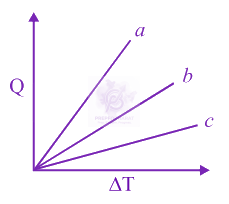
A certain amount of gas is taken through a cyclic process (A B C D A) that has two isobars, one isochore and one isothermal. The cycle can be represented on a $\mathrm{P}-\mathrm{V}$ indicator diagram as :
A sample of gas expands from $V_1$ to $V_2$. In which of the following, the work done will be greatest? 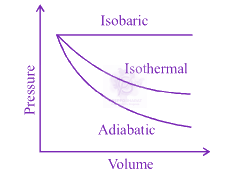
Given that $1 \mathrm{~g}$ of water in liquid phase has volume $1 \mathrm{~cm}^3$ and in vapour phase $1671 \mathrm{~cm}^3$ at atmospheric pressure and the latent heat of vaporization of water is $2256 \mathrm{~J} / \mathrm{g}$; the change in the internal energy in joules for $1 \mathrm{~g}$ of water at $373 \mathrm{~K}$ when it changes from liquid phase to vapour phase at the same temperature is :
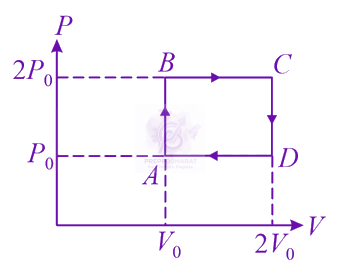 The above $P-V$ diagram represents the thermodynamic cycle of an engine, operating with an ideal mono-atomic gas. The amount of heat, extracted from the source in a single cycle, is:
$500 \mathrm{~g}$ of water and $100 \mathrm{~g}$ of ice at $0^{\circ} \mathrm{C}$ are in a calorimeter whose water equivalent is $40 \mathrm{~g} .10 \mathrm{~g}$ of steam at $100^{\circ} \mathrm{C}$ is added to it. Then water in the calorimeter is : (Latent heat of ice $=80 \mathrm{cal} / \mathrm{g}$, Latent heat of steam $=540 \mathrm{cal} / \mathrm{g}$ )