JEE Main Physics — Mechanics previous year questions with solutions.
If $\epsilon_0$ is the permittivity of free space and $\mathrm{E}$ is the electric field, then $\epsilon_0 \mathrm{E}^2$ has the dimensions :
What is the dimensional formula of $a b^{-1}$ in the equation $\left(\mathrm{P}+\frac{\mathrm{a}}{\mathrm{V}^2}\right)(\mathrm{V}-\mathrm{b})=\mathrm{RT}$, where letters have their usual meaning.
A train starting from rest first accelerates uniformly up to a speed of $80 \mathrm{~km} / \mathrm{h}$ for time $t$, then it moves with a constant speed for time $3 t$. The average speed of the train for this duration of journey will be (in $\mathrm{km} / \mathrm{h}$ ) :
A body moves on a frictionless plane starting from rest. If $S_n$ is distance moved between $t=n-1$ and $\mathrm{t}=\mathrm{n}$ and $\mathrm{S}_{\mathrm{n}-1}$ is distance moved between $\mathrm{t}=\mathrm{n}-2$ and $\mathrm{t}=\mathrm{n}-1$, then the ratio $\frac{\mathrm{S}_{\mathrm{n}-1}}{\mathrm{~S}_{\mathrm{n}}}$ is $\left(1-\frac{2}{x}\right)$ for $\mathrm{n}=10$. The value of $x$ is ______.
A particle is moving in a straight line. The variation of position $x$ as a function of time $t$ is given as $x=({t}^{3}-6{t}^{2}+20t+15)m$. The velocity of the body when its acceleration becomes zero is:
Match List-I with List-II. $\begin{matrix} & \text{ List-I } & & \text{ List-II } \\ \text{ A. } & \text{ Coefficient of viscosity } & \text{ I. } & [{\mathrm{ML}}^{2}{T}^{-2}] \\ \text{ B. } & \text{ Surface Tension } & \text{ II. } & [{\mathrm{ML}}^{2}{T}^{-1}] \\ \text{ C. } & \text{ Angular momentum } & \text{ III. } & [{\mathrm{ML}}^{-1}{T}^{-1}] \\ \text{ D. } & \text{ Rotational kinetic energy } & \text{ IV. } & [{\mathrm{ML}}^{0}{T}^{-2}]\end{matrix}$
The angle of projection for a projectile to have same horizontal range and maximum height is :
A force is represented by $F=a{x}^{2}+b{t}^{\frac{1}{2}}$, where $x=$ distance and $t=$ time. The dimensions of $\frac{{b}^{2}}{a}$ are :
A ball is projected at 45° with speed 20 m/s. Find the maximum height reached (in metres). Take g = 10 m/s².
A coin is placed on a disc. The coefficient of friction between the coin and the disc is $\mu$. If the distance of the coin from the center of the disc is $r$, the maximum angular velocity which can be given to the disc, so that the coin does not slip away, is :
All surfaces shown in figure are assumed to be frictionless and the pulleys and the string are light. The acceleration of the block of mass $2\mathrm{kg}$ is: 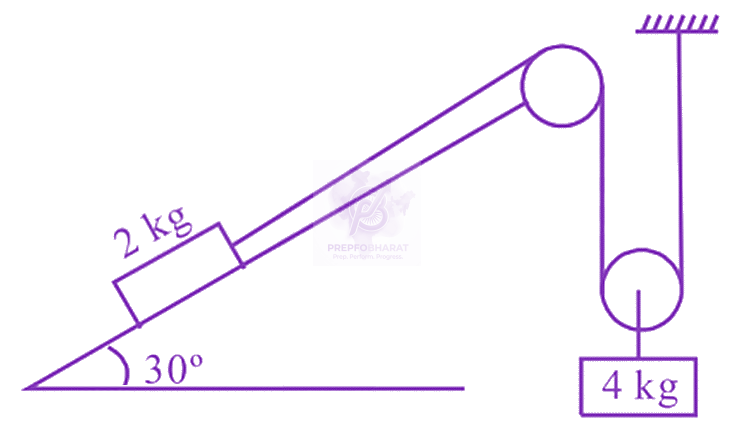
If the radius of curvature of the path of two particles of same mass are in the ratio $3:4$, then in order to have constant centripetal force, their velocities will be in the ratio of:
Given below are two statements : one is labelled as Assertion (A) and the other is labelled as Reason (R). Assertion (A) : The angular speed of the moon in its orbit about the earth is more than the angular speed of the earth in its orbit about the sun. Reason (R): The moon takes less time to move around the earth than the time taken by the earth to move around the sun. In the light of the above statements, choose the most appropriate answer from the options given below :
A body of mass $1000\mathrm{kg}$ is moving horizontally with a velocity $6m{s}^{-1}$. If $200\mathrm{kg}$ extra mass is added, the final velocity (in $m{s}^{-1}$) is:
A vector has magnitude same as that of $\vec{A}=3\hat{j}+4\hat{j}$ and is parallel to $\vec{B}=4\hat{i}+3\hat{j}$. The $x$ and $y$ components of this vector in first quadrant are $x$ and $3$ respectively where $x=$____.
A body of mass $50 \mathrm{~kg}$ is lifted to a height of $20 \mathrm{~m}$ from the ground in the two different ways as shown in the figures. The ratio of work done against the gravity in both the respective cases, will be : 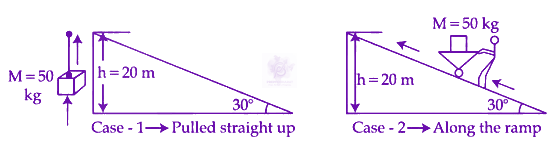
The potential energy function (in $J$ ) of a particle in a region of space is given as $U=(2{x}^{2}+3{y}^{3}+2z)$. Here $x,y$ and $z$ are in meter. The magnitude of $x$ - component of force (in $N$ ) acting on the particle at point $P(1,2,3)m$ is:
A particle is placed at the point $A$ of a frictionless track $\mathrm{ABC}$ as shown in figure. It is gently pushed towards right. The speed of the particle when it reaches the point $B$ is: $($Take $g=10m{s}^{-2})$. 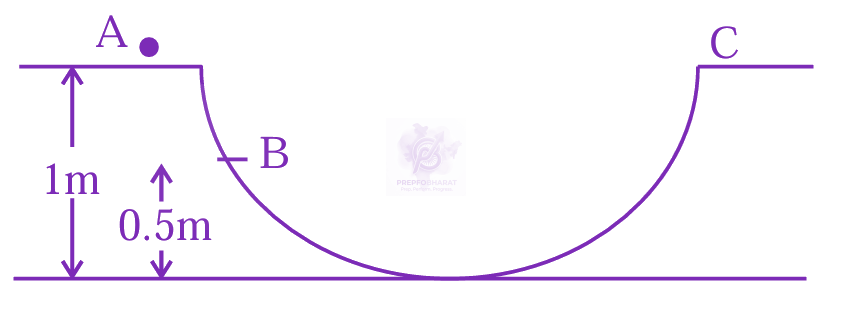
A ball suspended by a thread swings in a vertical plane so that its magnitude of acceleration in the extreme position and lowest position are equal. The angle $(\theta )$ of thread deflection in the extreme position will be :
If the percentage errors in measuring the length and the diameter of a wire are $0.1%$ each. The percentage error in measuring its resistance will be:
Small water droplets of radius $0.01 \mathrm{~mm}$ are formed in the upper atmosphere and falling with a terminal velocity of $10 \mathrm{~cm} / \mathrm{s}$. Due to condensation, if 8 such droplets are coalesced and formed a larger drop, the new terminal velocity will be _____$\mathrm{cm} / \mathrm{s}$.
In a system two particles of masses $m_1=3 \mathrm{~kg}$ and $m_2=2 \mathrm{~kg}$ are placed at certain distance from each other. The particle of mass $m_1$ is moved towards the center of mass of the system through a distance $2 \mathrm{~cm}$. In order to keep the center of mass of the system at the original position, the particle of mass $m_2$ should move towards the center of mass by the distance _____ $\mathrm{cm}$.
A force $\left(3 x^2+2 x-5\right) \mathrm{N}$ displaces a body from $x=2 \mathrm{~m}$ to $x=4 \mathrm{~m}$. Work done by this force is ________ $J$.
A string is wrapped around the rim of a wheel of moment of inertia $0.40 \mathrm{kgm}^2$ and radius $10 \mathrm{~cm}$. The wheel is free to rotate about its axis. Initially the wheel is at rest. The string is now pulled by a force of $40 \mathrm{~N}$. The angular velocity of the wheel after $10 \mathrm{~s}$ is $x \mathrm{rad} / \mathrm{s}$, where $x$ is _______