Mechanics PYQ — Page 21
JEE Main Physics — Mechanics previous year questions with solutions.
All Mechanics Questions (2069)
A bob of mass $m$ is suspended by a light string of length $L$. It is imparted a minimum horizontal velocity at the lowest point $A$ such that it just completes half circle reaching the top most position $B$. The ratio of kinetic energies $\frac{(K.E.{)}_{A}}{(K.E.{)}_{B}}$ is : 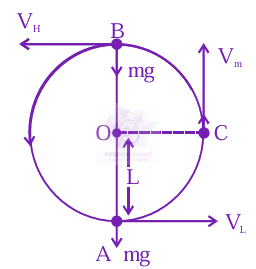
Mercury is filled in a tube of radius $2 \mathrm{~cm}$ up to a height of $30 \mathrm{~cm}$. The force exerted by mercury on the bottom of the tube is _____ N. (Given, atmospheric pressure $=10^5 \mathrm{Nm}^{-2}$, density of mercury $=1.36 \times 10^4 \mathrm{~kg} \mathrm{~m}^{-}$ $\left.{ }^3, \mathrm{~g}=10 \mathrm{~m} \mathrm{~s}^{-2}, \pi=\frac{22}{7}\right)$
If $\vec{a}$ and $\vec{b}$ makes an angle $\cos ^{-1}\left(\frac{5}{9}\right)$ with each other, then $|\vec{a}+\vec{b}|=\sqrt{2}|\vec{a}-\vec{b}|$ for $|\vec{a}|=n|\vec{b}|$ The integer value of $\mathrm{n}$ is ____
The dimension of Planck constant is same as
A particle moves in a circle of radius R with constant speed v. Its centripetal acceleration is
What is the maximum height attained by the ball perpendicular to the inclined surface?
What is the time of flight of the ball along the inclined plane?
The dimensional formula of latent heat is :
Four particles $A, B, C, D$ of mass $\frac{m}{2}, m, 2 m, 4 m$, have same momentum, respectively. The particle with maximum kinetic energy is :
A body of mass $5\mathrm{kg}$ moving with a uniform speed $3\sqrt{2}m{s}^{-1}$ in $X-Y$ plane along the line $y=x+4$. The angular momentum of the particle about the origin will be _______$\mathrm{kg}{m}^{2}{s}^{-1}$.
Given below are two statements : Statement (I) : Dimensions of specific heat is $\left[\mathrm{L}^2 \mathrm{~T}^{-2} \mathrm{~K}^{-1}\right]$. Statement (II) : Dimensions of gas constant is $\left[\mathrm{M} \mathrm{L}^2 \mathrm{~T}^{-1} \mathrm{~K}^{-1}\right]$. In the light of the above statements, choose the most appropriate answer from the options given below.
To project a body of mass $m$ from earth's surface to infinity, the required kinetic energy is (assume, the radius of earth is $R_E, g=$ acceleration due to gravity on the surface of earth):
A body projected vertically upwards with a certain speed from the top of a tower reaches the ground in $t_1$. If it is projected vertically downwards from the same point with the same speed, it reaches the ground in $t_2$. Time required to reach the ground, if it is dropped from the top of the tower, is :
In the given arrangement of a doubly inclined plane two blocks of masses $M$ and $m$ are placed. The blocks are connected by a light string passing over an ideal pulley as shown. The coefficient of friction between the surface of the plane and the blocks is $0.25$. The value of $m$, for which $M=10\mathrm{kg}$ will move down with an acceleration of $2m{s}^{-2}$, is: (take $g=10m{s}^{-2}$ and $\mathrm{tan}37^{\circ}=\frac{3}{4}$) 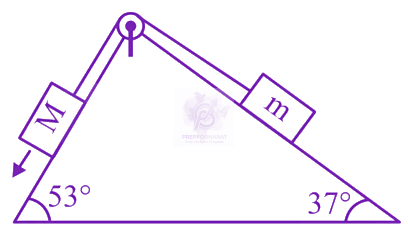
Assuming the earth to be a sphere of uniform mass density, a body weighed $300 \mathrm{~N}$ on the surface of earth. How much it would weigh at R/4 depth under surface of earth ?
Two bodies of mass $4g$ and $25g$ are moving with equal kinetic energies. The ratio of magnitude of their linear momentum is :
A physical quantity $Q$ is found to depend on quantities $a,b,c$ by the relation $Q=\frac{{a}^{4}{b}^{3}}{{c}^{2}}$. The percentage error in $a,b$ and $c$ are $3%,4%$ and $5%$ respectively. Then, the percentage error in $Q$ is:
Three blocks $A,B$ and $C$ are pulled on a horizontal smooth surface by a force of $80N$ as shown in figure. The tensions ${T}_{1}\text{and}{T}_{2}$ in the string are respectively: 
A block of mass $100\mathrm{kg}$ slides over a distance of $10m$ on a horizontal surface. If the co-efficient of friction between the surfaces is $0.4$ , then the work done against friction (in $J$) is:
A body moves on a frictionless plane starting from rest. If $S_n$ is distance moved between $t=n-1$ and $\mathrm{t}=\mathrm{n}$ and $\mathrm{S}_{\mathrm{n}-1}$ is distance moved between $\mathrm{t}=\mathrm{n}-2$ and $\mathrm{t}=\mathrm{n}-1$, then the ratio $\frac{\mathrm{S}_{\mathrm{n}-1}}{\mathrm{~S}_{\mathrm{n}}}$ is $\left(1-\frac{2}{x}\right)$ for $\mathrm{n}=10$. The value of $x$ is ______.
A planet takes $200$ days to complete one revolution around the Sun. If the distance of the planet from Sun is reduced to one fourth of the original distance, how many days will it take to complete one revolution?
Match List I with List II : 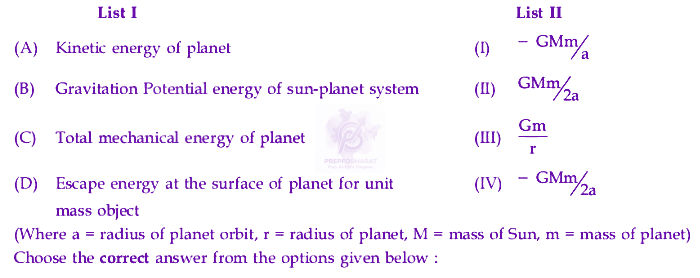
A body of $m \mathrm{~kg}$ slides from rest along the curve of vertical circle from point $A$ to $B$ in friction less path. The velocity of the body at $B$ is: 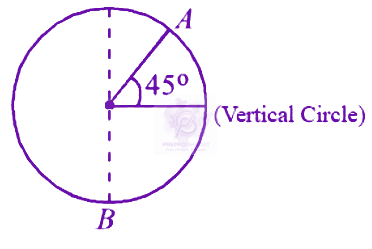 $\text { (given, } R=14 \mathrm{~m}, g=10 \mathrm{~m} / \mathrm{s}^2 \text { and } \sqrt{2}=1.4 \text { ) }$
Given below are two statements: Statement I : If a capillary tube is immersed first in cold water and then in hot water, the height of capillary rise will be smaller in hot water. Statement II : If a capillary tube is immersed first in cold water and then in hot water, the height of capillary rise will be smaller in cold water. In the light of the above statements, choose the most appropriate from the options given below