Mechanics PYQ — Page 11
JEE Main Physics — Mechanics previous year questions with solutions.
All Mechanics Questions (2069)
Consider a completely full cylindrical water tank of height 1.6 m and cross-sectional area $0.5 \mathrm{~m}^2$. It has a small hole in its side at a height 90 cm from the bottom. Assume, the cross-sectional area of the hole to be negligibly small as compared to that of the water tank. If a load 50 kg is applied at the top surface of the water in the tank then the velocity of the water coming out at the instant when the hole is opened is : $\left(\mathrm{g}=10 \mathrm{~m} / \mathrm{s}^2\right)$
Match List - I with List - II. 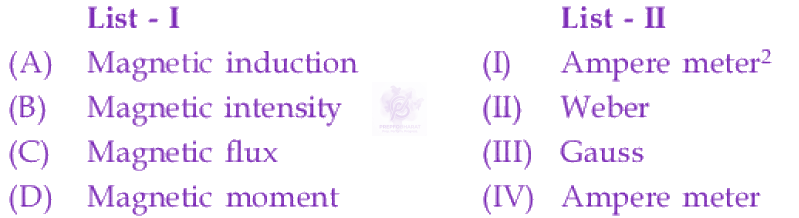 Choose the correct answer from the options given below :
Match the LIST-I with LIST-II $\begin{array}{|l|l|l|l|}\hline & \text{LIST-I} & & \text{LIST-II} \\ \hline \text{A.} & \text{Gravitational constant} & \text{I.} & {\left[\mathrm{LT}^{-2}\right]} \\ \hline \text{B.} & \begin{array}{l} \text{Gravitational potential} \\ \text{energy} \end{array} & \text{II.} & {\left[\mathrm{L}^2 \mathrm{~T}^{-2}\right]} \\ \hline \text{C.} & \text{Gravitational potential} & \text{III.} & {\left[\mathrm{ML}^2 \mathrm{~T}^{-2}\right]} \\ \hline \text{D.} & \begin{array}{l} \text{Acceleration due to} \\ \text{gravity} \end{array} & \text{IV.} & {\left[\mathrm{M}^{-1} \mathrm{~L}^3 \mathrm{~T}^{-2}\right]} \\ \hline \end{array}$ Choose the correct answer from the options given below :
A solid steel ball of diameter 3.6 mm acquired terminal velocity $2.45 \times 10^{-2} \mathrm{~m} / \mathrm{s}$ while falling under gravity through an oil of density $925 \mathrm{~kg} \mathrm{~m}^{-3}$. Take density of steel as $7825 \mathrm{~kg} \mathrm{~m}^{-3}$ and g as 9.8 $\mathrm{m} / \mathrm{s}^2$. The viscosity of the oil in SI unit is
A ball having kinetic energy KE, is projected at an angle of $60^{\circ}$ from the horizontal. What will be the kinetic energy of ball at the highest point of its flight ?
The range of a projectile launched with initial velocity u at angle θ with horizontal is given by:
A solid sphere is rolling without slipping on a horizontal plane. The ratio of the linear kinetic energy of the centre of mass of the sphere and rotational kinetic energy is :
If $\epsilon_0$ denotes the permittivity of free space and $\Phi_{\mathrm{E}}$ is the flux of the electric field through the area bounded by the closed surface, then dimension of $\left(\epsilon_0 \frac{\mathrm{~d} \phi_{\mathrm{E}}}{\mathrm{dt}}\right)$ are that of :
A rod of linear mass density ' $\lambda$ ' and length ' $L$ ' is bent to form a ring of radius 'R'. Moment of inertia of ring about any of its diameter is :
A particle is released from height $S$ above the surface of the earth. At certain height its kinetic energy is three times its potential energy. The height from the surface of the earth and the speed of the particle at that instant are respectively.
M and R be the mass and radius of a disc. A small disc of radius $R / 3$ is removed from the bigger disc as shown in figure. The moment of inertia of remaining part of bigger disc about an axis AB passing through the centre O and perpendicular to the plane of disc is $\frac{4}{x} M R^2$. The value of $x$ is ________. 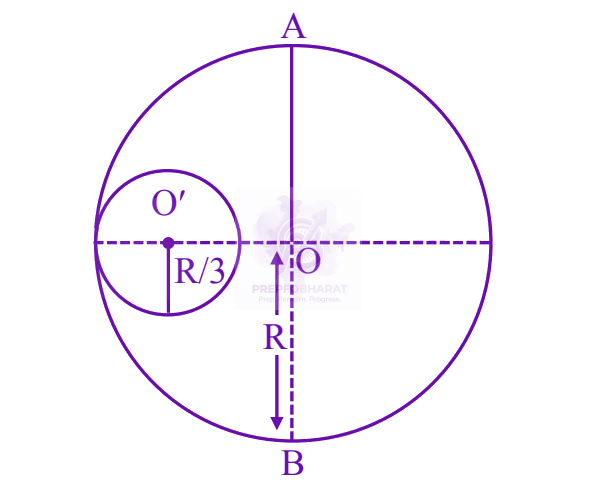
A force $\overrightarrow{\mathrm{F}}=2 \hat{i}+\mathrm{b} \hat{j}+\hat{k}$ is applied on a particle and it undergoes a displacement $\hat{i}-2 \hat{j}-\hat{k}$. What will be the value of $b$, if work done on the particle is zero.
The increase in pressure required to decrease the volume of a water sample by $0.2 \%$ is $\mathrm{P} \times 10^5 \mathrm{Nm}^{-2}$. Bulk modulus of water is $2.15 \times 10^9 \mathrm{Nm}^{-2}$. The value of P is $\ldots\ldots$
A force $\mathrm{f}=\mathrm{x}^2 \mathrm{y} \hat{\mathrm{i}}+\mathrm{y}^2 \hat{\mathrm{j}}$ acts on a particle in a plane $\mathrm{x}+\mathrm{y}=10$. The work done by this force during a displacement from $(0,0)$ to $(4 \mathrm{~m}, 2 \mathrm{~m})$ is $\qquad$ Joule (round off to the nearest integer)
The maximum speed of a boat in still water is \(27 \mathrm{~km} / \mathrm{h}\). Now this boat is moving downstream in a river flowing at \(9 \mathrm{~km} / \mathrm{h}\). A man in the boat throws a ball vertically upwards with speed of \(10 \mathrm{~m} / \mathrm{s}\). Range of the ball as observed by an observer at rest on the river bank, is _______ cm. (Take \(\mathrm{g}=10 \mathrm{~m} / \mathrm{s}^2\))
A thin solid disk of 1 kg is rotating along its diameter axis at the speed of 1800 rpm. By applying an external torque of $25 \pi \mathrm{Nm}$ for 40 s, the speed increases to 2100 rpm. The diameter of the disk is ________ m.
The energy of a system is given as $\mathrm{E}(\mathrm{t})=\alpha^3 \mathrm{e}^{-\beta t}$, where t is the time and $\beta=0.3 \mathrm{~s}^{-1}$. The errors in the measurement of $\alpha$ and $t$ are $1.2 \%$ and $1.6 \%$, respectively. At $t=5 \mathrm{~s}$, maximum percentage error in the energy is :
The equation for real gas is given by $\left(\mathrm{P}+\frac{\mathrm{a}}{\mathrm{V}^2}\right)(\mathrm{V}-\mathrm{b})=\mathrm{RT}$, where $\mathrm{P}, \mathrm{V}, \mathrm{T}$ and R are the pressure, volume, temperature and gas constant, respectively. The dimension of $\mathrm{ab}^{-2}$ is equivalent to that of :
Two cars $P$ and $Q$ are moving on a road in the same direction. Acceleration of car $P$ increases linearly with time whereas car $Q$ moves with a constant acceleration. Both cars cross each other at time $t=0$, for the first time. The maximum possible number of crossing(s) (including the crossing at $t=0)$ is ________.
A small rigid spherical ball of mass M is dropped in a long vertical tube containing glycerine. The velocity of the ball becomes constant after some time. If the density of glycerine is half of the density of the ball, then the viscous force acting on the ball will be (consider g as acceleration due to gravity)
A particle is projected with velocity $u$ so that its horizontal range is three times the maximum height attained by it. The horizontal range of the projectile is given as $\frac{n u^2}{25 g}$, where value of $n$ is : (Given ' $g$ ' is the acceleration due to gravity).
A body of mass $m$ is suspended by two strings making angles $\theta_1$ and $\theta_2$ with the horizontal ceiling with tensions $T_1$ and $T_2$ simultaneously. $T_1$ and $T_2$ are related by $T_1=\sqrt{3} T_2$. the angles $\theta_1$ and $\theta_2$ are
Match the LIST-I withLIST-II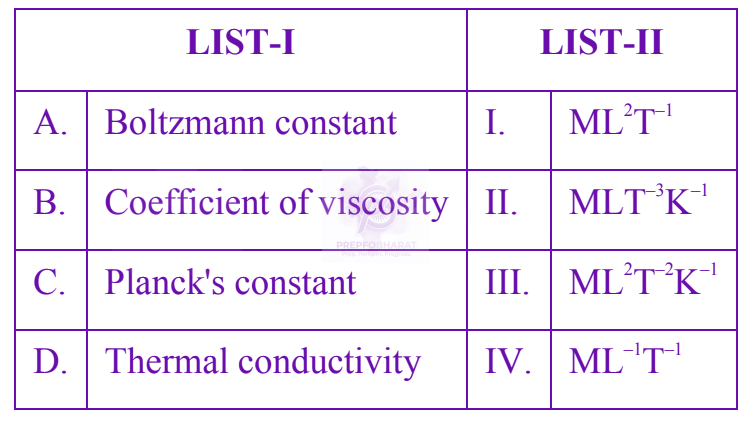 Choose the correct answer from the options given below :
Consider a circular disc of radius 20 cm with centre located at the origin. A circular hole of radius 5 cm is cut from this disc in such a way that the edge of the hole touches the edge of the disc. The distance of centre of mass of residual or remaining disc from the origin will be