JEE Main Physics — Electromagnetism previous year questions with solutions.
Given below are two statements : one is labelled as Assertion (A) and the other is labelled as Reason (R). Assertion (A) : Choke coil is simply a coil having a large inductance but a small resistance. Choke coils are used with fluorescent mercury-tube fittings. If household electric power is directly connected to a mercury tube, the tube will be damaged. Reason (R): By using the choke coil, the voltage across the tube is reduced by a factor \(\left(R / \sqrt{R^2+\omega^2 L^2}\right)\), where \(\omega\) is frequency of the supply across resistor \(R\) and inductor L . If the choke coil were not used, the voltage across the resistor would be the same as the applied voltage. In the light of the above statements, choose the most appropriate answer from the options given below :
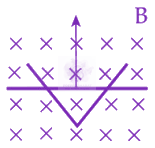 A conducting bar moves on two conducting rails as shown in the figure. A constant magnetic field B exists into the page. The bar starts to move from the vertex at time $t=0$ with a constant velocity. If the induced EMF is $\mathrm{E} \propto \mathrm{t}^{\mathrm{n}}$, then value of n is _.
Due to presence of an em-wave whose electric component is given by $\mathrm{E}=100 \sin (\omega \mathrm{t}-\mathrm{kx}) \mathrm{NC}^{-1}$, a cylinder of length 200 cm holds certain amount of em-energy inside it. If another cylinder of same length but half diameter than previous one holds same amount of em-energy, the magnitude of the electric field of the corresponding em-wave should be modified as
A wire of length 25 m and cross-sectional area $5 \mathrm{~mm}^2$ having resistivity of $2 \times 10^{-6} \Omega \mathrm{~m}$ is bent into a complete circle. The resistance between diametrically opposite points will be
Given below are two statements : one is labelled as Assertion (A) and the other is labelled as Reason (R). Assertion (A) : Electromagnetic waves carry energy but not momentum. Reason (\(\mathbf{R}\)): Mass of a photon is zero. In the light of the above statements, choose the most appropriate answer from the options given below :
A parallel plate capacitor of capacitance $1 \mu \mathrm{~F}$ is charged to a potential difference of 20 V . The distance between plates is $1 \mu \mathrm{~m}$. The energy density between plates of capacitor is.
A plane electromagnetic wave propagates along the $+x$ direction in free space. The components of the electric field, $\vec{E}$ and magnetic field, $\vec{B}$ vectors associated with the wave in Cartesian frame are
Current passing through a wire as function of time is given as $\mathrm{I}(\mathrm{t})=0.02 \mathrm{t}+0.01 \mathrm{~A}$. The charge that will flow through the wire from $t=1 s$ to $t=2 s$ is :
A tightly wound long solenoid carries a current of 1.5 A . An electron is executing uniform circular motion inside the solenoid with a time period of 75 ns . The number of turns per metre in the solenoid is $\ldots\ldots$ -. [Take mass of electron $\mathrm{m}_{\mathrm{e}}=9 \times 10^{-31} \mathrm{~kg}$, charge of electron $\left|\mathrm{q}_{\mathrm{e}}\right|=1.6 \times 10^{-19} \mathrm{C}$, $\left.\mu_0=4 \pi \times 10^{-7} \frac{\mathrm{~N}}{\mathrm{~A}^2}, 1 \mathrm{~ns}=10^{-9} \mathrm{~s}\right]$
Which of the following resistivity ( $\rho$ ) $\mathrm{v} / \mathrm{s}$ temperature (T) curves is most suitable to be used in wire bound standard resistors?
A point charge +q is placed at the origin. A second point charge +9 q is placed at $(\mathrm{d}, 0,0)$ in Cartesian coordinate system. The point in between them where the electric field vanishes is :
The magnetic field of an E.M. wave is given by $\overrightarrow{\mathrm{B}}=\left(\frac{\sqrt{3}}{2} \hat{i}+\frac{1}{2} \hat{j}\right) 30 \sin \left[\omega\left(\mathrm{t}-\frac{z}{\mathrm{c}}\right)\right]$ (S.I. Units). The corresponding electric field in S.I. units is :
A wire of resistance R is bent into an equilateral triangle and an identical wire is bent into $a$ square. The ratio of resistance between the two end points of an edge of the triangle to that of the square is Options
In a moving coil galvanometer, two moving coils $M_1$ and $M_2$ have the following particulars : $\begin{aligned}<br/>& \mathrm{R}_1=5 \Omega, \mathrm{~N}_1=15, \mathrm{~A}_1=3.6 \times 10^{-3} \mathrm{~m}^2, \mathrm{~B}_1=0.25 \mathrm{~T} \\ & \mathrm{R}_2=7 \Omega, \mathrm{~N}_2=21, \mathrm{~A}_2=1.8 \times 10^{-3} \mathrm{~m}^2, \mathrm{~B}_2=0.50 \mathrm{~T}<br/>\end{aligned}$ Assuming that torsional constant of the springs are same for both coils, what will be the ratio of voltage sensitivity of $M_1$ and $M_2$ ?
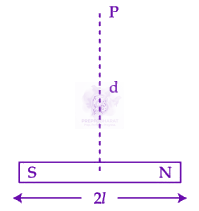 A bar magnet has total length $2 l=20$ units and the field point $P$ is at a distance $\mathrm{d}=10$ units from the centre of the magnet. If the relative uncertainty of length measurement is $1 \%$, then uncertainty of the magnetic field at point P is :
A time varying potential difference is applied between the plates of a parallel plate capacitor of capacitance $2.5 \mu \mathrm{~F}$. The dielectric constant of the medium between the capacitor plates is 1 . It produces an instantaneous displacement current of 0.25 mA in the intervening space between the capacitor plates, the magnitude of the rate of change of the potential difference will be _____ $\mathrm{Vs}^{-1}$.
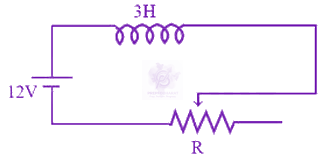 In the given circuit the sliding contact is pulled outwards such that electric current in the circuit changes at the rate of $8 \mathrm{~A} / \mathrm{s}$. At an instant when R is $12 \Omega$, the value of the current in the circuit will be ______ A.
A wire of resistance $R$ is bent into a triangular pyramid as shown in figure with each segment having same length. The resistance between points $A$ and $B$ is $R / n$. The value of $n$ is : 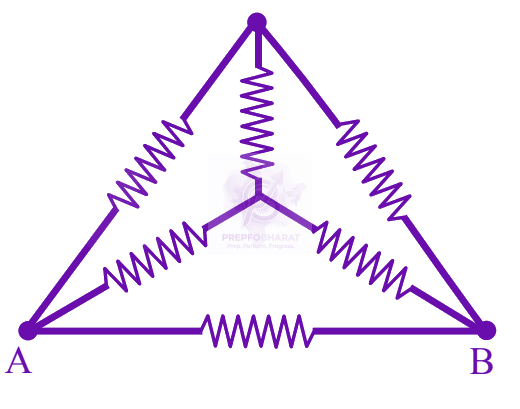
Two point charges $-4 \mu c$ and $4 \mu c$, constituting an electric dipole, are placed at $(-9,0,0) \mathrm{cm}$ and $(9,0,0) \mathrm{cm}$ in a uniform electric field of strength $10^4 \mathrm{NC}^{-1}$. The work done on the dipole in rotating it from the equilibrium through $180^{\circ}$ is :
Regarding self-inductance: A. The self-inductance of the coil depends on its geometry. B. Self-inductance does not depend on the permeability of the medium. C. Self-induced e.m.f. opposes any change in the current in a circuit. D. Self-inductance is electromagnetic analogue of mass in mechanics. E. Work needs to be done against self-induced e.m.f. in establishing the current. Choose the correct answer from the options given below:
A proton is moving undeflected in a region of crossed electric and magnetic fields at a constant speed of $2 \times 10^5 \mathrm{~ms}^{-1}$. When the electric field is switched off, the proton moves along a circular path of radius 2 cm . The magnitude of electric field is $x \times 10^4 \mathrm{~N} / \mathrm{C}$. The value of $x$ is _______ Take the mass of the proton $=1.6 \times 10^{-27} \mathrm{~kg}$.
A metallic ring is uniformly charged as shown in figure. AC and BD are two mutually perpendicular diameters. Electric field due to $\operatorname{arc} \mathrm{AB}$ to ' O ' is ' E ' is magnitude. What would be the magnitude of electric field at ' O ' due to arc ABC ? 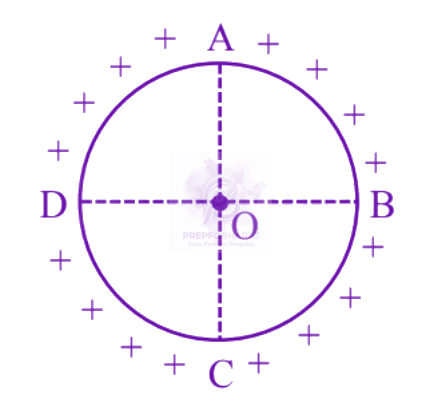
A plane electromagnetic wave of frequency 20 MHz travels in free space along the $+x$ direction. At a particular point in space and time, the electric field vector of the wave is $\mathrm{E}_y=9.3 \mathrm{Vm}^{-1}$. Then, the magnetic field vector of the wave at that point is
Given below are two statements. One is labelled as Assertion (A) and the other is labelled as Reason (R). Assertion (A) : A electron in a certain region of uniform magnetic field is moving with constant velocity in a straight line path. Reason (R): The magnetic field in that region is along the direction of velocity of the electron. In the light of the above statements, choose the correct answer from the options given below :