JEE Main Physics — Electromagnetism previous year questions with solutions.
An infinitely long wire has uniform linear charge density $\lambda=2 \mathrm{nC} / \mathrm{m}$. The net flux through a Gaussian cube of side length $\sqrt{3} \mathrm{~cm}$, if the wire passes through any two corners of the cube, that are maximally displaced from each other, would be $\mathrm{xNm}^2 \mathrm{C}^{-1}$, where x is : [Neglect any edge effects and use $\frac{1}{4 \pi \varepsilon_0}=9 \times 10^9$ SI units]
An inductor of self inductance 1 H connected in series with a resistor of $100 \pi \mathrm{ohm}$ and an ac supply of $100 \pi$ volt, 50 Hz. Maximum current flowing in the circuit is ________ A.
An inductor of reactance $100 \Omega$, a capacitor of reactance $50 \Omega$, and a resistor of resistance $50 \Omega$ are connected in series with an AC source of 10 V , 50 Hz. Average power dissipated by the circuit is ________ W.
An electron projected perpendicular to a uniform magnetic field B moves in a circle. If Bohr's quantization is applicable, then the radius of the electronic orbit in the first excited state is :
An electron is released from rest near an infinite non-conducting sheet of uniform charge density ' $-\sigma$ '. The rate of change of de-Broglie wave length associated with the electron varies inversely as $\mathrm{n}^{\text {th }}$ power of time. The numerical value of $n$ is ________.
An electron is made to enter symmetrically between two parallel and equally but oppositely charged metal plates, each of 10 cm length. The electron emerges out of the electric field region with a horizontal component of velocity $10^6 \mathrm{~m} / \mathrm{s}$. If the magnitude of the electric field between the plates is $9.1 \mathrm{~V} / \mathrm{cm}$, then the vertical component of velocity of electron is (mass of electron $=9.1 \times 10^{-31} \mathrm{~kg}$ and charge of electron $=1.6 \times 10^{-19} \mathrm{C}$ )
An electric dipole of mass m, charge q, and length \(l\) is placed in a uniform electric field \(\overrightarrow{\mathrm{E}}=\mathrm{E}_0 \hat{i}\). When the dipole is rotated slightly from its equilibrium position and released, the time period of its oscillations will be:
An electric dipole of dipole moment $6 \times 10^{-6} \mathrm{Cm}$ is placed in uniform electric field of magnitude $10^6 \mathrm{~V} / \mathrm{m}$. Initially, the dipole moment is parallel to electric field. The work that needs to be done on the dipole to make its dipole moment opposite to the field, will be ____ J.
An electric dipole is placed at a distance of 2 cm from an infinite plane sheet having positive charge density $\sigma_{\mathrm{o}}$. Choose the correct option from the following. 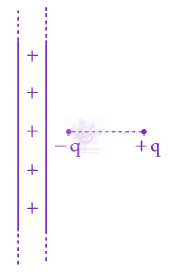
An electric bulb rated as $100 \mathrm{~W}-220 \mathrm{~V}$ is connected to an ac source of rms voltage 220 V. The peak value of current through the bulb is :
An alternating current is represented by the equation, $i=100 \sqrt{2} \sin (100 \pi t)$ ampere. The RMS value of current and the frequency of the given alternating current are
An alternating current is given by $\mathrm{I}=\mathrm{I}_{\mathrm{A}} \sin \omega \mathrm{t}+\mathrm{I}_{\mathrm{B}} \cos \omega \mathrm{t}$. The r.m.s current will be
An ac current is represented as $\mathrm{i}=5 \sqrt{2}+10 \cos \left(650 \pi \mathrm{t}+\frac{\pi}{6}\right) \mathrm{Amp}$ The r.m.s value of the current is
A wire of resistance R is bent into an equilateral triangle and an identical wire is bent into $a$ square. The ratio of resistance between the two end points of an edge of the triangle to that of the square is Options
A wire of resistance $9 \Omega$ is bent to form an equilateral triangle. Then the equivalent resistance across any two vertices will be _____ ohm.
A wire of resistance $R$ is bent into a triangular pyramid as shown in figure with each segment having same length. The resistance between points $A$ and $B$ is $R / n$. The value of $n$ is : 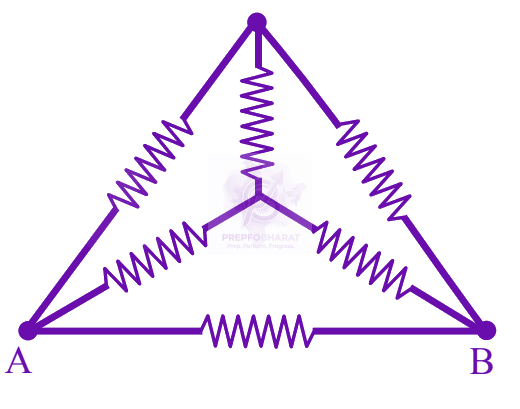
A wire of length 25 m and cross-sectional area $5 \mathrm{~mm}^2$ having resistivity of $2 \times 10^{-6} \Omega \mathrm{~m}$ is bent into a complete circle. The resistance between diametrically opposite points will be
A uniform magnetic field of 0.4 T acts perpendicular to a circular copper disc 20 cm in radius. The disc is having a uniform angular velocity of $10 \pi \mathrm{rad} \mathrm{s}^{-1}$ about an axis through its centre and perpendicular to the disc. What is the potential difference developed between the axis of the disc and the rim ? $(\pi=3.14)$
A time varying potential difference is applied between the plates of a parallel plate capacitor of capacitance $2.5 \mu \mathrm{~F}$. The dielectric constant of the medium between the capacitor plates is 1 . It produces an instantaneous displacement current of 0.25 mA in the intervening space between the capacitor plates, the magnitude of the rate of change of the potential difference will be _____ $\mathrm{Vs}^{-1}$.
A tightly wound long solenoid carries a current of 1.5 A . An electron is executing uniform circular motion inside the solenoid with a time period of 75 ns . The number of turns per metre in the solenoid is $\ldots\ldots$ -. [Take mass of electron $\mathrm{m}_{\mathrm{e}}=9 \times 10^{-31} \mathrm{~kg}$, charge of electron $\left|\mathrm{q}_{\mathrm{e}}\right|=1.6 \times 10^{-19} \mathrm{C}$, $\left.\mu_0=4 \pi \times 10^{-7} \frac{\mathrm{~N}}{\mathrm{~A}^2}, 1 \mathrm{~ns}=10^{-9} \mathrm{~s}\right]$
A square loop of sides $a=1 \mathrm{~m}$ is held normally in front of a point charge $\mathrm{q}=1 \mathrm{C}$. The flux of the electric field through the shaded region is $\frac{5}{\mathrm{p}} \times \frac{1}{\varepsilon_0} \frac{\mathrm{Nm}^2}{\mathrm{C}}$, where the value of p is _____. 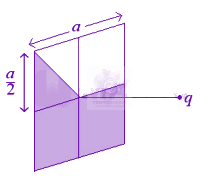
A solenoid having area $A$ and length ' $l$ ' is filled with a material having relative permeability 2. The magnetic energy stored in the solenoid is :
A small uncharged conducting sphere is placed in contact with an identical sphere but having $4 \times 10^{-8} \mathrm{C}$ charge and then removed to a distance such that the force of repulsion between them is $9 \times 10^{-3} \mathrm{~N}$. The distance between them is (Take $\frac{1}{4 \pi \epsilon_{\mathrm{o}}}$ as $9 \times 10^9 \mathrm{in} \mathrm{SI}$ units)
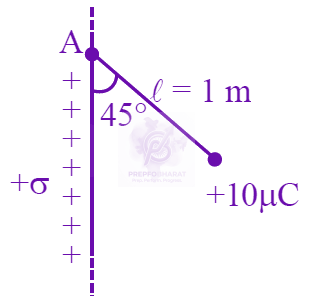
A small bob of mass 100 mg and charge $+10 \mu \mathrm{C}$ is connected to an insulating string of length 1 m. It is brought near to an infinitely long nonconducting sheet of charge density ' $\sigma$ ' as shown in figure. If string subtends an angle of $45^{\circ}$ with the sheet at equilibrium the charge density of sheet will be : (Given, $\varepsilon_0=8.85 \times 10^{-12} \frac{\mathrm{~F}}{\mathrm{~m}}$ and acceleration due to gravity, $g=10 \mathrm{~m} / \mathrm{s}^2$)