JEE Main Physics — Electromagnetism previous year questions with solutions.
The energy stored in the electric field produced by a metal sphere is $4.5J$. If the sphere contains $4\mu C$ charge, its radius will be: $[Take:\frac{1}{4\pi {\in }_{0}}=9\times {10}^{9}N{m}^{2}{C}^{-2}]$
An electric dipole has fixed dipole moment $\vec{p}$, which makes angle $\theta$ with respect to $x-$axis. When subjected to an electric field ${\vec{E}}_{1}=E\hat{i},$ it experiences a torque ${\vec{T}}_{1}=\tau \hat{k}$. When subjected to another electric field ${\vec{E}}_{2}= \sqrt{3} {E}_{1}\hat{j}$ it experiences a torque ${\vec{T}}_{2}=-{\vec{T}}_{1}$ . The angle $\theta$ is:
The figure shows three circuits $I, II$ and $III$ which are connected to a $3V$ battery. If the powers dissipated by the configurations $I, II$ and $III$ are ${P}_{1}, {P}_{2}$ and ${P}_{3}$ respectively, then - 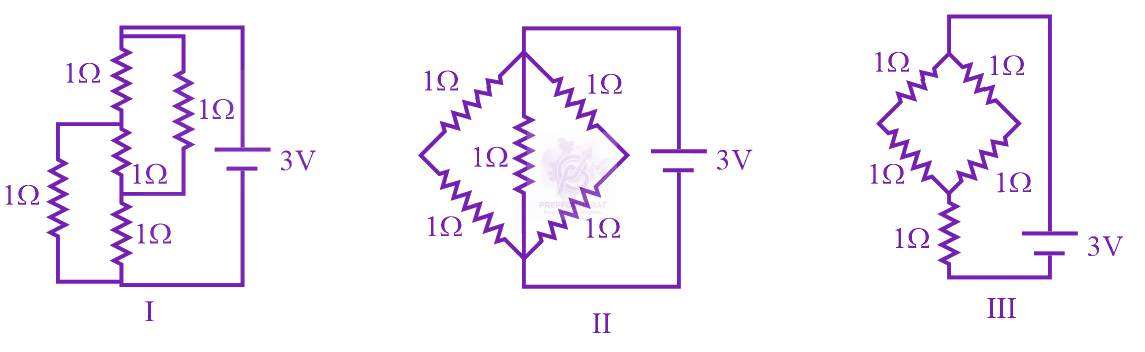
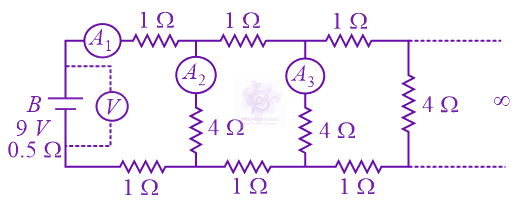 A $9V$ battery with an internal resistance of $0.5 \Omega$ is connected across an infinite network, as shown in the figure. All ammeters ${A}_{1}, {A}_{2}, {A}_{3}$ and voltmeter $V$ are ideal. Choose the correct statement.
In a meter bridge experiment resistances are connected as shown in the figure. Initially resistance $P=4 \Omega$ and the neutral point $N$ is at $60\mathrm{cm}$ from $A$ . Now an unknown resistance $R$ is connected in series to $P$ and the new position of the neutral point is at $80\mathrm{cm}$ from $A$ . The value of unknown resistance $R$ is - 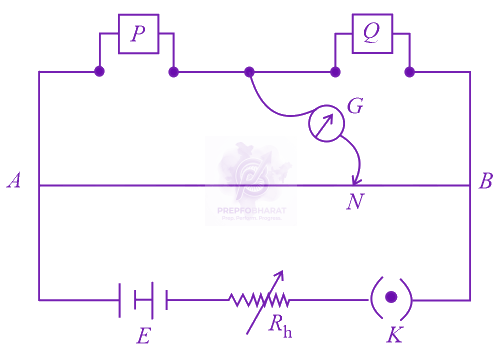
A combination of parallel plate capacitors is maintained at a certain potential difference. 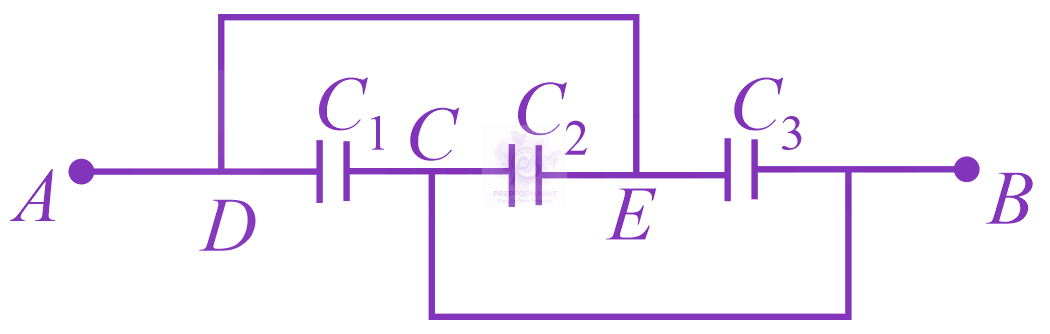 When a $3\mathrm{mm}$ thick slab is introduced between all the plates, in order to maintain the same potential difference, the distance between the plates is increased by $2.4\mathrm{mm}$. Find the dielectric constant of the slab.
In a coil of resistance $100\Omega$, a current is induced by changing the magnetic flux through it as shown in the figure. The magnitude of change in flux through the coil is: 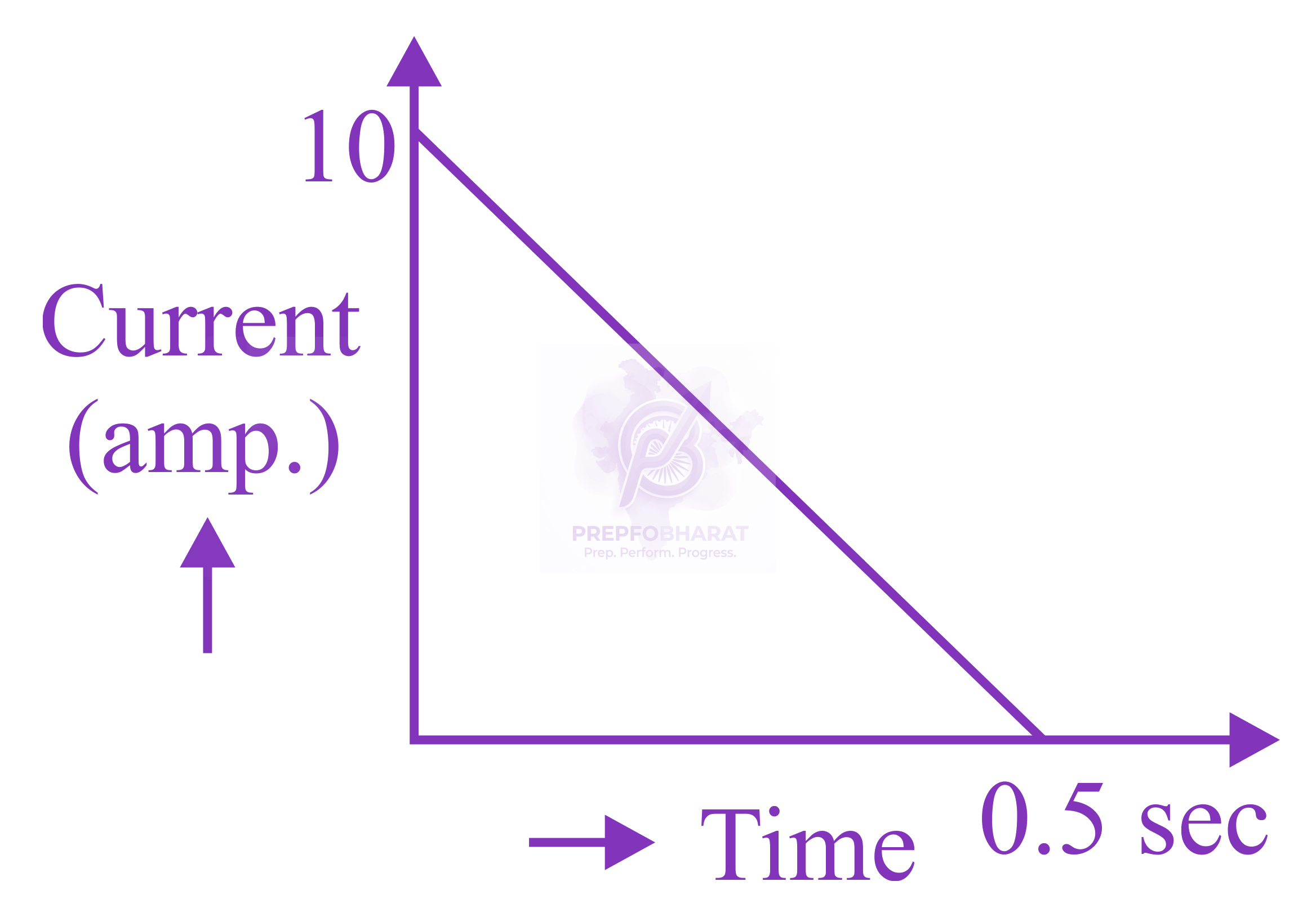
A uniform wire of length $l$ and radius $r$ has a resistance of $100 \text{Ω}$. It is recast into a wire of radius $\frac{r}{2}$. The resistance of new wire will be-
A magnetic needle of magnetic moment $6.7\times {10}^{-2} A{m}^{2}$ and moment of inertia $7.5\times {10}^{-6}\mathrm{kg} {m}^{2}$ is performing simple harmonic oscillations in a magnetic field of $0.01T$. Time taken for $10$ complete oscillations is:
When a current of $5\mathrm{mA}$ is passed through a galvanometer having a coil of resistance $15\Omega$, it shows full-scale deflection. The value of the resistance to be put in series with the galvanometer to convert it into a voltmeter of range $0-10V$ is:
Consider a thin metallic sheet perpendicular to the plane of the paper moving with speed $v$ in a uniform magnetic field $B$ going into the plane of the paper (see figure). If charge densities ${\sigma }_{1}$ and ${\sigma }_{2}$ are induced on the left and right surfaces respectively of the sheet, then (ignore fringe effects) 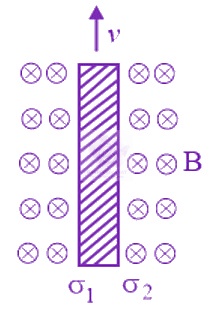
Two identical wires $A$ and $B$, each of length $l$, carry the same current $I$ . Wire $A$ is bent into a circle of radius $R$ and wire $B$ is bent to form a square of side $a$. If ${B}_{A}$ and ${B}_{B}$ are the values of magnetic field at the centres of the circle and square respectively, then the ratio $\frac{{B}_{A}}{{B}_{B}}$ is
An arc lamp requires a direct current of 10 A at 80 V to function. If it is connected to a 220 V (rms), 50 Hz AC supply, the series inductor needed for it to work is close to:
Arrange the following electromagnetic radiations per quantum in the order of increasing energy: $A:$ Blue light $B:$ Yellow light $C:$ X-ray $D:$ Radiowave
Microwave oven acts on the principle of:
The resistance of an electrical toaster has a temperature dependence given by $R(T)={R}_{0}[1+\alpha (T-{T}_{0})]$ in its range of operation. At ${T}_{0}=300 K, R=100\Omega \text{and} at T=500 K, R=120 \Omega$. The toaster is connected to a voltage source at $200V$ and its temperature is raised at a constant rate from $300\text{to}500K$ in $30s$. The total work done in raising the temperature is : Note: This question was awarded as the bonus since all options were incorrect in the exam.
A series $LR$ circuit is connected to a voltage source with $V(t)={V}_{0}\mathrm{sin}(\omega t)$ . After a very large time, current $I(t)$ behaves as $({t}_{0}\gg \frac{L}{R})$:
A galvanometer has a 50 division scale. Battery has no internal resistance. It is found that there is deflection of 40 divisions when $R.B.=2400 \Omega .$Deflection becomes 20 divisions when resistance taken from resistance box is 4900 Ω. Then we can conclude : 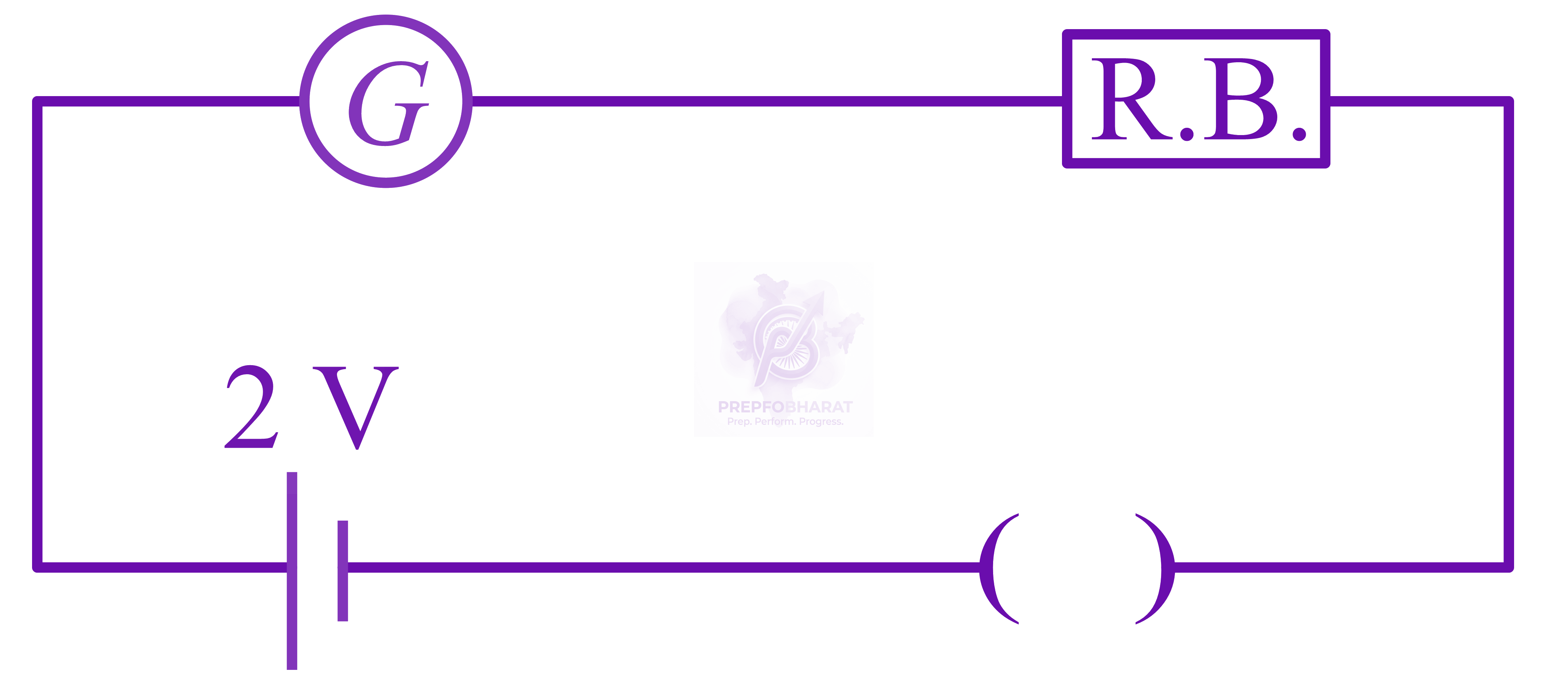 Note: This question is awarded as the bonus. Now the question is corrected.
A magnetic dipole is acted upon by two magnetic fields which are inclined to each other at an angle of ${75}^{o}$. One of the fields has a magnitude of $15\mathrm{mT}$. The dipole attains stable equilibrium at an angle of ${30}^{o}$ with this field. The magnitude of the other field (in $\mathrm{mT}$) is close to
A galvanometer having a coil resistance of $100 \Omega$ gives a full scale deflection, when a current of $1\mathrm{mA}$ is passed through it. The value of the resistance, which can convert this galvanometer into ammeter giving a full scale deflection for a current of $10A$, is:
To know the resistance $G$ of a galvanometer by half deflection method, a battery of emf ${V}_{E}$ and resistance $R$ is used to deflect the galvanometer by angle $\theta$ . If a shunt of resistance $S$ is needed to get half deflection the $G$, $R$ and $S$ are related by the equation:
Consider an electromagnetic wave propagating in vacuum. Choose the correct statement:
The potential (in volts) of a charge distribution is given by $V(z)=30-5{z}^{2}$ for $|z|\leq 1 m$ $V(z)=35-10 |z|$ for $|z|\geq 1 m$ . $V(z)$ does not depend on x and y. If this potential is generated by a constant charge per unit volume ${\rho }_{0}$ (in units of ${\epsilon }_{0}$ ) which is spread over a certain region, then choose the correct statement.
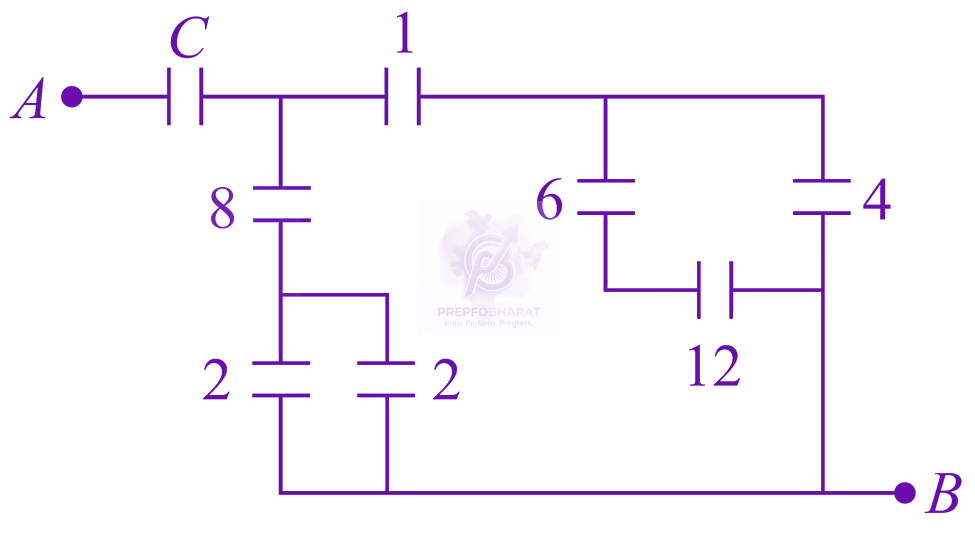
Figure shows a network of capacitors where the number indicates capacitances in micro Farad. The value of capacitance C if the equivalent capacitance between point A and B is to be $1 \mu F$ is :