JEE Main Physics — Electromagnetism previous year questions with solutions.
In the given circuit all resistance is of the value of $R$ ohm each. The equivalent resistance between $A$ and $B$ is: 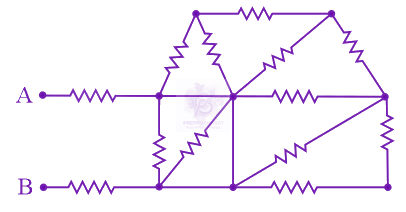
A coil of cross-sectional area $A$ having $n$ turns is placed in a uniform magnetic field $B$. When it is rotated with an angular velocity $\omega ,$ the maximum e.m.f. induced in the coil will be:
Three concentric metal shells $A,B$ and $C$ of respective radii $a,b$ and $c(a<b<c)$ have surface charge densities $+\sigma ,-\sigma$ and $+\sigma$ respectively. The potential of shell $B$ is:
Two identical conducting spheres $A$ and $B$ carry an equal charges. They are separated by a distance much larger than their diameters, and the force between them is $F$. A third identical conducting sphere, $C$, is uncharged. Sphere $C$ is first touched to $A$, then to $B$, and then removed. As a result, the force between $A$ and $B$ would be equal to:
An ideal capacitor of capacitance $0.2 \mu \mathrm{F}$ is charged to a potential difference of $10 \mathrm{~V}$. The charging battery is then disconnected. The capacitor is then connected to an ideal inductor of self inductance $0.5 \mathrm{mH}$. The current at a time when the potential difference across the capacitor is $5 \mathrm{~V}$, is:
At the centre of a fixed large circular coil of radius $\mathrm{R}$, a much smaller circular coil of radius $r$ is placed. The two coils are concentric and are in the same plane. The larger coil carries a current I. The smaller coil is set to rotate with a constant angular velocity $\omega$ about an axis along their common diameter. Calculate the emf induced in the smaller coil after a time $t$ of its start of rotation.
In a meter bridge as shown in the figure, it is given that resistance $Y=12.5\Omega$ and that the balance is obtained at a distance $39.5\mathrm{cm}$ from end $A$ (by jockey $J$). After interchanging the resistances $X$ and $Y$ a new balance point is found at a distance ${l}_{2}$ from end $A$. What are the values of $X$ (in $\Omega$) and ${l}_{2}$? 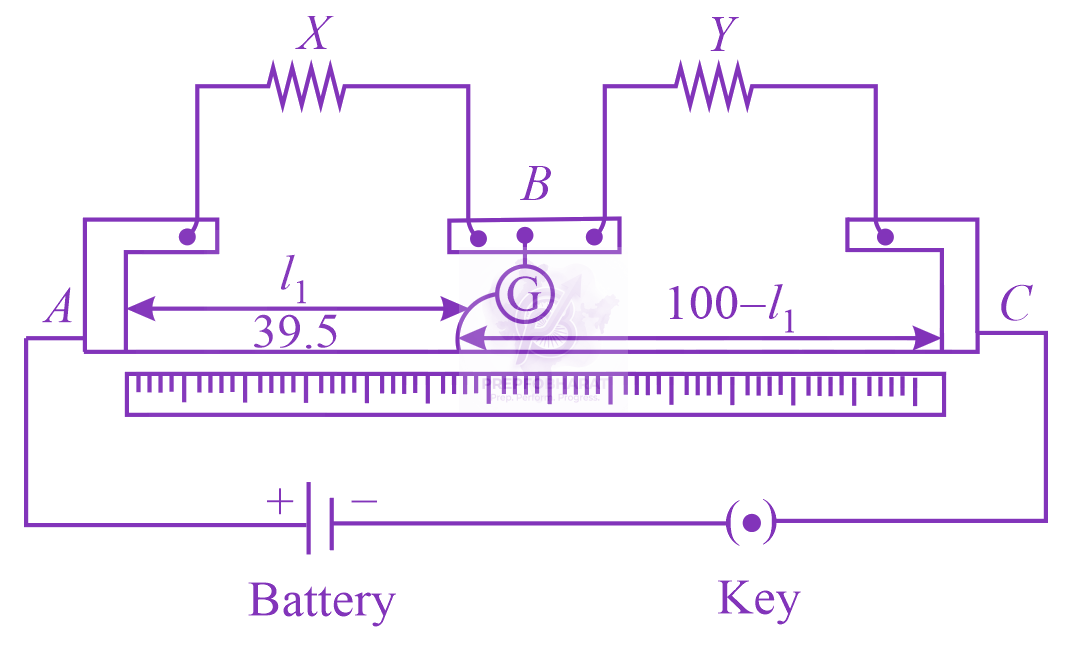
A charge $Q$ is placed at a distance $\mathrm{a} / 2$ above the centre of the square surface of edge a as shown in the figure. The electric flux through the square surface is: 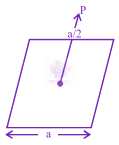
A monochromatic beam of light has a frequency $v=\frac{3}{2 \pi} \times 10^{12} \mathrm{~Hz}$ and is propagating along the direction $\frac{\hat{i}+\hat{j}}{\sqrt{2}}$. It is polarized along the $\hat{k}$ direction. The acceptable form for the magnetic field is:
Which of the following statements is false?
A small circular loop of wire of radius $a$ is located at the centre of a much larger circular wire loop of radius $b$. The two loops are in the same plane. The outer loop of radius $b$ carries an alternating current $I={I}_{0}\mathrm{cos}(\omega t).$ The emf induced in the smaller inner loop is nearly:
A sinusoidal voltage of peak value $283V$ and angular frequency $320{s}^{-1}$ is applied to a series $LCR$ circuit. Given that $R=5 \Omega , L=25 \mathrm{mH}$ and $C=1000\mu F$. The total impedance and phase difference between the voltage across the source and the current will respectively be-
The electric field component of a monochromatic radiation is given by $\vec{E}=2{E}_{0}\mathrm{cos}kz\mathrm{cos}\omega t\hat{i}$, Its magnetic field $\vec{B}$ is then given by:
A uniform magnetic field $B$ of $0.3T$ is along the positive $\text{Z}$ -direction. A rectangular loop ($abcd$) of sides $10 \mathrm{cm}\times 5 \mathrm{cm}$ carries a current $I$ of $12A$. Out of the following different orientations which one corresponds to stable equilibrium?
An electron beam is accelerated by a potential difference $V$ to hit a metallic target to produce $X-$rays. It produces continuous as well as characteristic $X-$rays. If ${\lambda }_{min}$ is the smallest possible wavelength of $X-$ray in the spectrum, the variation of $\mathrm{log}({\lambda }_{min})$ with $\mathrm{log}(V)$ is correctly represented in :
A magnetic dipole in a uniform magnetic field has: (Take zero potential energy when magnetic dipole is perpendicular to magnetic field)
Four closed surfaces and corresponding charge distributions are shown below. 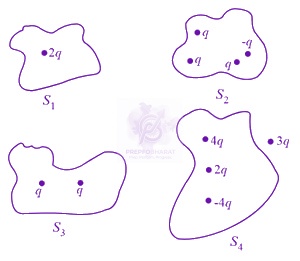 Let the respective electric fluxes through the surfaces be ${\phi }_{1}, {\phi }_{2}, {\phi }_{3}$ and ${\phi }_{4}$. Then:
There is a uniform electrostatic field in a region. The potential at various points on a small sphere centred at $P$, in the region, is found to vary between the limits $589.0V$ to $589.8V$. What is the potential at a point on the sphere whose radius vector makes an angle of $60^{\circ}$ with the direction of the field?
In the given circuit diagram, when the current reaches a steady-state in the circuit, the charge on the capacitor of capacitance $C$ will be: 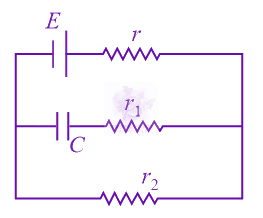
A capacitance of $2 \mu F$ is required in an electrical circuit across a potential difference of $1\text{.}0\mathrm{kV}$. A large number of $1 \mu F$ capacitors are available which can withstand a potential difference of not more than $300V$. The minimum number of capacitors required to achieve this is:
In a certain region static electric and magnetic fields exist. The magnetic field is given by $\vec{B}={B}_{0}(\hat{i}+2\hat{j}-4\hat{k})$. If a test charge moving with a velocity $\vec{v}={v}_{0}(3\hat{i}-\hat{j}+2\hat{k})$ experiences no force in that region, then the electric field in the region, in SI units, is:
A negative test charge is moving near a long straight wire carrying a current. The force acting on the test charge is parallel to the direction of the current. The motion of the charge is:
Magnetic field in a plane electromagnetic wave is given by, $\vec{B}={B}_{0}\mathrm{sin}(kx+\omega t)\hat{j} T$. Expression for corresponding electric field will be: (Where $c$ is speed of light)
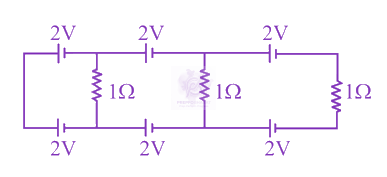 In the above circuit the current in each resistance is: