Electromagnetism PYQ — Page 49
JEE Main Physics — Electromagnetism previous year questions with solutions.
All Electromagnetism Questions (1703)
A paramagnetic sample shows a net magnetisation of $6A/m$ when it is placed in an external magnetic field of $0.4T$ at a temperature of $4K$. When the sample is placed in an external magnetic field of $0.3T$ at a temperature of $24K$, then the magnetisation will be :
A circular coil has moment of inertia $0.8\mathrm{kg}{m}^{2}$ around any diameter and is carrying current to produce a magnetic moment of $20{\mathrm{Am}}^{2}$. The coil is kept initially in a vertical position and it can rotate freely around a horizontal diameter. When a uniform magnetic field of $4T$ is applied along the vertical, it starts rotating around its horizontal diameter. The angular speed the coil acquires after rotating by ${60}^{o}$ will be :
An electron is moving along $+x$ direction with a velocity of $6\times {10}^{6}{\mathrm{ms}}^{-1}$. It enters a region of uniform electric field of $300V/cm$ pointing along $+y$ direction. The magnitude and direction of the magnetic field set up in this region such that the electron keeps moving along the x direction will be:
A circuit to verify Ohm's law uses ammeter and voltmeter in series or parallel connected corrected correctly to the resistor. In the circuit :
A wire carrying current $I$ is bent in the shape$\mathrm{ABCDEFA}$ as shown, where rectangle $\mathrm{ABCDA}$ and $\mathrm{ADEFA}$ are perpendicular to each other. If the sides of the rectangles are of lengths $a$ and $b$, then the magnitude and direction of magnetic moment of the loop $\mathrm{ABCDEFA}$ is : 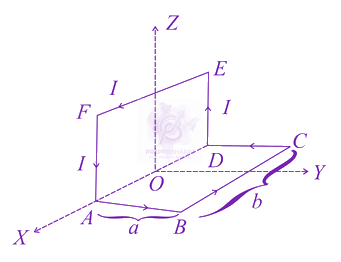
A beam of protons with speed $4\times {10}^{5}m{s}^{-1}$ enters a uniform magnetic field of $0.3T$ at an angle $60^{\circ}$ to the magnetic field, the pitch of the resulting helical path of protons is close to : (Mass of the proton$=1.67\times {10}^{-27}\mathrm{kg}$, charge of the proton$=1.69\times {10}^{-19}C$)
The figure shows a region of length '$l$' with a uniform magnetic field of $0.3T$ in it and a proton entering the region with velocity $4\times {10}^{5}m{s}^{-1}$ making an angle $60^{\circ}$ with the field. If the proton completes $10$ revolution by the time it cross the region shown, '$l$' is close to (mass of proton $=1.67\times {10}^{-27}\mathrm{kg}$, charge of the proton$=1.6\times {10}^{-19}C$) 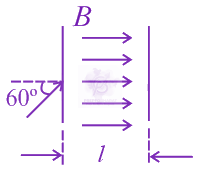
A parallel plate capacitor has plate of length $l$, width $w$ and separation of plates is $d$. It is connected to a battery of emf $V$. A dielectric slab of the same thickness $d$ and of dielectric constant $K=4$ is being inserted between the plates of the capacitor. At what length of the slab inside plates, will the energy stored in the capacitor be two times the initial energy stored?
The series combination of two batteries, both of the same emf $10V,$ but different internal resistance of $20 \Omega$ and $5 \Omega ,$ is connected to the parallel combination of two resistors $30 \Omega$ and $\text{x }\Omega .$ The voltage difference across the battery of internal resistance $20 \Omega$ is zero, the value of $\text{x}$ (in $\Omega )$ is____
The current ${I}_{1}$ (in $A$ ) flowing through $1\Omega$ resistor in the following circuit is: 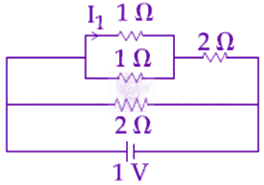
Two identical electric point dipoles have dipole have dipole moments ${\vec{p}}_{1}=p\hat{i}$ and ${\vec{p}}_{2}=-p\hat{i}$ and are held on the $x$-axis at distance '$a$' from each other. When released, they move along the $x$-axis with the direction of their dipole moments remaining unchanged. If the mass of each dipole is '$m$', their speed when they are infinitely far apart is :
Ten charges are placed on the circumference of a circle of radius R with constant angular separation between successive charges. Alternate charges$1,3,5,7,9$ have charge $(+q)$ each, while $2,4,6,8,10$ have charge $(–q)$ each. The potential V and the electric field E at the centre of the circle are respectively : (Take$V=0$ at infinity)
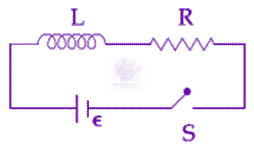 As shown in the figure, a battery of emf $\in$ is connected to an inductor $L$ and resistance $R$ in series. The switch is closed at $t=0.$ The total charge that flows from the battery, between $t=0$ and $t={t}_{c}$ ( ${t}_{c}$ is the time constant of the circuit) is:
Two sources of light emit X-rays of wavelength 1 nm and visible light of wavelength 500 nm, respectively. Both the sources emit light of the same power 200 W. The ratio of the number density of photons of X-rays to the number density of photons of the visible light of the given wavelengths is:
An inductance coil has a reactance of $100\Omega$ . When an AC signal of frequency $1000\mathrm{Hz}$ is applied to the coil, the applied voltage leads the current by $45^{\circ}$. The self-inductance of the coil is
The electric fields of two plane electromagnetic plane waves in vacuum are given by $\vec{{E}_{1}}={E}_{0}\hat{j}\mathrm{cos}(\omega t-kx)$ and $\vec{{E}_{2}}={E}_{0}\hat{k}\mathrm{cos}(\omega t-ky)$ At $t=0,$ a particle of charge $q$ is at origin with a velocity $\vec{v}=08c\hat{j}$ ( $c$ is the speed of light in vaccum). The instantaneous force experienced by the particle is:
Two infinite planes each with uniform surface charge density $+\sigma$ are kept in such a way that the angle between them is ${30}^{o}$ . The electric field in the region shown between them is given by: 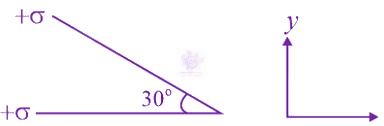
In the figure shown, what is the current (in Ampere) drawn from the battery? You are given: ${R}_{1}=15 \Omega , {R}_{2}=10 \Omega , {R}_{3}=20 \Omega , {R}_{4}=5 \Omega , {R}_{5}=25 \Omega , {R}_{6}=30 \Omega , E=15V$ 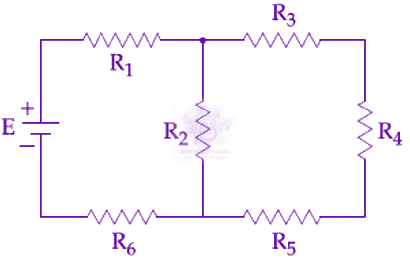
An alternating voltage $V(t)=220\mathrm{sin}(100\pi t)$ volt is applied to a purely resistive load of $50 \Omega$ . The time taken for the current to rise from half of the peak value to the peak value is:
Consider the LR circuit shown in the figure. If the switch S is closed at $t=0$ then the amount of charge that passes through the battery between $t=0$ and $t=\frac{L}{R}$ is: 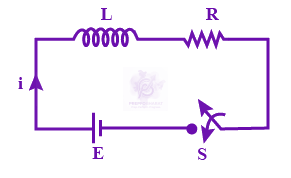
The electric field of a plane electromagnetic wave is given by $\vec{E}={E}_{0}\hat{i}\mathrm{cos}(kz)cos(\omega t)$ The corresponding magnetic field $\vec{B}$ is then given by:
The electric field of a plane polarized electromagnetic wave in free space at time $t=0$ is given by the expression $\vec{E}(x, y)=10\hat{j}cos(6x+8z)$. The magnetic field $\vec{B}(x, z, t)$ is given by ($c$ is the velocity of light.)
An electromagnetic wave is represented by the electric filed $\vec{E}={E}_{0}\hat{n}\mathrm{sin}[\omega t+(6y-8z)].$ Taking unit vectors in $x,y$ and $z$ directions to be $\hat{i},\hat{j},\hat{k},$ the directions of propogations $\hat{s},$ is:
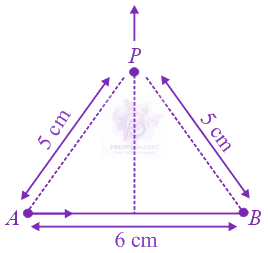
Find the magnetic field at point $P$ due to a straight line segment $AB$ of length $6 cm$ carrying a current of $5 A.$ (See figure) $({\mu }_{0}=4\pi \times {10}^{-7}{\mathrm{NA}}^{-2})$