JEE Main Physics — Electromagnetism previous year questions with solutions.
A square loop of side $2a$ and carrying current $I$ is kept in $\mathrm{xz}$ plane with its centre at origin. A long wire carrying the same current $I$ is placed parallel to $z$-axis and passing through point $(0,b,0),(b>>a)$. The magnitude of torque on the loop about $z$-axis will be :
A $750\mathrm{Hz},20V(\mathrm{rms})$ source is connected to a resistance of $100\Omega ,$ an inductance of $0.1803H$ and a capacitance of $10\mu F$ all in series. The time in which the resistance (heat capacity $2J/^{\circ}C$ ) will get heated by $10^{\circ}C.$ (assume no loss of heat to the surroundings) is close to :
A solid sphere of radius $R$ carries a charge $Q+q$ distributed uniformly over its volume. A very small point like piece of it of mass $m$ gets detached from the bottom of the sphere and falls down vertically under gravity. This piece carries charge $q$. If it acquires a speed $\nu$ when it has fallen through a vertical height $y$ (see figure), then (assume the remaining portion to be spherical) 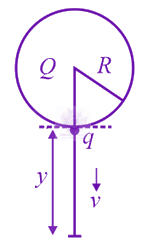
A small point mass carrying some positive charge on it, is released from the edge of a table. There is a uniform electric field in this region in the horizontal direction. Which of the following options then correctly describe the trajectory of the mass ? (Curves are drawn schematically and are not to scale)
A small circular loop of conducting wire has radius a and carries current $I.$ It is placed in a uniform magnetic field $B$ perpendicular to its plane such that when rotated slightly about its diameter and released, it starts performing simple harmonic motion of time period $T.$ The mass of the loop is $m$ then:
A small bar magnet is placed with its axis at ${30}^{o}$ with an external magnetic field of $0.06T$ experiences a torque of $0.018\mathrm{Nm}$. The minimum work required to rotate it from its stable to unstable equilibrium position is:
A small bar magnet is moved through a coil at constant speed from one end to the other. Which of the following series of observations will be seen on the galvanometer $\text{G}$ attached across the coil? 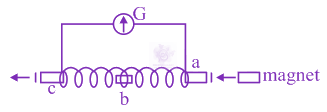 Three positions shown describe: (a) the magnet's entry (b) magnet is completely inside and (c) magnet's exit.
A series $L-R$ circuit is connected to a battery of emf $V$. If the circuit is switched on at $t=0$, then the time at which the energy stored in the inductor reaches $(\frac{1}{n})$ times of its maximum value, is :
A plane electromagnetic wave of frequency $25GHz$ is propagating in vacuum along the z-direction. At a particular point in space and time, the magnetic filed is given by $\vec{B}=5\times {10}^{-8} \hat{j} T.$ The corresponding electric field $\vec{E}$ is (speed of light $=3\times {10}^{8} m{s}^{-1}$ )
A plane electromagnetic wave is propagating along the direction $\frac{\hat{i}+\hat{j}}{\sqrt{2}},$ with its polarization along the direction $\hat{k.}$ The correct form of the magnetic field of the wave would be (here ${B}_{0}$ is an appropriate constant):
A plane electromagnetic wave, has frequency of $2.0\times {10}^{10}\mathrm{Hz}$ and its energy density is $1.02\times {10}^{-8}J{m}^{-3}$ in vacuum. The amplitude of the magnetic field of the wave is close to $(\frac{1}{4{\pi \epsilon }_{0}}=9\times {10}^{9}\frac{{\mathrm{Nm}}^{2}}{{C}^{2}})$ and speed of light $=3\times {10}^{8}m{s}^{-1}$.
A planar loop of wire rotates in a uniform magnetic field. Initially, at $t=0$ , the plane of the loop is perpendicular to the magnetic field. If it rotates with a period of $10s$ about an axis in its plane then the magnitude of induced emf will be maximum and minimum, respectively at:
A perfectly diamagnetic sphere has a small spherical cavity at its centre, which is filled with a paramagnetic substance. The whole system is placed in a uniform magnetic field $\vec{B}$. Then the field inside the paramagnetic substance is: 
A particle of mass $m$ and charge $q$ has an initial velocity $\vec{v}={v}_{0}\hat{j}$ . If an electric field $\vec{E}={E}_{0}\hat{i}$ and magnetic field $\vec{B}={B}_{0}\hat{i}$ act on the particle, its speed will double after a time
A particle of charge $q$ and mass $m$ is moving with a velocity $-v\hat{i}(v\neq 0)$ towards a large screen placed in the $Y-Z$ plane at distance d. If there is magnetic field $\vec{B}={B}_{0}\hat{k},$ the minimum value of $v$ for which the particle will not hit the screen is :
A part of a complete circuit is shown in the figure. At some instant, the value of current I is $1A$ and it is decreasing at a rate of ${10}^{2}{\mathrm{As}}^{-1}$. The value of the potential difference ${V}_{p}-{V}_{Q},$ (in volts) at that instant is- 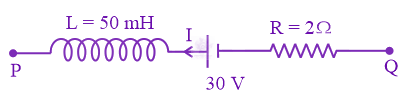
A paramagnetic sample shows a net magnetisation of $6A/m$ when it is placed in an external magnetic field of $0.4T$ at a temperature of $4K$. When the sample is placed in an external magnetic field of $0.3T$ at a temperature of $24K$, then the magnetisation will be :
A parallel plate capacitor has plate of length $l$, width $w$ and separation of plates is $d$. It is connected to a battery of emf $V$. A dielectric slab of the same thickness $d$ and of dielectric constant $K=4$ is being inserted between the plates of the capacitor. At what length of the slab inside plates, will the energy stored in the capacitor be two times the initial energy stored?
A loop $ABCDEFA$ of straight edges has six corner points $A(0,0,0),B(5,0,0),C(5,5,0),D(0,5,0),E(0,5,5)$ and $F(0,0,5)$ . The magnetic field in this region is $\vec{B}=(3\hat{i}+4\hat{k})T$ . The quantity of flux through the loop $ABCDEFA$ (in $Wb$ ) is _____________
A long, straight Wire of radius a carries a current distributed uniformly over its cross-section. The ratio of the magnetic fields due to the wire at distance $\frac{a}{3}$ and $2a$ , respectively from the axis of the wire is:
A long solenoid of radius $R$ carries a time $(t)$ dependent current $I(t)={I}_{0}t(1-t)$ . A ring of radius $2R$ is placed coaxially near its middle. During the time interval $0\leq t\leq 1,$ the induced current $({I}_{R})$ and the induced $EMF({V}_{R})$ in the ring change as:
A galvanometer of resistance $G$ is converted into a voltameter of range $0-1V$ by connecting a resistance $R$ in series with it. The additional resistance that should be connected in series with ${R}_{1}$ to increase the range of the voltmeter to $0-2V$ will be :
A galvanometer is used in laboratory for detecting the null point in electrical experiments. If, on passing a current of $6mA$ it produces a deflection of $2^{\circ}$, its figure of merit is close to :
A galvanometer having a coil resistance $100 \Omega$ gives a full scale deflection when a current of $1mA$ is passed through it. What is the value of the resistance which can convert this galvanometer into a voltmeter given full scale deflection for a potential difference of $10V?$