JEE Main Physics — Electromagnetism previous year questions with solutions.
At time $t=0$ magnetic field of $1000Gauss$ is passing perpendicularly through the area defined by the closed loop shown in the figure. If the magnetic field reduces linearly to $500Gauss,$ in the next $5s,$ then induced $EMF$ in the loop is: 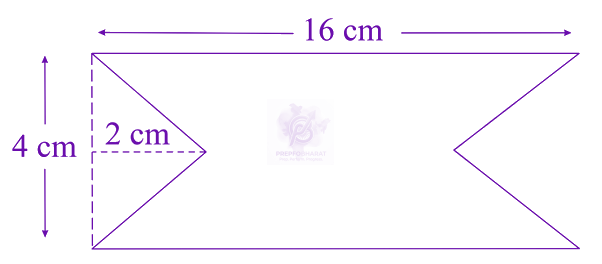
A galvanometer of resistance $G$ is converted into a voltameter of range $0-1V$ by connecting a resistance $R$ in series with it. The additional resistance that should be connected in series with ${R}_{1}$ to increase the range of the voltmeter to $0-2V$ will be :
The electric field of a plane electromagnetic wave is given by $\vec{E}={E}_{0}\frac{\hat{i}+\hat{j}}{\sqrt{2}}\mathrm{cos}(kz+\omega t)$ . At $t=0$ , a positively charged particle is at the point $(x,y,z)=(0,0,\frac{\pi }{k})$ . If its instantaneous velocity at $(t=0)$ is ${v}_{0}\hat{k}$ , the force acting on it due to the wave is:
The series combination of two batteries, both of the same emf $10V,$ but different internal resistance of $20 \Omega$ and $5 \Omega ,$ is connected to the parallel combination of two resistors $30 \Omega$ and $\text{x }\Omega .$ The voltage difference across the battery of internal resistance $20 \Omega$ is zero, the value of $\text{x}$ (in $\Omega )$ is____
A uniform magnetic field B exists in a direction perpendicular to the plane of a square loop made of a metal wire. The wire has a diameter of $4\mathrm{mm}$ and a total length of $30\mathrm{cm}.$ The magnetic field changes with time at a steady rate $\mathrm{dB}/\mathrm{dt}=0.032{\mathrm{Ts}}^{-1}.$ The induced current in the $loop$is close to (Resistivity of the metal wire is $1.23\times {10}^{-8}\Omega m$ )
Two identical electric point dipoles have dipole have dipole moments ${\vec{p}}_{1}=p\hat{i}$ and ${\vec{p}}_{2}=-p\hat{i}$ and are held on the $x$-axis at distance '$a$' from each other. When released, they move along the $x$-axis with the direction of their dipole moments remaining unchanged. If the mass of each dipole is '$m$', their speed when they are infinitely far apart is :
A charge Q is distributed over two concentric conducting thin spherical shells radii $r$ and $R(R>r)$. If the surface charge densities on the two shells are equal, the electric potential at the common centre is : 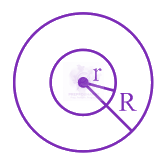
A particle of mass $m$ and charge $q$ has an initial velocity $\vec{v}={v}_{0}\hat{j}$ . If an electric field $\vec{E}={E}_{0}\hat{i}$ and magnetic field $\vec{B}={B}_{0}\hat{i}$ act on the particle, its speed will double after a time
In finding the electric field using Gauss law the formula $|\vec{E}|=\frac{{q}_{enc}}{{\epsilon }_{0}|A|}$ is applicable. In the formula ${\epsilon }_{0}$ is permittivity of free space, $A$ is the area of Gaussian surface and ${q}_{enc}$ is charge enclosed by the Gaussian surface. This equation can be used in which of the following situation?
Suppose that intensity of a laser is $(\frac{315}{\pi })W{m}^{-2}.$ The rms electric field, in units of $V{m}^{-1}$ associated with this source is close to the nearest integer is $-({\epsilon }_{0}=8.86\times {10}^{-12}{C}^{2}N{m}^{-2};c=3\times {10}^{8}m{s}^{-1})$
A $5\mu F$ capacitor is charged fully by a $220V$ supply. It is then disconnected from the supply and is connected in series to another uncharged $2.5\mu F$ capacitor. If the energy change during the charge redistribution is $\frac{X}{100}J$ then value of $X$ to the nearest integer is :
A $60pF$ capacitor is fully charged by a $20V$ supply. It is then disconnected from the supply and is connected to another uncharged $60pF$ capacitor in parallel. The electrostatic energy that is lost in this process by the time the charge is redistributed between them is (in $nJ$ ) ________
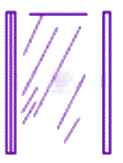 A parallel plate capacitor has plates of area A separated by distance $d$ between them. It is filled with a dielectric which has a dielectric constant that varies as $K(x)={K}_{0}(1+\alpha x)$ where $x$ is the distance measured from one of the plates. If $(\alpha d)<<1,$ the total capacitance of the system is best given by the expression:
A parallel plate capacitor has plate of length $l$, width $w$ and separation of plates is $d$. It is connected to a battery of emf $V$. A dielectric slab of the same thickness $d$ and of dielectric constant $K=4$ is being inserted between the plates of the capacitor. At what length of the slab inside plates, will the energy stored in the capacitor be two times the initial energy stored?
An ideal cell of emf $10V$ is connected in circuit shown in figure. Each resistance is $2\Omega$. The potential difference (in $V$) across the capacitor when it is fully charged is _____________ 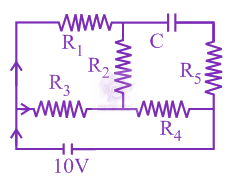
A galvanometer is used in laboratory for detecting the null point in electrical experiments. If, on passing a current of $6mA$ it produces a deflection of $2^{\circ}$, its figure of merit is close to :
A galvanometer coil has 500 turns and each turn has an average area of $3\times {10}^{-4}{m}^{2}$. If a torque of $1.5\mathrm{Nm}$ is required to keep this coil parallel to a magnetic field when a current of $0.5A$ is flowing through it, the strength of the field (in $T$) is _________ .
In the figure shown, the current in the $10V$ battery is close to : 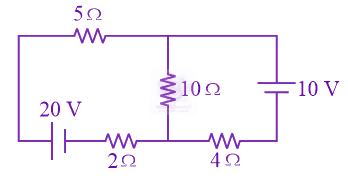
Four resistance $40\Omega ,60\Omega ,90\Omega$ $110\Omega$ and make the arms of a quadrilateral $ABCD$. Across $AC$ is a battery of emf $40V$ and internal resistance negligible. The potential difference across $BD$ in $V$ is __________ 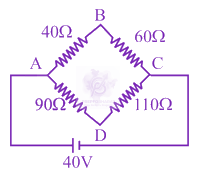
Two resistors $400\Omega$ and $800\Omega$ are connected in series across a $6\vee$ battery. The potential difference measured by a voltmeter of $10k\Omega$ across $400\Omega$ resistor is close to:
Which of the following will NOT be observed when a multimeter (operating in resistance measuring mode) probes connected across a component, are just reversed?
In a meter bridge experiment $S$ is a standard resistance. $R$ is a resistance wire. It is found that balancing length is $l=25cm.$ If $R$ is replaced by a wire of hall length and half diameter that of $R$ of same material, then the balancing distance $l'$ (in $cm$ ) will now be ______________. 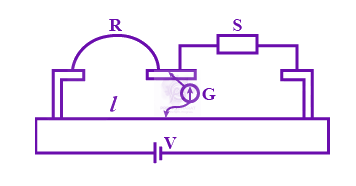
A galvanometer having a coil resistance $100 \Omega$ gives a full scale deflection when a current of $1mA$ is passed through it. What is the value of the resistance which can convert this galvanometer into a voltmeter given full scale deflection for a potential difference of $10V?$
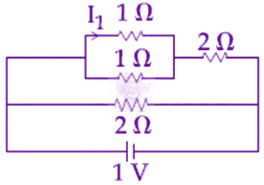
The current ${I}_{1}$ (in $A$ ) flowing through $1\Omega$ resistor in the following circuit is: