JEE Main Physics — Electromagnetism previous year questions with solutions.
A plane electromagnetic wave, has frequency of $2.0\times {10}^{10}\mathrm{Hz}$ and its energy density is $1.02\times {10}^{-8}J{m}^{-3}$ in vacuum. The amplitude of the magnetic field of the wave is close to $(\frac{1}{4{\pi \epsilon }_{0}}=9\times {10}^{9}\frac{{\mathrm{Nm}}^{2}}{{C}^{2}})$ and speed of light $=3\times {10}^{8}m{s}^{-1}$.
A wire $A$, bent in the shape of an arc of a circle, carrying a current of $2A$ and having radius $2\mathrm{cm}$ and another wire $B$, also bent in the shape of an arc of a circle, carrying a current of $3A$ and having radius of $4\text{ cm}$, are placed as shown in the figure. The ratio of the magnetic fields due to the wires $\text{A}$ and $\text{B}$ at the common centre $\text{O}$ is: 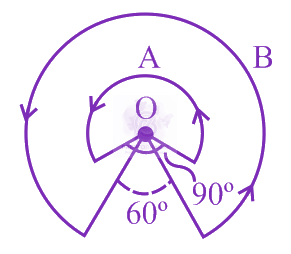
An infinitely long straight wire carrying current I, one side opened rectangular loop and a conductor $C$ with a sliding connector are located in the same plane, as shown in the figure. The connector has length l. and resistance $R$. It slides to the right with a velocity $v$. The resistance of the conductor and the self inductance of the loop are negligible. The induced current in the loop, as a function of separation r, between the connector and the straight wire is 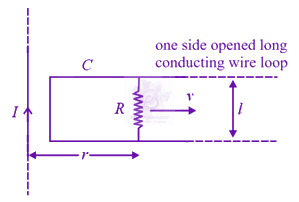
A small circular loop of conducting wire has radius a and carries current $I.$ It is placed in a uniform magnetic field $B$ perpendicular to its plane such that when rotated slightly about its diameter and released, it starts performing simple harmonic motion of time period $T.$ The mass of the loop is $m$ then:
A very long wire ABDMNDC is shown in figure carrying current I. AB and BC parts are straight, long and at right angle. At D wire forms a circular turn DMND of radius R. AB, BC parts are tangential to circular turn at N and D. Magnetic filed at the center of circle is: 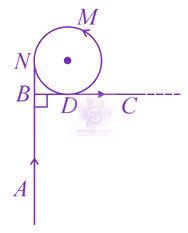
A plane electromagnetic wave of frequency $25GHz$ is propagating in vacuum along the z-direction. At a particular point in space and time, the magnetic filed is given by $\vec{B}=5\times {10}^{-8} \hat{j} T.$ The corresponding electric field $\vec{E}$ is (speed of light $=3\times {10}^{8} m{s}^{-1}$ )
In a building there are $15$ bulbs of $45W$ , $15$ bulbs of $100W,15$ small fans of $10W$ and $2$ heaters of $1kW$ . The voltage of electric main supply is $220V$ . The minimum fuse capacity (rated value) of the building will be:
For the given input voltage waveform ${V}_{\text{in }}(t),$ the output voltage waveform ${V}_{0}(t),$ across the capacitor is correctly depicted by : 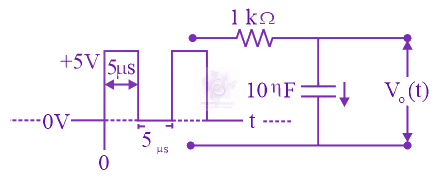
A loop $ABCDEFA$ of straight edges has six corner points $A(0,0,0),B(5,0,0),C(5,5,0),D(0,5,0),E(0,5,5)$ and $F(0,0,5)$ . The magnetic field in this region is $\vec{B}=(3\hat{i}+4\hat{k})T$ . The quantity of flux through the loop $ABCDEFA$ (in $Wb$ ) is _____________
The electric field of a plane electromagnetic wave is given by $\vec{E}={E}_{0}(\hat{x}+\hat{y})\mathrm{sin}(kz-\omega t)$. Its magnetic field will be given by
A capacitor is made of two square plates each of side ‘ $a$ ’ making a very small angle $\alpha$ between them, as shown in figure. The capacitance will be close to: 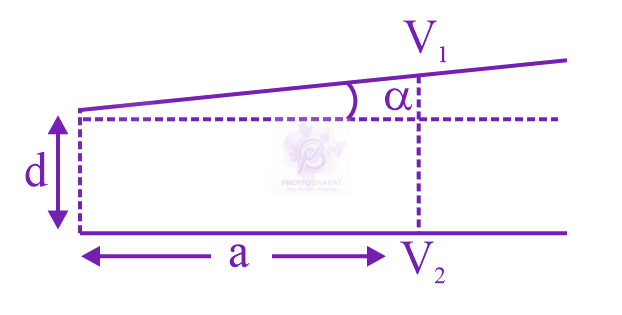
A small point mass carrying some positive charge on it, is released from the edge of a table. There is a uniform electric field in this region in the horizontal direction. Which of the following options then correctly describe the trajectory of the mass ? (Curves are drawn schematically and are not to scale)
A planar loop of wire rotates in a uniform magnetic field. Initially, at $t=0$ , the plane of the loop is perpendicular to the magnetic field. If it rotates with a period of $10s$ about an axis in its plane then the magnitude of induced emf will be maximum and minimum, respectively at:
An electromagnetic wave has electric field amplitude E₀ and magnetic field amplitude B₀. The ratio E₀/B₀ is equal to:
Three charged particles $\text{A}, \text{B}$ and $\text{C}$ with charges $-4q,2q$ and $-2q$ are present on the circumference of a circle of radius $d.$ The charged particles $\text{A}, \text{C}$ and centre $\text{O}$ of the circle formed an equilateral triangle as shown in the figure. The electric field at the point $\text{O}$ is 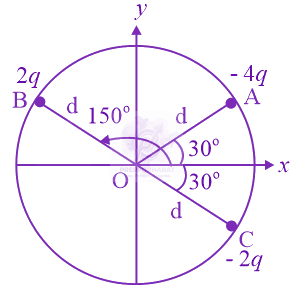
Concentric metallic hollow spheres of radii R and 4R hold charges ${Q}_{1}$ and ${Q}_{2}$ respectively. Given that surface charge densities of the concentric spheres are equal, the potential difference $V(R)-V(4R)$ is:
A square loop of side $2a,$ and carrying current $I$ is kept in $XZ$ plane with its centre at origin. A long wire carrying the same current $I$ is placed parallel to the $z$-axis and passing through the point $(0,b,0),(b>>a)$. The magnitude of the torque on the loop about $z$-axis is given by.
A small bar magnet is placed with its axis at ${30}^{o}$ with an external magnetic field of $0.06T$ experiences a torque of $0.018\mathrm{Nm}$. The minimum work required to rotate it from its stable to unstable equilibrium position is:
The electric field of a plane electromagnetic wave propagating along the x direction in vacuum is $\vec{E}={E}_{0}\mathrm{jcos}(\omega t-\mathrm{kx}).$ The magnetic field $\vec{B},$ at the moment $t=0$ is:
An electron is moving along $+x$ direction with a velocity of $6\times {10}^{6}{\mathrm{ms}}^{-1}$. It enters a region of uniform electric field of $300V/cm$ pointing along $+y$ direction. The magnitude and direction of the magnetic field set up in this region such that the electron keeps moving along the x direction will be:
A $750\mathrm{Hz},20V(\mathrm{rms})$ source is connected to a resistance of $100\Omega ,$ an inductance of $0.1803H$ and a capacitance of $10\mu F$ all in series. The time in which the resistance (heat capacity $2J/^{\circ}C$ ) will get heated by $10^{\circ}C.$ (assume no loss of heat to the surroundings) is close to :
A beam of protons with speed $4\times {10}^{5}m{s}^{-1}$ enters a uniform magnetic field of $0.3T$ at an angle $60^{\circ}$ to the magnetic field, the pitch of the resulting helical path of protons is close to : (Mass of the proton$=1.67\times {10}^{-27}\mathrm{kg}$, charge of the proton$=1.69\times {10}^{-19}C$)
The correct match between the entries in column I and column II are : <table class="pyq-table"><tbody><tr><td></td><td>I</td><td></td><td>II</td></tr><tr><td></td><td>Radiation</td><td></td><td>Wavelength</td></tr><tr><td>a</td><td>Microwave</td><td>i</td><td>$100m$</td></tr><tr><td>b</td><td>Gamma rays</td><td>ii</td><td>${10}^{-15}m$</td></tr><tr><td>c</td><td>A.M. radio</td><td>iii</td><td>${10}^{-10}m$</td></tr><tr><td>d</td><td>X–rays</td><td>iv</td><td>${10}^{-3}m$</td></tr></tbody></table>
A plane electromagnetic wave is propagating along the direction $\frac{\hat{i}+\hat{j}}{\sqrt{2}},$ with its polarization along the direction $\hat{k.}$ The correct form of the magnetic field of the wave would be (here ${B}_{0}$ is an appropriate constant):