JEE Main Physics — Electromagnetism previous year questions with solutions.
A long, straight Wire of radius a carries a current distributed uniformly over its cross-section. The ratio of the magnetic fields due to the wire at distance $\frac{a}{3}$ and $2a$ , respectively from the axis of the wire is:
Proton with kinetic energy of $1MeV$ moves from south to north. It gets an acceleration of ${10}^{12}m/{s}^{2}$ by an applied magnetic field (west to east). The value of magnetic field: (Rest mass of proton is $1.6\times {10}^{-27}kg$ )
Consider a circular coil of wire carrying constant current $I,$ forming a magnetic dipole. The magnetic flux through an infinite plane that contains the circular coil and excluding the circular coil area is given by ${\phi }_{i}$ The magnetic flux through the area of the circular coil area is given by ${\phi }_{0}$ . Which of the following option is correct?
Magnetic materials used for making permanent magnets $(P)$ and magnets in a transformer $(T)$ have different properties of the following, which property best matches for the type of magnet required?
A part of a complete circuit is shown in the figure. At some instant, the value of current I is $1A$ and it is decreasing at a rate of ${10}^{2}{\mathrm{As}}^{-1}$. The value of the potential difference ${V}_{p}-{V}_{Q},$ (in volts) at that instant is- 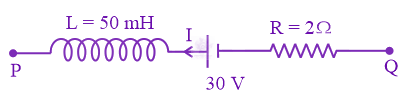
The magnetic field of a plane electromagnetic wave is $\vec{B}=3\times {10}^{-8}\mathrm{sin}[200\pi (y+ct)]\hat{i}T$ . Where, $c=3\times {10}^{8}m{s}^{-1}$ is the speed of light the corresponding electric filed is :
If the magnetic field in a plane electromagnetic wave is given by $\vec{B}=3\times {10}^{-8}\mathrm{sin}(1.6\times {10}^{3}x+48\times {10}^{10}t)\hat{j}T,$ then what will be expression for electric field ?
Effective capacitance of parallel combination of two capacitors ${C}_{1}$ and ${C}_{2}$ is $10\mu F.$ When these capacitors are individually connected to a voltage source of $1V,$ the energy stored in the capacitor ${C}_{2}$ is $4$ times that of ${C}_{1}.$ If these capacitors are connected in series, their effective capacitance will be:
An electric dipole of moment $\vec{\text{p}}=(-\hat{i}-3\hat{j}+2\hat{k})\times {10}^{-29}\text{C m}$ at the origin $(0,0,0)$ . The electric field due to this dipole at $\vec{\text{r}}=+\hat{i}+3\hat{j}+5\hat{k}$ (note that $\vec{r}\cdot \vec{p}=0$ ) is parallel to:
A capacitor $C$ is fully charged with voltage ${V}_{0}$. After disconnecting the voltage source, it is connected in parallel with another uncharged capacitor of capacitance $\frac{C}{2}$. The energy loss in the process after the charge is distributed between the two capacitors is :
A circular coil of radius $10\mathrm{cm}$ is placed in a uniform magnetic field of $3.0\times {10}^{-5}T$ with its plane perpendicular to the field initially. It is rotated at constant angular speed about an axis along the diameter of coil and perpendicular to magnetic field so that it undergoes half of rotation in $0.2s$. The maximum value of EMF induced (in $\mu V$) in the coil will be close to the integer....
Radiation, with wavelength $6561Å$ falls on a metal surface to produce photoelectrons. The electrons are made to enter a uniform magnetic field of $3\times {10}^{-4}T$ . If the radius of the largest circular path followed by the electrons is $10mm$ , the work function of the metal is close to:
Ten charges are placed on the circumference of a circle of radius R with constant angular separation between successive charges. Alternate charges$1,3,5,7,9$ have charge $(+q)$ each, while $2,4,6,8,10$ have charge $(–q)$ each. The potential V and the electric field E at the centre of the circle are respectively : (Take$V=0$ at infinity)
A long solenoid of radius $R$ carries a time $(t)$ dependent current $I(t)={I}_{0}t(1-t)$ . A ring of radius $2R$ is placed coaxially near its middle. During the time interval $0\leq t\leq 1,$ the induced current $({I}_{R})$ and the induced $EMF({V}_{R})$ in the ring change as:
The figure shows a region of length '$l$' with a uniform magnetic field of $0.3T$ in it and a proton entering the region with velocity $4\times {10}^{5}m{s}^{-1}$ making an angle $60^{\circ}$ with the field. If the proton completes $10$ revolution by the time it cross the region shown, '$l$' is close to (mass of proton $=1.67\times {10}^{-27}\mathrm{kg}$, charge of the proton$=1.6\times {10}^{-19}C$) 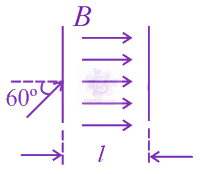
In $LC$ circuit the inductance $L=40\mathrm{mH}$ and capacitance $C=100\mu F.$ If a voltage $V(t)=10sin(314t)$ is applied to the circuit, the current in the circuit is given as:
In a series $\mathrm{LR}$ circuit, power of $400W$ is dissipated from a source of $250V,50\mathrm{Hz}$. The power factor of the circuit is $0.8$. In order to bring the power factor to unity, a capacitor of value $C$ is added in series to the $L$ and $R$. Taking the value of $C$ as $(\frac{n}{3\pi })\mu F$, then value of $n$ is
Charges ${Q}_{1}$ and ${Q}_{2}$ are at points $A$ and $B$ of a right-angled triangle $OAB$. The resultant electric field at point $O$ is perpendicular to the hypotenuse, then ${Q}_{1}/{Q}_{2}$ is proportional to: 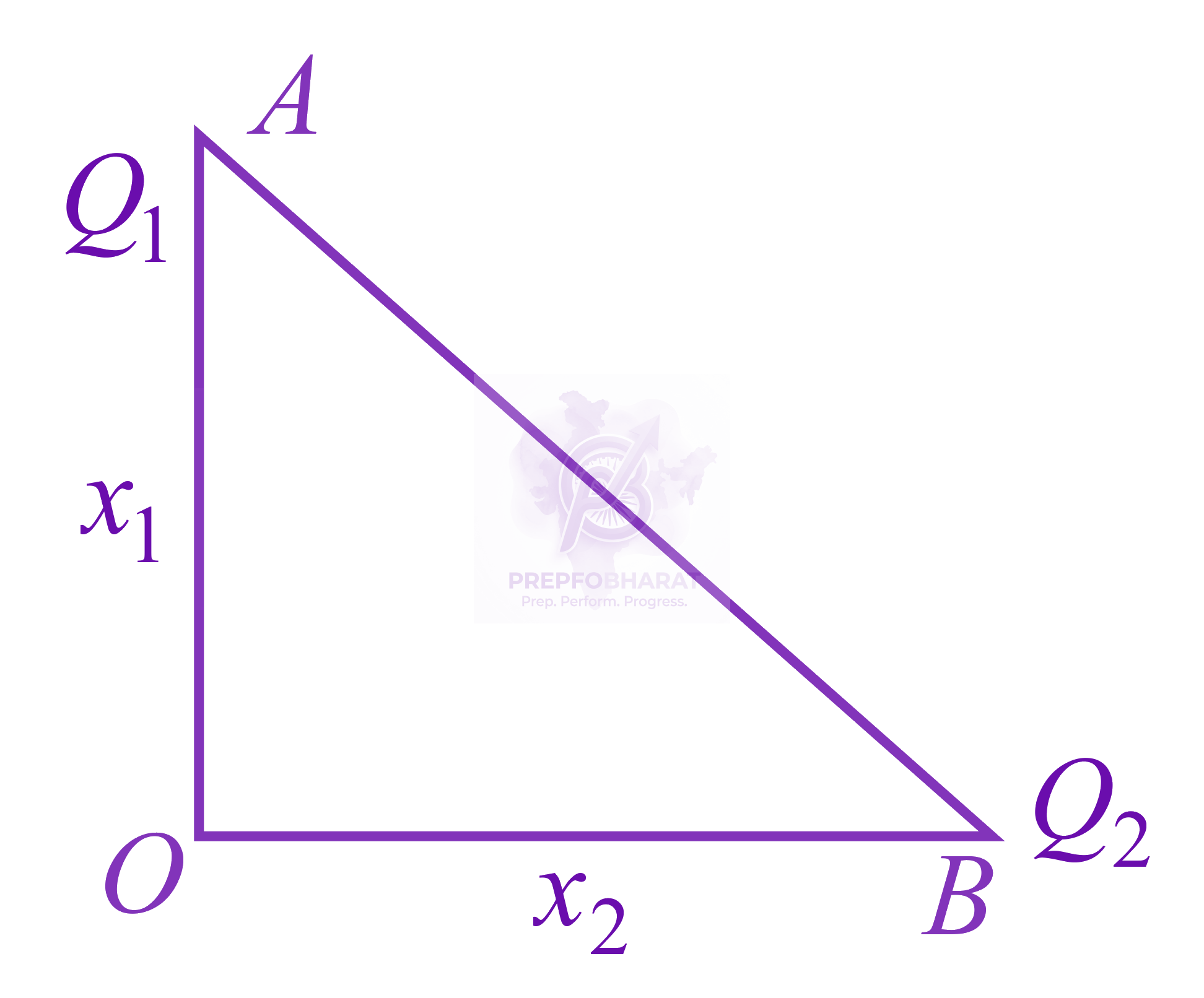
An electron is constrained to move along the $y$-axis with a speed of $0.1c$ (c is the speed of light) in the presence of electromagnetic wave, whose electric field is $\vec{E}=30\hat{j}\mathrm{sin}(1.5\times {10}^{7}t-5\times {10}^{-2}x)V{m}^{-1}.$ where $t$ in in seconds and $x$ is im meters.The maximum magnetic force experienced by the electron will be: (given $c=3\times {10}^{8}m{s}^{-1}$ and electron charge $=1.6\times {10}^{-19}\mathrm{Coloumbs}$
Consider four conducing materials copper, tungsten, mercury and aluminum with resistivity ${\rho }_{C},{\rho }_{T},{\rho }_{M}$ and ${\rho }_{A}$ respectively. Then :
A square loop of side $2a$ and carrying current $I$ is kept in $\mathrm{xz}$ plane with its centre at origin. A long wire carrying the same current $I$ is placed parallel to $z$-axis and passing through point $(0,b,0),(b>>a)$. The magnitude of torque on the loop about $z$-axis will be :
A circular coil has moment of inertia $0.8\mathrm{kg}{m}^{2}$ around any diameter and is carrying current to produce a magnetic moment of $20{\mathrm{Am}}^{2}$. The coil is kept initially in a vertical position and it can rotate freely around a horizontal diameter. When a uniform magnetic field of $4T$ is applied along the vertical, it starts rotating around its horizontal diameter. The angular speed the coil acquires after rotating by ${60}^{o}$ will be :
A charged particle of mass ‘ $m$ ’ and charge ‘ $q$ ’ moving under the influence of uniform electric field $\vec{\text{E}}\hat{i}$ and a uniform magnetic field $\vec{\text{B}}\hat{k}$ follows a trajectory from point P to Q as shown in figure. The velocities at P and Q are respectively, $v\vec{i}$ and $-2v\vec{j}$ . Then which of the following statements (A, B, C, D) are the correct? (Trajectory shown is schematic and not to scale) 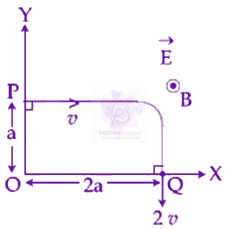 $(A)$ $E=\frac{3}{2}(\frac{m{v}^{2}}{qa})$ $(B)$ Rate of work done by the electric field at P is $\frac{3}{2}(\frac{m{v}^{3}}{a})$ $(C)$ Rate of work done by both the fields at Q is zero $(D)$ The difference between the magnitude of angular momentum of the particle at P and Q is $2mav$ .
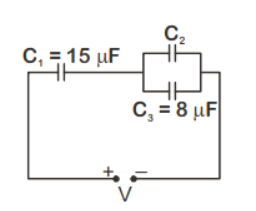
In the circuit shown in the figure, the total charge is $750\mu C$ and the voltage across capacitor ${C}_{2}$ is $20V$. Then the charge on capacitor ${C}_{2}$ is :