Electromagnetism PYQ — Page 43
JEE Main Physics — Electromagnetism previous year questions with solutions.
All Electromagnetism Questions (1703)
The electric field in a region is given by $\vec{E}=\frac{2}{5}{E}_{0}\hat{i}+\frac{3}{5}{E}_{0}\hat{j}$ with ${E}_{0}=4.0\times {10}^{3}N{C}^{-1}.$ The flux of this field through a rectangular surface, area $0.4{m}^{2}$ parallel to the $Y-Z$ plane is _______ $N{m}^{2}{C}^{-1}$.
A solenoid of $1000$ turns per metre has a core with relative permeability $500.$ Insulated windings of the solenoid carry an electric current of $5A.$ The magnetic flux density produced by the solenoid is: (Permeability of free space$=4\pi \times {10}^{-7}H{m}^{-1}$)
A proton, a deuteron and an $\alpha$ particle are moving with same momentum in a uniform magnetic field. The ratio of magnetic forces acting on them ______ is and their speed is ______ in the ratio.
If ${q}_{f}$ is the free charge on the capacitor plates and ${q}_{b}$ is the bound charge on the dielectric slab of dielectric constant $k$ placed between the capacitor plates, then bound charge ${q}_{b}$ can be expressed as :
An X-ray tube is operated at $1.24$ million volt. The shortest wavelength of the produced photon will be:
An electric bulb of $500W$ at $100V$ is used in a circuit having a $200V$ supply. Calculate the resistance $R$ to be connected in series with the bulb so that the power delivered by the bulb is $500W$.
An electric dipole is placed on $x-$axis in proximity to a line charge of linear charge density $3.0\times {10}^{-6}C{m}^{-1}.$ Line charge is placed on $z-$axis and positive and negative charge of dipole is at a distance of $10\mathrm{mm}$ and $12\mathrm{mm}$ from the origin respectively. If total force of $4N$ is exerted on the dipole, find out the amount of positive or negative charge of the dipole.
Five identical cells each of internal resistance $1\Omega$ and emf $5V$ are connected in series and in parallel with an external resistance $R.$ For what value of $R,$ current in series and parallel combination will remain the same?
A parallel plate capacitor of capacitance $200\mu F$ is connected to a battery of $200V.$ A dielectric slab of dielectric constant $2$ is now inserted into the space between plates of capacitor while the battery remain connected. The change in the electrostatic energy in the capacitor will be __________ $J.$
At very high frequencies, the effective impedance of the given circuit will be _________$\Omega .$ 
The electric field in a region is given by $\vec{E}=(\frac{3}{5}{E}_{0}\hat{i}+\frac{4}{5}{E}_{0}\hat{j})N{C}^{-1}$. The ratio of flux of reported field through the rectangular surface of area $0.2{m}^{2}$ (parallel to $y-z$ plane) to that of the surface of area $0.3{m}^{2}$ (parallel to $x-z$ plane) is $a:b=a:2,$ where $a=?$ [Here $\hat{i},\hat{j}$ and $\hat{k}$ are unit vectors along $x,y$ and $z$ -axes respectively]
In the given circuit the $\mathrm{AC}$ source has $\omega =100\mathrm{rad}{s}^{-1}$. Considering the inductor and capacitor to be ideal, what will be the current $I$ flowing through the circuit? 
The equivalent resistance of series combination of two resistors is $s.$ When they are connected in parallel, the equivalent resistance is $p.$ If $s=np,$ then the minimum value for $n$ is ______. (Round off to the Nearest Integer)
A capacitor of $50\mu F$ is connected in a circuit as shown in figure. The charge on the upper plate of the capacitor is _________ $\mu C.$ 
Figure $A$ and $B$ shown two long straight wires of circular cross-section ( $a$ and $b$ with $a<b$ ), carrying current $I$ which is uniformly distributed across the cross-section. The magnitude of magnetic field $B$ varies with radius $r$ and can be represented as: 
A loop of flexible wire of irregular shape carrying current is placed in an external magnetic field. Identify the effect of the field on the wire.
A bar magnet is passing through a conducting loop of radius $R$ with velocity $v.$ The radius of the bar magnet is such that it just passes through the loop. The induced e.m.f. in the loop can be represented by the approximate curve:  
$AC$ voltage $V(t)=20\mathrm{sin}\omega t$ of frequency $50\mathrm{Hz}$ is applied to a parallel plate capacitor. The separation between the plates is $2\mathrm{mm}$ and the area is $1{m}^{2}$. The amplitude of the oscillating displacement current for the applied $AC$ voltage is $[\text{Take }{\epsilon }_{0}=8.85\times {10}^{-12}F{m}^{-1}]$
Find out the surface charge density at the intersection of point $x=3m$ plane and $x$-axis, in the region of uniform line charge of $8\mathrm{nC}{m}^{-1}$ lying along the $z$-axis in free space.
Consider a galvanometer shunted with $5\Omega$ resistance and $2%$ of current passes through it. What is the resistance of the given galvanometer?
A $16\Omega$ wire is bent to form a square loop. A $9V$ supply having an internal resistance of $1\Omega$ is connected across one of its sides. The potential drop across the diagonals of the square loop is __________$\times {10}^{-1}V$.
Two resistors ${R}_{1}=(4\pm 0.8)\Omega$ and ${R}_{2}=(4\pm 0.4)\Omega$ are connected in parallel. The equivalent resistance of their parallel combination will be :
The voltage drop across $15\Omega$ resistance in the given figure will be _______ $V.$ 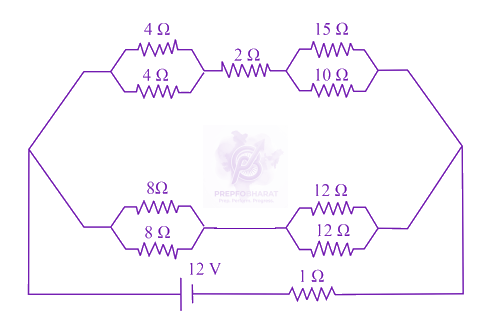
Consider a $72\mathrm{cm}$ long wire $AB$ as shown in the figure. The galvanometer jockey is placed at $P$ on $AB$ at a distance $x\mathrm{cm}$ from $A$. The galvanometer shows zero deflection.  The value of $x$, to the nearest integer, is