JEE Main Physics — Electromagnetism previous year questions with solutions.
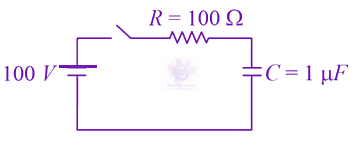 A capacitor of capacitance $C=1\mu F$ is suddenly connected to a battery of $100V$ through a resistance $R=100\Omega .$ The time taken for the capacitor to be charged to get $50V$ is: (Take $\mathrm{ln}2=0.69$)
A parallel plate capacitor whose capacitance $C$ is $14\mathrm{pF}$ is charged by a battery to a potential difference $V=12V$ between its plates. The charging battery is now disconnected and a porcelain plate with $k=7$ is inserted between the plates, then the plate would oscillate back and forth between the plates with a constant mechanical energy of _______ $\mathrm{pJ}.$ (Assume no friction)
Consider the combination of two capacitors ${C}_{1}$ and ${C}_{2}$, with ${C}_{2}>{C}_{1}$, when connected in parallel, the equivalent capacitance is $10$ times the equivalent capacitance of the same connected in series. Calculate the ratio of capacitors, $\frac{{C}_{2}}{{C}_{1}}$.
Two resistors ${R}_{1}=(4\pm 0.8)\Omega$ and ${R}_{2}=(4\pm 0.4)\Omega$ are connected in parallel. The equivalent resistance of their parallel combination will be :
In the given figure switches ${S}_{1}$ and ${S}_{2}$ are in open condition. The resistance across $ab$ when the switches ${S}_{1}$ and ${S}_{2}$ are closed is ________$\Omega .$ 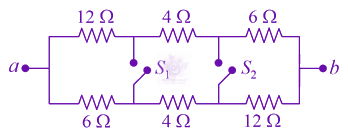
The voltage drop across $15\Omega$ resistance in the given figure will be _______ $V.$ 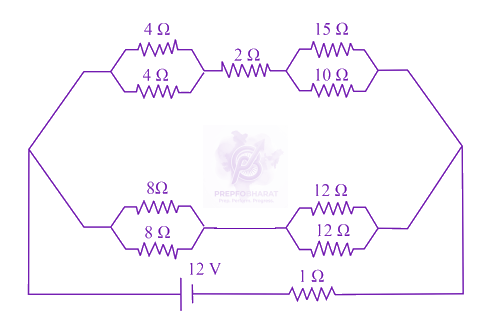
A square-shaped wire with a resistance of each side $3\Omega$ is bent to form a complete circle. The resistance between two diametrically opposite points of the circle in a unit of $\Omega$ will is, _____.
If you are provided a set of resistances, $2\Omega ,4\Omega ,6\Omega$ and $8\Omega .$ Connect these resistances to obtain an equivalent resistance of $\frac{46}{3}\Omega$.
Five identical cells each of internal resistance $1\Omega$ and emf $5V$ are connected in series and in parallel with an external resistance $R.$ For what value of $R,$ current in series and parallel combination will remain the same?
What equal length of an iron wire and a copper-nickel alloy wire, each of $2\mathrm{mm}$ diameter connected parallel to give an equivalent resistance of $3\Omega$? (Given resistivities of iron and copper-nickel alloy wire are $12\mu \Omega \mathrm{cm}$ and $51\mu \Omega \mathrm{cm}$ respectively)
In the given figure, the emf of the cell is $2.2V$ and if internal resistance is $0.6\Omega$. Calculate the power dissipated in the whole circuit: 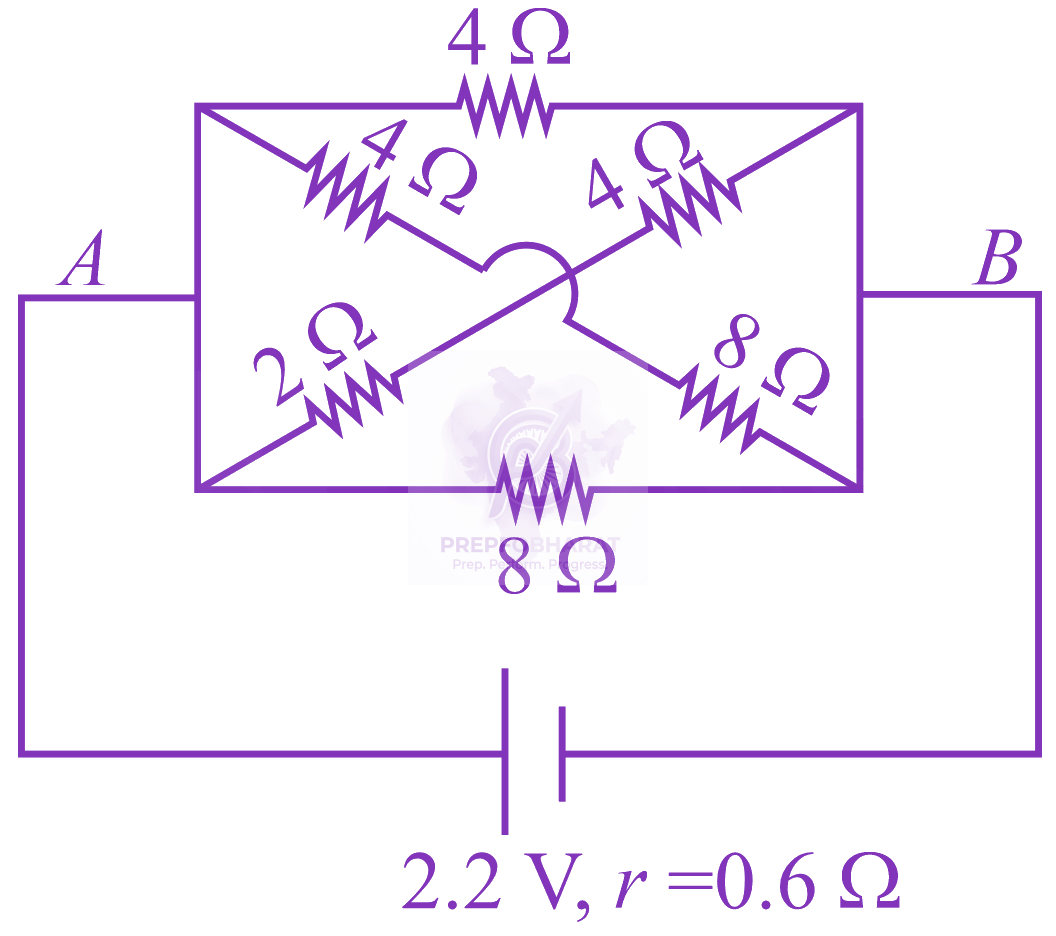
In an electric circuit, a call of certain emf provides a potential difference of $1.25V$ across a load resistance of $5\Omega .$ However, it provides a potential difference of $1V$ across a load resistance of $2\Omega .$The emf of the cell is given by $\frac{x}{10}V.$ Then the value of $x$ is $.$
The four arms of a Wheatstone bridge have resistances as shown in the figure. A galvanometer of $15\Omega$ resistance is connected across BD. Calculate the current through the galvanometer when a potential difference of $10V$ is maintained across AC. 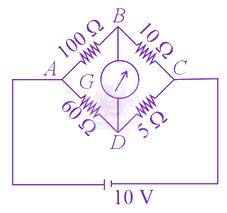
The circuit shown in the figure consists of a charged capacitor of capacity $3\mu F$ and a charge of $30\mu C.$ At time $t=0,$ when the key is closed, the value of current flowing through the $5M\Omega$ resistor is $x\mu A.$ The value of $x$ to the nearest integer is 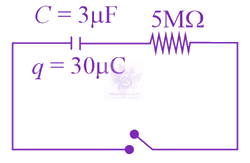
In the experiment of Ohm's law, a potential difference of $5.0V$ is applied across the end of a conductor of length $10.0\mathrm{cm}$ and diameter of $5.00\mathrm{mm}.$ The measured current in the conductor is $2.00A.$ The maximum permissible percentage error in the resistivity of the conductor is :-
The energy dissipated by a resistor is $10\mathrm{mJ}$ in $1s$, when an electric current of $2\mathrm{mA}$ flows through it. The resistance is ________$\Omega$. (Round off to the Nearest Integer)
A current of $10A$ exists in a wire of cross-sectional area of $5{\mathrm{mm}}^{2}$ with a drift velocity of $2\times {10}^{-3}{ms}^{-1}.$ The number of free electrons in each cubic meter of the wire is
A conducting wire of length $l$, area of crosssection $A$ and electric resistivity $\rho$ is connected between the terminals of a battery. A potential difference $V$ is developed between its ends, causing an electric current. If the length of the wire of the same material is doubled and the area of cross-section is halved, the resultant current would be___
A current through a wire depends on time as $i={\alpha }_{0}t+\beta {t}^{2}$, where ${\alpha }_{0}=20A{s}^{-1}$ and $\beta =8A{s}^{-2}$. Find the charge crossed through a section of the wire in $15s.$
Following plots show Magnetization $(M)$ vs Magnetising field $(H)$ and Magnetic susceptibility $(\chi )$ vs Temperature $(T)$ graph : 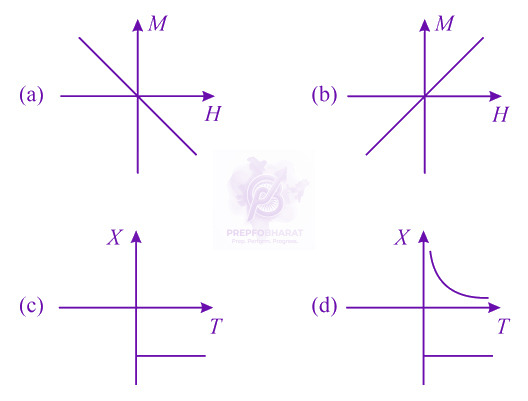 Which of the following combination will be represented by a diamagnetic material?
In a uniform magnetic field, the magnetic needle has a magnetic moment $9.85\times {10}^{-2}A{m}^{-2}$ and moment of inertia $5\times {10}^{-6}\mathrm{kg}{m}^{2}.$ If it performs $10$ complete oscillations in $5$ seconds then the magnitude of the magnetic field is ____$\mathrm{mT}$ [Take ${\pi }^{2}$ as $9.85]$
A soft ferromagnetic material is placed in an external magnetic field. The magnetic domains:
A plane electromagnetic wave with a frequency of $30\mathrm{MHz}$ travels in free space. At a particular point in space and time, the electric field is $6V{m}^{-1}$. The magnetic field at this point will be $x\times {10}^{-8}T$. The value of $x$ is,
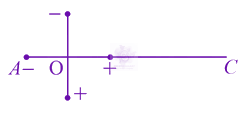
Two ideal electric dipoles $A$ and $B$, having their dipole moment ${p}_{1}$ and ${p}_{2}$ respectively are placed on a plane with their centres at $O$ as shown in the figure. At point $C$ on the axis of dipole $A$, the resultant electric field is making an angle of $37^{\circ}$ with the axis. The ratio of the dipole moment of $A$ and $B,\frac{{p}_{1}}{{p}_{2}}$ is$:($ take $\mathrm{sin}37^{\circ}=\frac{3}{5})$