Electromagnetism PYQ — Page 38
JEE Main Physics — Electromagnetism previous year questions with solutions.
All Electromagnetism Questions (1703)
A circular conducting coil of radius $1m$ is being heated by the change of magnetic field $\vec{B}$ passing perpendicular to the plane in which the coil is laid. The resistance of the coil is $2\mu \Omega$. The magnetic field is slowly switched off such that its magnitude changes in time as $B=\frac{4}{\pi }\times {10}^{-3}T(1-\frac{t}{100})$ The energy dissipated by the coil before the magnetic field is switched off completely is $E=______\mathrm{mJ}$.
An $AC$ source rated $220V,50\mathrm{Hz}$ is connected to a resistor. The time taken by the current to change from its maximum to the rms value is :
Two circuits are shown in figure $(a)$ and $(b)$. At a frequency of _______ $\mathrm{rad}{s}^{-1}$ the average power dissipated in one cycle will be the same in both the circuits. 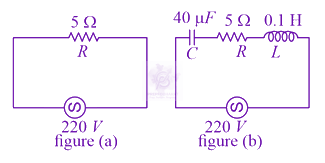
In a series LCR circuit, the inductive reactance $({X}_{L})$ is $10\Omega$ and the capacitive reactance $({X}_{C})$ is $4\Omega$. The resistance $(R)$ in the circuit is $6\Omega$. The power factor of the circuit is :
The time taken for the magnetic energy to reach $25%$ of its maximum value, when a solenoid of resistance $R$, inductance $L$ is connected to a battery, is :
The current $(i)$ at time $t=0$ and $t=\infty$ respectively for the given circuit is : 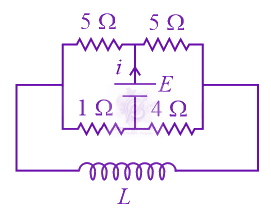
The electric field in a plane electromagnetic wave is given by $\vec{E}=200\mathrm{cos}[(0.5\times {10}^{3}{m}^{-1})x-(1.5\times {10}^{11}\mathrm{rad}{s}^{-1})t]V{m}^{-1}\hat{j}$. If this wave falls normally on a perfectly reflecting surface having an area of $100{\mathrm{cm}}^{2}$. If the radiation pressure exerted by the E.M. wave on the surface during a $10\mathrm{min}$ exposure is $\frac{k}{{10}^{9}}N{m}^{-2}$. Find the value of $k$
A linearly polarised electromagnetic wave in vacuum is $E=3.1\mathrm{cos}[(1.8)z-(5.4\times {10}^{6})t]\hat{i}N{C}^{-1}$ is incident normally on a perfectly reflecting wall at $z=a$. Choose the correct option.
The total charge enclosed in an incremental volume of $2\times {10}^{-9}{m}^{3}$ located at the origin is $\mathrm{nC},$ if electric flux density of its field is found as$D={e}^{-x}\mathrm{sin}y\hat{i}-{e}^{-x}\mathrm{cosy}\hat{j}+2z\hat{k}C{m}^{-2}$
A parallel plate capacitor has plate area A and separation d. It is charged to potential V. The energy stored in the capacitor is:
For a series $\mathrm{LCR}$ circuit with $R=100\Omega ,L=0.5\mathrm{mH}$ and $C=0.1\mathrm{pF}$ connected across $220V-50\mathrm{Hz}$ $\mathrm{AC}$ supply, the phase angle between current and supplied voltage and the nature of the circuit is:
A plane electromagnetic wave of frequency $100\mathrm{MHz}$ is traveling in a vacuum along the $x-$direction. At a particular point in space and time, $\vec{B}=2.0\times {10}^{-8}\hat{k}T\cdot$ (where, $\hat{k}$ is unit vector along $z-$direction) What is $\vec{E}$ at this point?
A long solenoid with $1000\mathrm{turns}{m}^{-1}$ has a core material with relative permeability $500$ and volume ${10}^{3}{\mathrm{cm}}^{3}.$ If the core material is replaced by another material having relative permeability of $750$ with same volume maintaining same current of $0.75A$ in the solenoid, the fractional change in the magnetic moment of the core would be approximately $(\frac{x}{499}).$ Find the value of $x.$
A solid metal sphere of radius $R$ having charge $q$ is enclosed inside the concentric spherical shell of inner radius $a$ and outer radius $b$ as shown in the figure. The approximate variation electric field $\vec{E}$, as a function of distance $r$, from centre $O$, is given by: 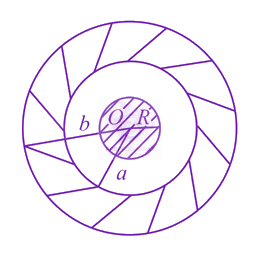
A Copper $(\mathrm{Cu})$ rod of length $25\mathrm{cm}$ and cross-sectional area $3{\mathrm{mm}}^{2}$ is joined with a similar Aluminium $(\mathrm{Al})$ rod as shown in figure. Find the resistance of the combination between the ends $A$ and $B.$ (Take resistivity of Copper $=1.7\times {10}^{-8}\Omega m$, Resistivity of aluminium $=2.6\times {10}^{-8}\Omega m$) 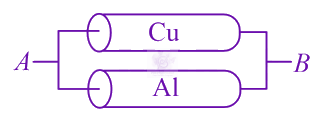
Seawater at a frequency $f=9\times {10}^{2}\mathrm{Hz}$, has permittivity $\epsilon =80{\epsilon }_{0}$ and resistivity $\rho =0.25\Omega m$. Imagine a parallel plate capacitor is immersed in seawater and is driven by an alternating voltage source $V(t)={V}_{0}\mathrm{sin}(2\pi ft)$. Then the conduction current density becomes ${10}^{x}$ times the displacement current density after time $t=\frac{1}{800}s.$ The value of $x$ is _______ (Given $:\frac{1}{4\pi {\epsilon }_{0}}=9\times {10}^{9}N{m}^{2}{C}^{-2})$
A circular coil of radius $8.0\mathrm{cm}$ and $20$ turns is rotated about its vertical diameter with an angular speed of $50\mathrm{rad}{s}^{-1}$ in a uniform horizontal magnetic field of $3.0\times {10}^{-2}T$. The maximum emf induced in the coil will be _______$\times {10}^{-2}$ volt (rounded off to the nearest integer).
A sinusoidal voltage of peak value $250V$ is applied to a series $LCR$ circuit, in which $R=8\Omega ,L=24\mathrm{mH}$ and $C=60\mu F$. The value of power dissipated at resonant condition is $x$ $\mathrm{kW}$. The value of $x$ to the nearest integer is _______.
A proton and an $\alpha$-particle, having kinetic energies ${K}_{p}$ and ${K}_{\alpha }$, respectively, enter into a magnetic field at right angles. The ratio of the radii of the trajectory of proton to that of $\alpha$ -particle is $2:1$. The ratio of ${K}_{p}:{K}_{\alpha }$ is:
In the given figure, a battery of emf $E$ is connected across a conductor $PQ$ of length $l$ and different area of cross-sections having radii ${r}_{1}$ and ${r}_{2}({r}_{2}<{r}_{1}).$ 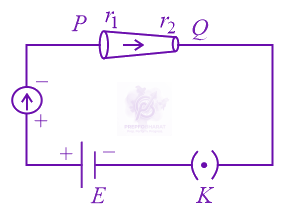 Choose the correct option as one moves from $P$ to $Q$.
For the given circuit, comment on the type of transformer used : 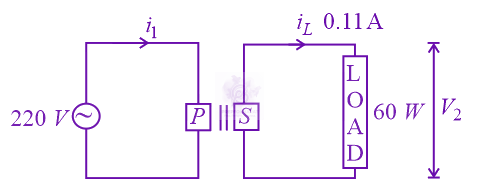
In an electrical circuit, a battery is connected to pass $20C$ of charge through it in a certain given time. The potential difference between two plates of the battery is maintained at $15V$. The workdone by the battery is _______ $J$
A cube is placed inside an electric field, $\vec{E}=150{y}^{2}\hat{j}$ The side of the cube is $0.5m$ and is placed in the field as shown in the given figure. The charge inside the cube is: 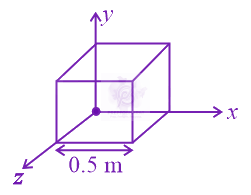
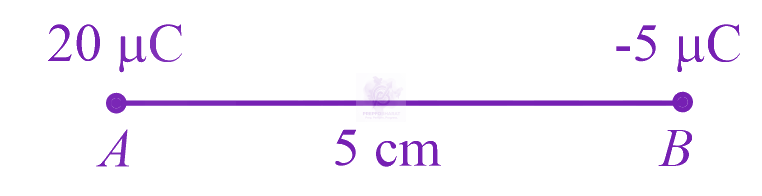
Two particles $A$ and $B$ having charges $20\mu C$ and $-5\mu C$ respectively are held fixed with a separation of $5\mathrm{cm}$ At what position a third charged particle should be placed so that it does not experience a net electric force ?