JEE Main Physics — Electromagnetism previous year questions with solutions.
A coil of negligible resistance is connected in series with $90 \Omega$ resistor across $120 \mathrm{~V}, 60 \mathrm{~Hz}$ supply. A voltmeter reads $36 \mathrm{~V}$ across resistance. Inductance of the coil is :
A stream of a positively charged particles having $\frac{q}{m}=2\times {10}^{11}C{\mathrm{kg}}^{-1}$ and velocity ${\vec{v}}_{0}=3\times {10}^{7}\hat{i}m{s}^{-1}$ is deflected by an electric field $1.8\hat{j}\mathrm{kV}{m}^{-1}$. The electric field exists in a region of $10\mathrm{cm}$ along $x$ direction. Due to the electric field, the deflection of the charge particles in the $y$ direction is _____ $\mathrm{mm}$.
Two identical circular wires of radius $20\mathrm{cm}$ and carrying current $\sqrt{2}A$ are placed in perpendicular planes as shown in figure. The net magnetic field at the centre of the circular wires is$________\times {10}^{-8}T.$ 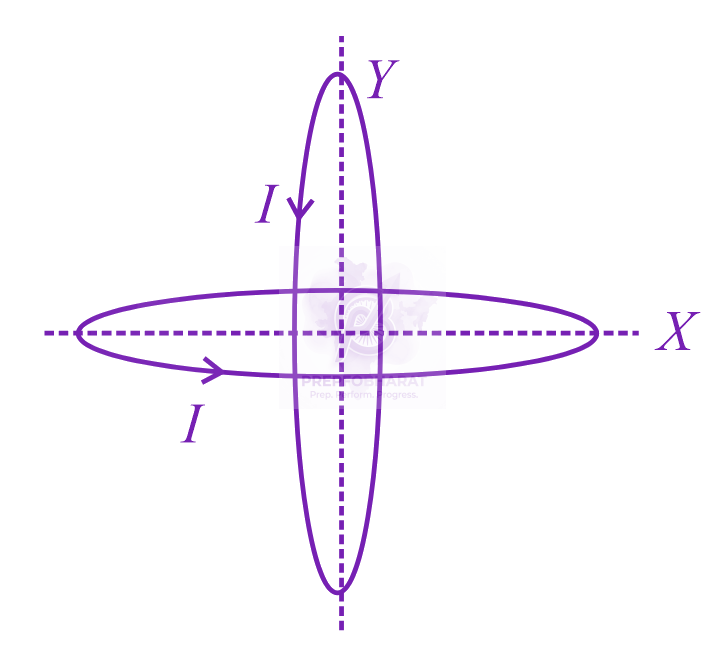 (Take $\pi =3.14$)
Two identical heater filaments are connected first in parallel and then in series. At the same applied voltage, the ratio of heat produced in same time for parallel to series will be:
A coil is placed in magnetic field such that plane of coil is perpendicular to the direction of magnetic field. The magnetic flux through a coil can be changed: A. By changing the magnitude of the magnetic field within the coil. B. By changing the area of coil within the magnetic field. C. By changing the angle between the direction of magnetic field and the plane of the coil. D. By reversing the magnetic field direction abruptly without changing its magnitude. Choose the most appropriate answer from the options given below:
A point charge of $10\mu C$ is placed at the origin. At what location on the $X$-axis should a point charge of $40\mu C$ be placed so that the net electric field is zero at $x=2\mathrm{cm}$ on the $X$-axis ?
A proton with a kinetic energy of $2.0\mathrm{eV}$ moves into a region of uniform magnetic field of magnitude $\frac{\pi }{2}\times {10}^{-3}T$. The angle between the direction of magnetic field and velocity of proton is ${60}^{o}$. The pitch of the helical path taken by the proton is ____ $\mathrm{cm}$. (Take, mass of proton $=1.6\times {10}^{-27}\mathrm{kg}$ and charge on proton $=1.6\times {10}^{-19}C$).
A current carrying rectangular loop $PQRS$ is made of uniform wire. The length $PR=QS=5\mathrm{cm}\text{and}PQ=RS=100\mathrm{cm}$. If ammeter current reading changes from $I$ to $2I$, the ratio of magnetic forces per unit length on the wire $PQ$ due to wire $RS$ in the two cases respectively $({f}_{PQ}^{I}:{f}_{PQ}^{2I})$ is: 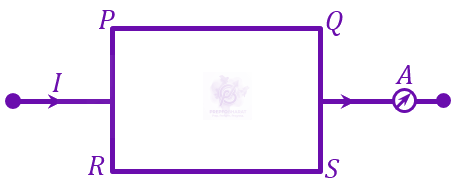
Ratio of thermal energy released in two resistor $R$ and $3R$ connected in parallel in an electric circuit is :
Three identical resistors with resistance $R=12\Omega$ and two identical inductors with sell inductance $L=5\mathrm{mH}$ are connected to an ideal battery with emf of $12V$ as shown in figure. The current through the battery long after the switch has been closed will be________$A$. 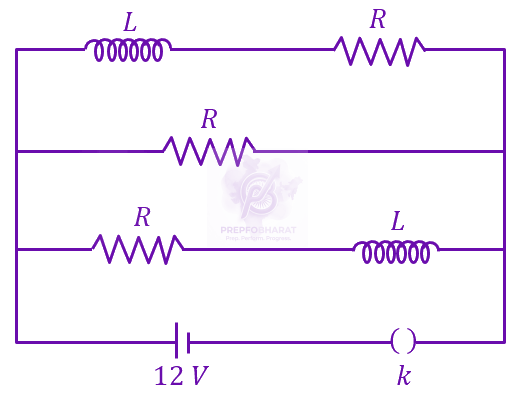
Two isolated metallic solid spheres of radii $R$ and $2R$ are charged such that both have same charge density $\sigma$ . The spheres are then connected by a thin conducting wire. If the new charge density of the bigger sphere is ${\sigma }^{'}$. The ratio $\frac{{\sigma }^{'}}{\sigma }$ is :
Equivalent resistance between the adjacent corners of a regular $n$-sided polygon of uniform wire of resistance $R$ would be :
Figure shows a part of an electric circuit. The potentials at points $a,b$ and $c$ are $30V,12V$ and $2V$ respectively. The current through the $20\Omega$ resistor will be, 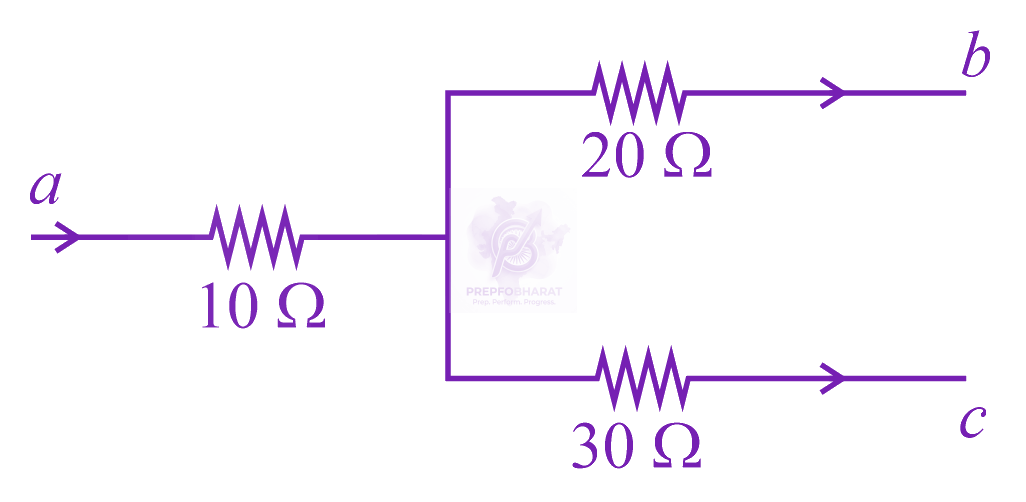
Expression for an electric field is given by $\vec{E}=4000{x}^{2}\hat{i}V{m}^{-1}$. The electric flux through the cube of side $20\mathrm{cm}$ when placed in electric field (as shown in the figure) is ______ $V\mathrm{cm}$. 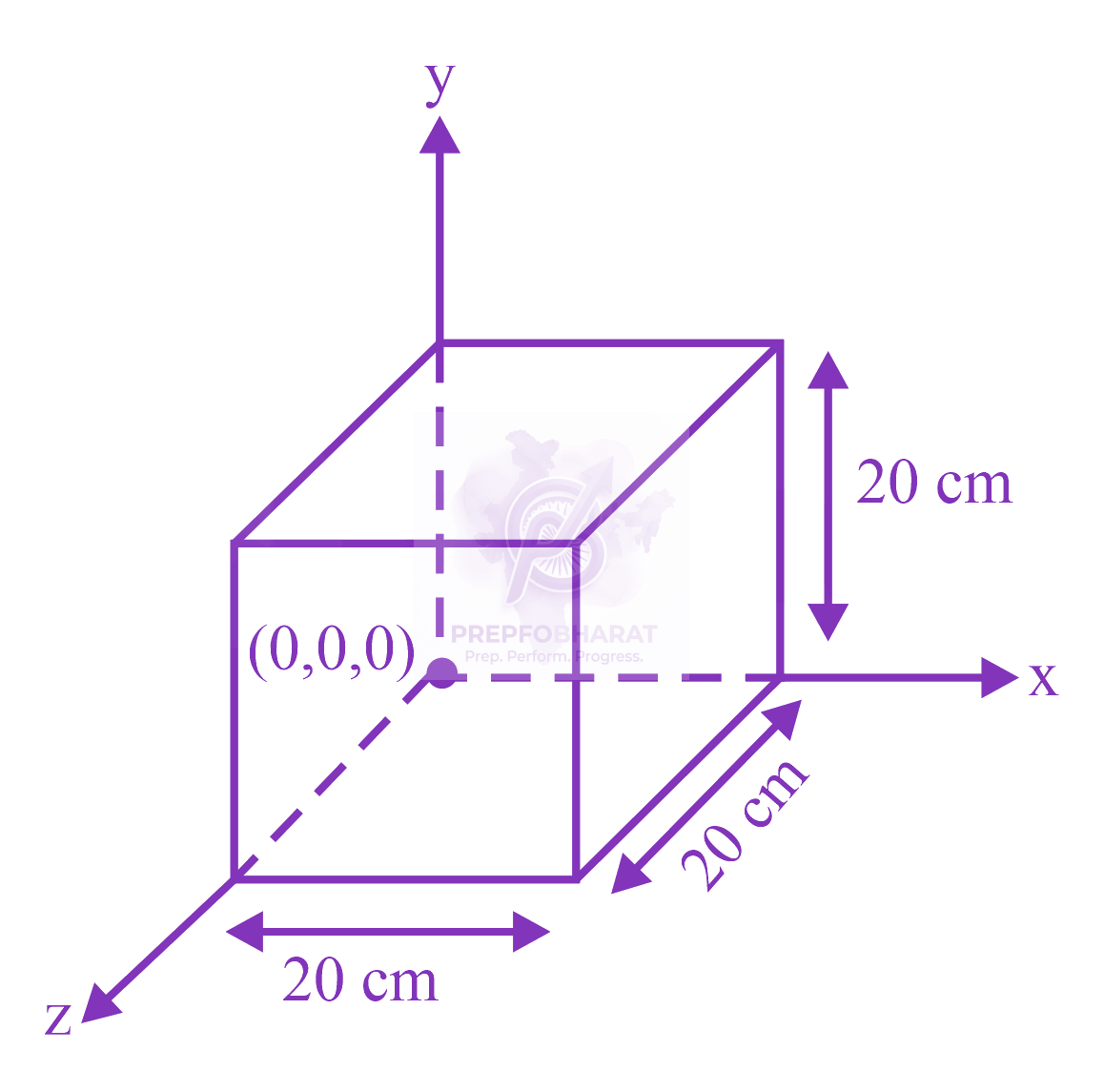
An insulated copper wire of $100$ turns is wrapped around a wooden cylindrical core of the cross-sectional area $24{\mathrm{cm}}^{2}$. The two ends of the wire are connected to a resistor. The total resistance in the circuit is $12\Omega$. If an externally applied uniform magnetic field in the core along its axis changes from $1.5T$ in one direction to $1.5T$ in the opposite direction, the charge flowing through a point in the circuit during the change of magnetic field will be _____ $\mathrm{mC}$.
An emf of $0.08V$ is induced in a metal rod of length $10\mathrm{cm}$ held normal to a uniform magnetic field of $0.4T$, when move with a velocity of:
All electromagnetic wave is transporting energy in the negative $z$ direction. At a certain point and certain time the direction of electric field of the wave is along positive $y$ direction. What will be the direction of the magnetic field of the wave at that point and instant?
Considering a group of positive charges, which of the following statements is correct?
A hollow cylindrical conductor has length of $3.14m$, while its inner and outer diameters are $4\mathrm{mm}$ and $8\mathrm{mm}$ respectively. The resistance of the conductor is $n\times {10}^{-3}\Omega$. If the resistivity of the material is $2.4\times {10}^{-8}\Omega m$. The value of $n$ is _____.
Experimentally it is found that $12.8\mathrm{eV}$ energy is required to separate a hydrogen atom into a proton and an electron. So the orbital radius of the electron in a hydrogen atom is $\frac{9}{x}\times {10}^{-10}m$. The value of the $x$ is: _____. ($1\mathrm{eV}=1.6\times {10}^{-19}J,\frac{1}{4\pi {\epsilon }_{0}}=9\times {10}^{9}\frac{{\mathrm{Nm}}^{2}}{{C}^{2}}$ and electronic charge $=1.6\times {10}^{-19}C$)
The drift velocity of electrons for a conductor connected in an electrical circuit is ${V}_{d}$. The conductor is now replaced by another conductor with same material and same length but double the area of cross-section. The applied voltage remains same. The new drift velocity of electrons will be
In the given circuit, the current $I$ through the battery will be 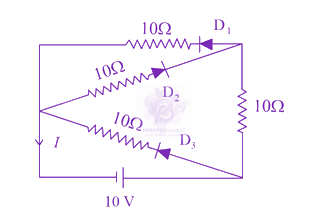
A rod with circular cross-section area $2{\mathrm{cm}}^{2}$ and length $40\mathrm{cm}$ is wound uniformly with $400$ turns of an insulated wire. If a current of $0.4A$ flows in the wire windings, the total magnetic flux produced inside windings is $4\pi \times {10}^{-6}\mathrm{Wb}$. The relative permeability of the rod is (Given : Permeability of vacuum ${\mu }_{0}=4\pi \times {10}^{-7}N{A}^{-2}$)
A bar magnet is released from rest along the axis of a very long vertical copper tube. After some time the magnet will