JEE Main 2007 — Electromagnetism
Physics Electromagnetism questions from JEE Main 2007.
Other Years
14 Electromagnetism Questions from 2007
A charged particle with charge $\mathrm{q}$ enters a region of constant, uniform and mutually orthogonal fields $\mathrm{\vec{E}}$ and $\mathrm{\vec{B}}$ with a velocity $\mathrm{\vec{v}}$ perpendicular to both $\mathrm{\vec{E}}$ and $\mathrm{\vec{B}}$, and comes out without any change in magnitude or direction of $\mathrm{\vec{v}}$. Then
In an a.c. circuit the voltage applied is $\mathrm{E}=\mathrm{E}_0 \sin \omega \mathrm{t}$. The resulting current in the circuit is $\mathrm{I}=\mathrm{I}_0 \sin \left(\omega \mathrm{t}-\frac{\pi}{2}\right)$. The power consumption in the circuit is given by
Charges are placed on the vertices of a square as shown. Let $\mathrm{E}$ be the electric field and $\mathrm{V}$ the potential at the centre. If the charges on $\mathrm{A}$ and $\mathrm{B}$ are interchanged with those on $\mathrm{D}$ and $\mathrm{C}$ respectively, then 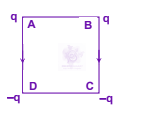
The resistance of a wire is $5 \mathrm{~ohm}$ at $50^{\circ} \mathrm{C}$ and $6 \mathrm{~ohm}$ at $100^{\circ} \mathrm{C}$. The resistance of the wire at $0^{\circ} \mathrm{C}$ will be
A parallel plate condenser with a dielectric of dielectric constant $\mathrm{K}$ between the plates has a capacity $\mathrm{C}$ and is charged to a potential $\mathrm{~V ~volts}$. The dielectric slab is slowly removed from between the plates and then reinserted. The net work done by the system in this process is
Two identical conducting wires $\mathrm{A O B}$ and $\mathrm{C O D}$ are placed at right angles to each other. The wire $\mathrm{AOB}$ carries an electric current $\mathrm{I_1}$ and $\mathrm{COD}$ carries a current $\mathrm{I_2}$. The magnetic field on a point lying at a distance ' $\mathrm{d}$ ' from $\mathrm{O}$, in a direction perpendicular to the plane of the wires $\mathrm{A O B}$ and $\mathrm{C O D}$, will be given by
An ideal coil of $10 \mathrm{H}$ is connected in series with a resistance of $5 \Omega$ and a battery of $5 \mathrm{~V}$. $2$ second after the connection is made the current flowing in amperes in the circuit is
A battery is used to charge a parallel plate capacitor till the potential difference between the plates becomes equal to the electromotive force of the battery. The ratio of the energy stored in the capacitor and the work done by the battery will be
An electric charge $10^{-3} \mu \mathrm{C}$ is placed at the origin $(0,0)$ of $X-Y$ co-ordinate system. Two points $A$ and $\mathrm{B}$ are situated at $(\sqrt{2}, \sqrt{2})$ and $(2,0)$ respectively. The potential difference between the points $A$ and $B$ will be
The potential at a point $x$ (measured in $\mu \mathrm{m}$ ) due to some charges situated on the $\mathrm{x}$-axis is given by $\mathrm{V(x)=20 /\left(x^2-4\right)} \mathrm{~Volts}$. The electric field $\mathrm{E}$ at $\mathrm{x=4 ~\mu m}$ is given by
A charged particle moves through a magnetic field perpendicular to its direction. Then
A current $\mathrm{I}$ flows along the length of an infinitely long, straight, thin walled pipe. Then
If $\mathrm{g}_{\mathrm{E}}$ and $\mathrm{g}_{\mathrm{m}}$ are the accelerations due to gravity on the surfaces of the earth and the moon respectively and if Millikan's oil drop experiment could be performed on the two surfaces, one will find the ratio $\frac{\text { electronic charge on the moon }}{\text { electronic charge on the earth }}$ to be
A long straight wire of radius ' $a$ ' caries a steady current $\mathrm{i}$. The current is uniformly distributed across its cross section. The ratio of the magnetic field at $\frac{a}{2}$ and $2 a$ is