JEE Main 2005 — Electromagnetism
Physics Electromagnetism questions from JEE Main 2005.
Other Years
22 Electromagnetism Questions from 2005
A charged particle of mass $\mathrm{m}$ and charge $q$ travels on a circular path of radius $r$ that is perpendicular to a magnetic field $\mathrm{B}$. The time taken by the particle to complete one revolution is
A fully charged capacitor has a capacitance ' $C$ ' it is discharged through a small coil of resistance wire embedded in a thermally insulated block of specific heat capacity ' $s$ ' and mass ' $\mathrm{m}$ '. If the temperature of the block is raised by ' $\Delta \mathrm{T}$ '. The potential difference $V$ across the capacitance is
The phase difference between the alternating current and emf is $\pi / 2$. Which of the following cannot be the constituent of the circuit?
Two thin wires rings each having a radius $R$ are placed at a distance $d$ apart with their axes coinciding. The charges on the two rings are $+q$ and $-q$. The potential difference between the centres of the two rings is
A uniform electric field and a uniform magnetic field are acting along the same direction in a certain region. If an electron is projected along the direction of the fields with a certain velocity then
Two point charges $+8 q$ and $-2 q$ are located at $x=0$ and $x=L$ respectively. The location of a point on the $x$ axis at which the net electric field due to these two point charges is zero is
A heater coil is cut into two equal parts and only one part is now used in the heater. The heat generated will now be
An energy source will supply a constant current into the load of its internal resistance is
A charged ball B hangs from a silk thread $S$ which makes an angle $\theta$ with a large charged conducting sheet $\mathrm{P}$, as show in the figure. The surface charge density $\sigma$ of the sheet is proportional to 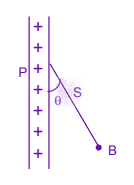
In the circuit, the galvanometer $G$ shows zero deflection. If the batteries $A$ and $B$ have negligible internal resistance, the value of the resistor $\mathrm{R}$ will be 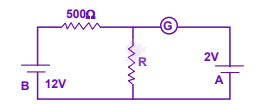
The resistance of hot tungsten filament is about 10 times the cold resistance. What will be the resistance of $100 \mathrm{~W}$ and $200 \mathrm{~V}$ lamp when not in use?
A magnetic needle is kept in a non-uniform magnetic field. It experiences
A parallel plate capacitor is made by stacking n equally spaced plates connected alternatively. If the capacitance between any two adjacent plates is C then the resultant capacitance is
Two voltameters one of copper and another of silver, are joined in parallel. When a total charge $q$ flows through the voltameters, equal amount of metals are deposited. If the electrochemical equivalents of copper and silver are $z_1$ and $z_2$ respectively the charge which flows through the silver voltameter is
Two thin, long parallel wires separated by a distance 'd' carry a current of 'i' $A$ in the same direction. They will
A moving coil galvanometer has 150 equal divisions. Its current sensitivity is 10 divisions per milliampere and voltage sensitivity is 2 divisions per millivolt. In order that each division reads 1 volt, the resistance in ohms needed to be connected in series with the coil will be
One conducting U tube can slide inside another as shown in figure, maintaining electrical contacts between the tubes. The magnetic field $B$ is perpendicular to the plane of the figure. if each tube moves towards the other at a constant speed V, then the emf induced in the circuit in terms of $B, \ell$ and $\mathrm{V}$ where $\ell$ is the width of each tube will be 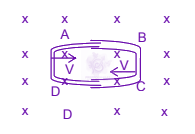
The self inductance of the motor of an electric fan is $10 \mathrm{H}$. In order to impart maximum power at $50 \mathrm{~Hz}$, it should be connected to a capacitance of
Two sources of equal emf are connected to an external resistance R. The internal resistance of the two sources are $R_1$ and $R_2\left(R_2>R_1\right)$. If the potential difference across the source having internal resistance $\mathrm{R}_2$ is zero, then
A circuit has a resistance of $12 \Omega$ and an impedance of $15 \Omega$. The power factor of the circuit will be
Two concentric coils each of radius equal to $2 \pi \mathrm{cm}$ are placed at right angles to each other. 3 Ampere and 4 ampere are the currents flowing in each coil respectively. The magnetic induction in Weber $/ \mathrm{m}^2$ at the centre of the coils will be $\left(\mu_0=4 \pi \times 10^{-7}\right.$ Wb/A-m)
A coil of inductance $300 \mathrm{mH}$ and resistance $2 \Omega$ is connected to a source of voltage 2V. The current reaches half of its steady state value in