Algebra PYQ — Page 52
JEE Main Mathematics — Algebra previous year questions with solutions.
All Algebra Questions (1966)
Let $A=[\begin{matrix}x & y & z \\ y & z & x \\ z & x & y\end{matrix}],$ where $x,y$ and $z$ are real numbers such that $x+y+z>0$ and $xyz=2$. If ${A}^{2}={I}_{3}$, then the value of ${x}^{3}+{y}^{3}+{z}^{3}$ is
The sum of all the $4$-digit distinct numbers that can be formed with the digits $1,2,2$ and $3$ is:
Let a complex number $z,|z|\neq 1$, satisfy ${\mathrm{log}}_{\frac{1}{\sqrt{2}}}(\frac{|z|+11}{{(|z|-1)}^{2}})\leq 2$. Then, the largest value of $|z|$ is equal to _________.
In a school, there are three types of games to be played. Some of the students play two types of games, but none play all the three games. Which Venn diagrams can justify the above statement? 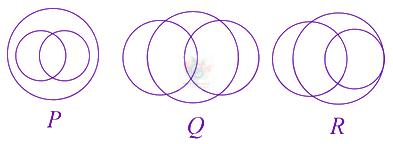
Let $f:R\rightarrow R$ be defined as $f(x+y)+f(x-y)=2f(x)f(y),f(\frac{1}{2})=-1.$ Then the value of $\sum _{k=1}^{20}\frac{1}{\mathrm{sin}(k)\mathrm{sin}(k+f(k))}$ is equal to :
If the functions are defined as $f(x)=\sqrt{x}$ and $g(x)=\sqrt{1-x},$ then what is the common domain of the following functions: $f+g,f-g,f/g,g/f,g-f$, where $(f\pm g)(x)=f(x)\pm g(x),(f/g)(x)=\frac{f(x)}{g(x)}$
If the constant term, in binomial expansion of ${(2{x}^{r}+\frac{1}{{x}^{2}})}^{10}$ is $180,$ then $r$ is equal to ____________.
Let $A={{a}_{ij}}$ be a $3\times 3$ matrix, where ${a}_{ij}={\begin{matrix}{(-1)}^{j-i}\mathrm{if}i<j \\ 2\mathrm{if}i=j \\ {(-1)}^{i+j}\mathrm{if}i>j\end{matrix}$ then $\mathrm{det}(3Adj(2{A}^{-1}))$ is equal to ________.
If the sum of an infinite $\mathrm{GP}$, $a,ar,a{r}^{2},a{r}^{3},\ldots$ is $15$ and the sum of the squares of its each term is $150,$ then the sum of $ar,2a{r}^{4},a{r}^{6},\ldots$ is:
Let $S={n\in N,{(\begin{matrix}0 & i \\ 1 & 0\end{matrix})}^{n}(\begin{matrix}a & b \\ c & d\end{matrix})=(\begin{matrix}a & b \\ c & d\end{matrix})\forall a,b,c,d\in R},$ where $i=\sqrt{-1}.$ Then the number of $2-$ digit numbers in the set $S$ is
Let ${S}_{n}$ be the sum of the first $n$ terms of an arithmetic progression. If ${S}_{3n}=3{S}_{2n}$, then the value of $\frac{{S}_{4n}}{{S}_{2n}}$ is :
Let $A=[\begin{matrix}0 & 1 & 0 \\ 1 & 0 & 0 \\ 0 & 0 & 1\end{matrix}].$ Then the number of $3\times 3$ matrices $B$ with entries from the set ${1,2,3,4,5}$ and satisfying $AB=BA$ is ________.
If $a+\alpha =1,b+\beta =2$ and $af(x)+\alpha f(\frac{1}{x})=bx+\frac{\beta }{x},x\neq 0,$ then the value of the expression $\frac{f(x)+f(\frac{1}{x})}{x+\frac{1}{x}}$ is ___________.
The least positive integer $n$ such that $\frac{(2i{)}^{n}}{(1-i{)}^{n-2}},i=\sqrt{-1},$ is a positive integer, is ______.
Let $A=[\begin{matrix}1 & 0 & 0 \\ 0 & 1 & 1 \\ 1 & 0 & 0\end{matrix}].$ Then ${A}^{2025}-{A}^{2020}$ is equal to
Let $A={n\in N:n$ is a $3-$digit number$}$ $B={9k+2:k\in N}$ and $C={9k+l:k\in N}$ for some $l(0<l<9)$. If the sum of all the elements of the set $A\cap (B\cup C)$ is $274\times 400,$ then $l$ is equal to
If $A=[\begin{matrix}\frac{1}{\sqrt{5}} & \frac{2}{\sqrt{5}} \\ \frac{-2}{\sqrt{5}} & \frac{1}{\sqrt{5}}\end{matrix}],B=[\begin{matrix}1 & 0 \\ i & 1\end{matrix}],i=\sqrt{-1}$, and $Q={A}^{T}BA$, then the inverse of the matrix $A{Q}^{2021}{A}^{T}$ is equal to:
The number of elements in the set {$A=[\begin{matrix}a & b \\ 0 & d\end{matrix}]:a,b,d\in {-1,0,1}$ and $(I-A{)}^{3}=I-{A}^{3}$}, where $I$ is $2\times 2$ identity matrix, is .
If the matrix $A=[\begin{matrix}0 & 2 \\ K & -1\end{matrix}]$ satisfies $A({A}^{3}+3I)=2I,$ then the value of $K$ is
If the arithmetic mean and the geometric mean of the ${p}^{\mathrm{th}}$ and ${q}^{\mathrm{th}}$ terms of the sequence $-16,8,-4,2,\ldots$ satisfy the equation $4{x}^{2}-9x+5=0$, then $p+q$ is equal to _______.
The number of elements in the set ${x\in R:(|x|-3)|x+4|=6}$ is equal to
The number of real roots of the equation ${e}^{4x}-{e}^{3x}-4{e}^{2x}-{e}^{x}+1=0$ is equal to
If the matrix $A=[\begin{matrix}1 & 0 & 0 \\ 0 & 2 & 0 \\ 3 & 0 & -1\end{matrix}]$ satisfies the equation ${A}^{20}+\alpha {A}^{19}+\beta A=[\begin{matrix}1 & 0 & 0 \\ 0 & 4 & 0 \\ 0 & 0 & 1\end{matrix}]$ for some real numbers $\alpha$ and $\beta$, then $\beta -\alpha$ is equal to ______.
Let $A+2B=[\begin{matrix}1 & 2 & 0 \\ 6 & -3 & 3 \\ -5 & 3 & 1\end{matrix}]$ and $2A-B=[\begin{matrix}2 & -1 & 5 \\ 2 & -1 & 6 \\ 0 & 1 & 2\end{matrix}].$ If $Tr(A)$ denotes the sum of all diagonal elements of the matrix $A,$ then $Tr(A)-Tr(B)$ has value equal to