JEE Main Mathematics — Algebra previous year questions with solutions.
Let a complex number be $w=1-\sqrt{3}i$. Let another complex number $z$ be such that $|zw|=1$ and $\mathrm{arg}(z)-\mathrm{arg}(w)=\frac{\pi }{2}$. Then the area of the triangle (in sq. units) with vertices origin, $z$ and $w$ is equal to
$\frac{1}{{3}^{2}-1}+\frac{1}{{5}^{2}-1}+\frac{1}{{7}^{2}-1}+\ldots +\frac{1}{(201{)}^{2}-1}$ is equal to
In an increasing geometric series, the sum of the second and the sixth term is $\frac{25}{2}$ and the product of the third and fifth term is $25.$ Then, the sum of ${4}^{th},{6}^{th}$ and ${8}^{th}$ terms is equal to:
In a school, there are three types of games to be played. Some of the students play two types of games, but none play all the three games. Which Venn diagrams can justify the above statement? 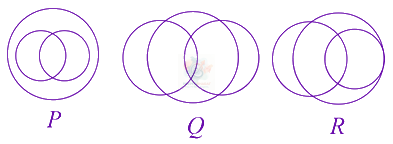
If $A=[\begin{matrix}2 & 3 \\ 0 & -1\end{matrix}],$ then the value of $det({A}^{4})+det({A}^{10}-(Adj(2A){)}^{10})$ is equal to ________.
If $\alpha +\beta +\gamma =2\pi ,$ then the system of equations $x+(\mathrm{cos}\gamma )y+(\mathrm{cos}\beta )z=0$ $(\mathrm{cos}\gamma )x+y+(\mathrm{cos}\alpha )z=0$ $(\mathrm{cos}\beta )x+(\mathrm{cos}\alpha )y+z=0$ has :
If ${a}_{r}=\mathrm{cos}\frac{2r\pi }{9}+i\mathrm{sin}\frac{2r\pi }{9},r=1,2,3,\ldots ,i=\sqrt{-1}$, then the determinant $|\begin{matrix}{a}_{1} & {a}_{2} & {a}_{3} \\ {a}_{4} & {a}_{5} & {a}_{6} \\ {a}_{7} & {a}_{8} & {a}_{9}\end{matrix}|$ is equal to :
If $P=[\begin{matrix}1 & 0 \\ \frac{1}{2} & 1\end{matrix}],$ then ${P}^{50}$ is:
If ${x}^{2}+9{y}^{2}-4x+3=0,x,y\in R,$ then $x$ and $y$ respectively lie in the intervals
If $(\sqrt{3}+i{)}^{100}={2}^{99}(p+iq),$ then $p$ and $q$ are roots of the equation :
If $S={z\in C:\frac{z-i}{z+2i}\in R}$, then
If the system of linear equations $2x+y-z=3$ $x-y-z=\alpha$ $3x+3y+\beta z=3$ has infinitely many solutions, then $|\alpha +\beta -\alpha \beta |$ is equal to __________.
If the system of equations$kx+y+2z=1$ $3x-y-2z=2$ $-2x-2y-4z=3$ has infinitely many solutions, then $k$ is equal to ______ .
If the sum of the coefficients in the expansion of $(x+y{)}^{n}$ is $4096,$ then the greatest coefficient in the expansion is _____.
If the sum of an infinite $\mathrm{GP}$, $a,ar,a{r}^{2},a{r}^{3},\ldots$ is $15$ and the sum of the squares of its each term is $150,$ then the sum of $ar,2a{r}^{4},a{r}^{6},\ldots$ is:
If the sides $AB,BC$ and $CA$ of a triangle $ABC$ have $3,5$ and $6$ interior points respectively, then the total number of triangles that can be constructed using these points as vertices, is equal to:
If the remainder when $x$ is divided by $4$ is $3$, then the remainder when ${(2020+x)}^{2022}$ is divided by $8$ is ___ .
If the real part of the complex number $z=\frac{3+2i\mathrm{cos}\theta }{1-3i\mathrm{cos}\theta },\theta \in (0,\frac{\pi }{2})$ is zero, then the value of ${\mathrm{sin}}^{2}3\theta +{\mathrm{cos}}^{2}\theta$ is equal to ______.
If the real part of the complex number ${(1-\mathrm{cos}\theta +2i\mathrm{sin}\theta )}^{-1}$ is $\frac{1}{5}$ for $\theta \in (0,\pi ),$ then the value of the integral ${\int }_{0}^{\theta }\mathrm{sin}xdx$ is equal to:
If the matrix $A=[\begin{matrix}0 & 2 \\ K & -1\end{matrix}]$ satisfies $A({A}^{3}+3I)=2I,$ then the value of $K$ is
If the matrix $A=[\begin{matrix}1 & 0 & 0 \\ 0 & 2 & 0 \\ 3 & 0 & -1\end{matrix}]$ satisfies the equation ${A}^{20}+\alpha {A}^{19}+\beta A=[\begin{matrix}1 & 0 & 0 \\ 0 & 4 & 0 \\ 0 & 0 & 1\end{matrix}]$ for some real numbers $\alpha$ and $\beta$, then $\beta -\alpha$ is equal to ______.
If the least and the largest real values of $\alpha ,$ for which the equation $z+\alpha |z-1|+2i=0$ $(z\in C\text{and}i=\sqrt{-1})$ has a solution, are $p$ and $q$ respectively; then $4({p}^{2}+{q}^{2})$ is equal to_______.
If the greatest value of the term independent of $x$ in the expansion of ${(x\mathrm{sin}\alpha +a\frac{\mathrm{cos}\alpha }{x})}^{10}$ is $\frac{10!}{{(5!)}^{2}},$ then the value of $a$ is equal to:
If the functions are defined as $f(x)=\sqrt{x}$ and $g(x)=\sqrt{1-x},$ then what is the common domain of the following functions: $f+g,f-g,f/g,g/f,g-f$, where $(f\pm g)(x)=f(x)\pm g(x),(f/g)(x)=\frac{f(x)}{g(x)}$