JEE Main Chemistry — Physical Chemistry previous year questions with solutions.
A flask contains a mixture of compounds $A$ and $B$. Both compounds decompose by first-order kinetics. The half-lives for $A$ and $B$ are $300s$ and $180s$, respectively. If the concentrations of $A$ and $B$ are equal initially, the time required for the concentration of A to be four times that of $B$ (in s) is : $(\mathrm{Use}\mathrm{ln}2=0.693)$
A cylinder containing an ideal gas ( $0.1mol$ of $1.0d{m}^{3}$ ) is in thermal equilibrium with a large volume of $0.5$ molal aqueous solution of ethylene glycol at its freezing point. If the stoppers ${S}_{1}$ and ${S}_{2}$ (as shown in the figure) are suddenly withdrawn, the volume of the gas in litres after equilibrium is achieved will be _____________. (Given, ${K}_{f}(water)=2.0Kkgmo{l}^{-1},R=0.08d{m}^{3}atm{K}^{-1}mo{l}^{-1})$ 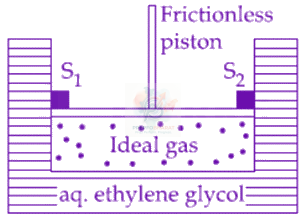
Which one of the following statements regarding Henry's law is not correct?
Which one of the following graphs between molar conductivity $({\Lambda }_{m})$ versus $\sqrt{C}$ is correct?
Which one of the following equations does not correctly represent the first law of thermodynamics for the given processes involving an ideal gas? (Assume non- expansion work is zero)
Which one of the following about an electron occupying the 1s orbital in a hydrogen atom is incorrect? (The Bohr radius is represented by ${a}_{0}$ ).
Which of the graphs shown below does not represent the relationship between incident light and the electron ejected from metal surface?
Which of the following combination of statements is true regarding the interpretation of the atomic orbitals? $(A)$ An electron in an orbital of high angular momentum stays away from the nucleus than an electron in the orbital of lower angular momentum. $(B)$ For a given value of the principal quantum number, the size of the orbit is inversely proportional to the azimuthal quantum number. $(C)$ According to wave mechanics, the ground state angular momentum is equal to $\frac{h}{2\pi }$ . $(D)$ The plot of $\psi$ Vs $r$ for various azimuthal quantum numbers, shows peak shifting towards higher $r$ value.
What would be the molality of 20% (mass/mass) aqueous solution of $KI$ ? (molar mass of $KI=166 g mo{l}^{-1}$ )
What is the work function of the metal if the light of wavelength $4000\overset{o}{A}$ generates photoelectrons of velocity $6\times {10}^{5} {\mathrm{ms}}^{-1}$ from it? (Mass of electron $=9\times {10}^{-31}\mathrm{kg}$, velocity of light $=3\times {10}^{8}{\mathrm{ms}}^{-1}$, Planck's constant $=6.626\times {10}^{-34}\mathrm{Js}$, Charge of electron $=6.626\times {10}^{-34}\mathrm{Js}$)
What is the molar solubility of $AI{(OH)}_{3}$ in $0.2$ $M NaOH$ solution? Given that, solubility product of $\mathrm{Al}{(OH)}_{3}=2.4\times {10}^{-24}$ :
What are the values of $\frac{{K}_{p}}{{K}_{c}}$ for the following reactions at $300 K$ respectively? (At $300 K, \mathrm{RT}=24.62 {\mathrm{dm}}^{2}\mathrm{atm} {\mathrm{mol}}^{-1}$ ) ${N}_{2}(g)+{O}_{2}(g)\rightleftharpoons 2\mathrm{NO}(g)$ ${N}_{2}{O}_{4}(g)\rightleftharpoons 2\mathrm{NO}(g)$ ${N}_{2}(g)+3{H}_{2}(g)\rightleftharpoons 2{\mathrm{NH}}_{3}(g)$
Two solids dissociate as follows: $A(s)\rightleftharpoons B(g)+C(g); {K}_{{P}_{1}}=x {\mathrm{atm}}^{2}$ $D(s)\rightleftharpoons C(g)+E(g); {K}_{{P}_{2}}=y {\mathrm{atm}}^{2}$ The total pressure when both the solids dissociate simultaneously is:
Two blocks of the same metal having same mass and at temperature $\mathrm{T}_{1},$ and $\mathrm{T}_{2}$, respectively, are brought in contact with each other and allowed to attain thermal equilibrium at constant pressure. The change in entropy, $\Delta \mathrm{S}$, for this process is :
The vapour pressures of pure liquids $A$ and $B$are $400$ and $600\mathrm{mm}\mathrm{Hg}$ respectively at $298 K.$On mixing the two liquids, the sum of their volumes is equal to the volume of the final mixture. The mole fraction of liquid $B$ is $0.5$ in the mixture. The vapour pressure of the final solution, the mole fractions of components $A$ and $B$ in the vapour phase, respectively are
The standard reaction Gibbs energy for a chemical reaction at an absolute temperature $\mathrm{T}$ is given by $\Delta \mathrm{G}^{\circ}=\mathrm{A}-\mathrm{BT}$ where A and $B$ are non-zero constants. Which of the following is true about this reaction?
The standard Gibbs energy for the given cell reaction in $kJ mo{l}^{-1}$ at $298 K$ is: $Zn(s)+C{u}^{2+}(aq)\longrightarrow Z{n}^{2+}(aq)+Cu(s)$ , ${E}^{0}=2 V at 298 K$ $(Faraday's constant ,F=96000 C mo{l}^{-1})$
The standard electrode potential ${E}^{o}$ and its temperature coefficient $(\frac{\mathrm{dE}}{\mathrm{dT}})$ for a cell are $2V$ and $-5{\times 10}^{-4} V{K}^{-1}$ at $300 K$, respectively. The reaction is $\mathrm{Zn}(s)+{\mathrm{Cu}}^{2+}(\mathrm{aq})\rightarrow {\mathrm{Zn}}^{2+}(\mathrm{aq})+\mathrm{Cu}(s)$. The standard reaction enthalpy $({\Delta }_{r}{H}^{-})$ at $300K$ in $mo{l}^{-1}$ is $[$Use $R=8J{K}^{-1}{\mathrm{mol}}^{-1}$ and $F=96,500C{\mathrm{mol}}^{-1}]$
The reaction $2 \mathrm{X} \rightarrow \mathrm{B}$ is a zeroth order reaction. If the initial concentration of $\mathrm{X}$ is $0.2 \mathrm{M}$, the half-life is $6 \mathrm{~h}$. When the initial concentration of $X$ is $0.5 \mathrm{M}$, the time required to reach its final concentration of $0.2 \mathrm{M}$ will be
The reaction $\mathrm{MgO}(\mathrm{s})+\mathrm{C}(\mathrm{s}) \rightarrow \mathrm{Mg}(\mathrm{s})+\mathrm{CO}(\mathrm{g}),$ for which $\Delta \mathrm{H}^{\circ}=+491.1 \mathrm{~kJ} \mathrm{~mol}^{-1}$ and $\Delta \mathrm{S}^{\circ}=198.0 \mathrm{JK}^{-1} \mathrm{~mol}^{-1}$ is not feasible at $298 \mathrm{~K}$. Temperature above which reaction will be feasible is
The ratio of the shortest wavelength of two spectral series of hydrogen spectrum is found to be about $9$. The spectral series are:
The quantum number of four electrons are given below: $I. n=4, l=2, {m}_{l}=–2, {m}_{s}=–1/2$ $II. n=3, l=2, {m}_{l}=1, {m}_{s}=+1/2$ $III. n=4, l=1, {m}_{l}=0, {m}_{s}=+1/2$ $IV. n=3, l=1, {m}_{l}=1, {m}_{s}=–1/2$ The correct order of their increasing energies will be:
The process with negative entropy change is:
The percentage composition of carbon by mole in methane is: