JEE Main Chemistry — Physical Chemistry previous year questions with solutions.
$100\mathrm{mL}$ of $0.1M\mathrm{HCl}$ is taken in a beaker and to it $100\mathrm{mL}$ $0.1M\mathrm{NaOH}$ of is added in steps of $2\mathrm{mL}$ and the $\mathrm{pH}$ is continuously measured. Which of the following graphs correctly depicts the change in $\mathrm{pH}$ ?
$250\mathrm{mL}$ of a waste solution obtained from the workshop of a goldsmith contains $0.1M{\mathrm{AgNO}}_{3}$ and $0.1M\mathrm{AuCl}$. The solution was electrolyzed at $2V$ by passing a current of $1A$ for $15$ minutes. The metal/metals electrodeposited will be : $({\text{E}}_{{\text{Ag}}^{+}/\text{Ag}}^{0}=0.80\text{V},{\text{E}}_{{\text{Au}}^{+}/\text{Au}}^{0}=1.69\text{V})$
The volume strength of $8.9{\mathrm{MH}}_{2}{O}_{2}$ solution calculated at $273K$ and 1 atm is $........(R=0.0821L\mathrm{atm}{K}^{-1}{\mathrm{mol}}^{-1})$ (rounded off to the nearest integer)
For the following reactions $\text{A}\overset{700\text{K}}{\rightarrow }\text{Product}$ $\text{A}\overset{500\text{K}}{\underset{\text{catalyst}}{\rightarrow }}\text{Product}$ It was found that the ${E}_{a}$ is decreased by $30 KJ/mol$ in the presence of catalyst. If the rate remains unchanged, the activation energy for catalysed reaction is (Assume pre-exponential factor is same)
At constant volume, $4mol$ of an ideal gas when heated from $300K$ to $500K$ changes its internal energy by $5000J.$ The molar heat capacity at constant volume is ________
The magnitude of work done by a gas that undergoes a reversible expansion along the path $ABC$ shown in the figure is _________. 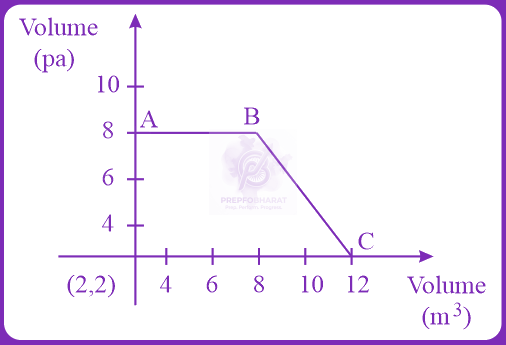
For the reaction; $A(l)\rightarrow 2B(g)$ $\Delta U=2.1kcal,\Delta S=20cal{K}^{-1}$ at $300K.$ Hence $\Delta G$ in $kcal$ is _____________.
The internal energy change (in $J$) when $90g$ of water undergoes complete evaporation at $100^{\circ}C$ is .............. (Given : ${\Delta H}_{\mathrm{vap}}$ for water at $373K=41\mathrm{kJ}/\mathrm{mol}$, $R=8.314{\mathrm{JK}}^{-1}{\mathrm{mol}}^{-1}$)
If $75%$ of a first order reaction was completed in $90$ minutes, $60%$ of the same reaction would be completed in approximately (in minutes) _____ (Take: $\mathrm{log}2=0.30;\mathrm{log}2.5=0.40$)
For a reaction $X+Y=2Z,1.0\mathrm{mol}$ of $X,1.5\mathrm{mol}$ of $Y$ and $0.5\mathrm{mol}$ of $Z$ were taken in a $1L$ vessel and allowed to react. At equilibrium, the concentration of $Z$ was $1.0{\mathrm{molL}}^{-1}$. the equilibrium constant of the reaction is $\ldots \ldots \ldots \ldots \frac{x}{15}.$ The value of x is $\ldots \ldots .$
Given that the standard potentials $({E}^{o})$ of ${\mathrm{Cu}}^{2+}/\mathrm{Cu}$ and ${\mathrm{Cu}}^{+}/\mathrm{Cu}$ are $0.34V$ and $0.522V$ respectively, the ${E}^{o}$ of ${\mathrm{Cu}}^{2+}/{\mathrm{Cu}}^{+}$ is:
The strength of an aqueous $NaOH$ solution is most accurately determined by titrating: (Note: consider that an appropriate indicator is used)
If the equilibrium constant for $A\rightleftharpoons B+C$ is ${K}_{\mathrm{eq}}^{(1)}$ and that of $B+C\rightleftharpoons P$ is ${K}_{\mathrm{eq}}^{(2)},$ the equilibrium constant for $A\rightleftharpoons P$ is :
A flask contains a mixture of compounds $A$ and $B$. Both compounds decompose by first-order kinetics. The half-lives for $A$ and $B$ are $300s$ and $180s$, respectively. If the concentrations of $A$ and $B$ are equal initially, the time required for the concentration of A to be four times that of $B$ (in s) is : $(\mathrm{Use}\mathrm{ln}2=0.693)$
Lattice enthalpy and enthalpy of solution of $\mathrm{NaCl}$ are $788{\mathrm{kJmol}}^{-1}$and $4kJmol{}^{-1}$, respectively. The hydration enthalpy of $NaCl$is:
A set of solutions is prepared using $180g$ of water as a solvent and $10g$ of different non-volatile solutes $A,B$ and $C$. The relative lowering of vapour pressure in the presence of these solutes are in the order [Given, molar mass of $A=100g{\mathrm{mol}}^{-1};B=200g{\mathrm{mol}}^{-1};C=10,000g{\mathrm{mol}}^{-1}$]
Arrange the following solutions in the decreasing order of pOH : (A) $0.01\mathrm{MHCl}$ (B) $0.01\mathrm{MNaOH}$ (C) $0.01{\mathrm{MCH}}_{3}\mathrm{COONa}$ (D) $0.01\mathrm{MNaCl}$
The mole fraction of glucose $({C}_{6}{H}_{12}{O}_{6})$ in an aqueous binary solution is $0.1.$ The mass percentage of water in it, to the nearest integer, is $\ldots \ldots \ldots$
In the sixth period, the orbitals that are filled are :
The variation of molar conductively with concentration of an electrolyte (X) in aqueous solution is shown in the given figure. 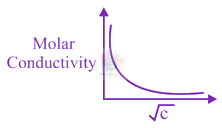 The electrolyte X is :
If $250{\mathrm{cm}}^{3}$of an aqueous solution containing $0.73g$ of a protein $A$ is isotonic with one litre of another aqueous solution containing $1.65g$ of a protein $B,$ at $298K$, the ratio of the molecular masses of $A$ and $B$ is $___________\times {10}^{-2}$ (to the nearest integer).
For the given cell; $\mathrm{Cu}(s)|{\mathrm{Cu}}^{2+}({C}_{1}M)||{\mathrm{Cu}}^{2+}({C}_{2}M)|\mathrm{Cu}(s)$ change in Gibbs energy $(\Delta G)$ is negative, it :
For the reaction $2{H}_{2}(g)+2NO(g)\rightarrow {N}_{2}(g)+2{H}_{2}O(g)$ the observed rate expression is, rate $={k}_{f}{[\mathrm{NO}]}^{2}[{H}_{2}]$ . The rate expression for the reverse reaction is:
The correct statement about probability density (except at infinite distance from nucleus) is :