JEE Main Chemistry — Physical Chemistry previous year questions with solutions.
During the nuclear explosion, one of the products is ${}^{90}Sr$ with half life of $6.93$ years. If $1\mu g$ of ${}^{90}Sr$ was absorbed in the bones of a newly born baby in place of $Ca,$ how much time, in years, is required to reduce it by $90%$ if it is not lost metabolically ____________.
How much amount of $NaCl$ should be added to $600g$ of water $(\rho =1.00g/mL)$ to decrease the freezing point of water to $-0.2{}^{o}C$? ________. (The freezing point depression constant for water $=2 K kg{mol}^{-1}$ )
For the following Assertion and Reason, the correct option is Assertion (A) : When $\mathrm{Cu}$ (II) and sulphide ions are mixed, they react together extremely quickly to give a solid. Reason (R) : The equilibrium constant of ${\mathrm{Cu}}^{2+}(\mathrm{aq})+{S}^{2-}(\mathrm{aq})\rightleftharpoons \mathrm{Cus}(s)$ is high because the solubility product is low.
Henry's constant (in kbar) for four gases $\alpha ,\beta ,\gamma$ and $\delta$ in water at $298K$ is given below : $\begin{matrix} & \alpha & \beta & \gamma & \delta \\ {K}_{H} & 50 & 2 & 2\times {10}^{-5} & 0.5\end{matrix}$ (density of water $={10}^{3}k{\mathrm{gm}}^{-3}$ at $298K$ ) This table implies that :
The compound that cannot act both as oxidizing and reducing agent is
$3 g$ of acetic acid is added to $250 mL$ of $0.1 MHCl$ and the solution made up to $500 mL$. To $20 mL$ of this solution $\frac{1}{2 }mL$ of $5MNaOH$ is added. The $pH$ of the solution is ________ [Given: $pKa$ of acetic acid $=4.75,$ molar mass of acetic acid $60 g/mol,\mathrm{log}3=0.4771$ , Neglect any changes in volume]
Five moles of an ideal gas at $1$ bar and $298K$ is expanded into vacuum to double the volume. The work done is :
Ferrous sulphate heptahydrate is used to fortify foods with iron. The amount (in grams) of the salt required to achieve $10ppm$ of iron in $100kg$ of wheat is ____________. Atomic weight: $Fe=55.85;S=32.00;O=16.00$
For the reaction $2A+3B+\frac{3}{2}C\rightarrow 3P$, which statement is correct?
The solubility product of $Cr{(OH)}_{3}$ at $298K$ is $6.0\times {10}^{-31}.$ The concentration of hydroxide ions in a saturated solution of $Cr{(OH)}_{3}$ will be
The results given in the below table were obtained during kinetic studies of the following reaction: $2A+B\rightarrow C+D$ <table class="pyq-table"><tbody><tr><td>Experiment</td><td>$[A]/{\mathrm{molL}}^{-1}$</td><td>$[B]/{\mathrm{molL}}^{-1}$</td><td>Initial rate/${\mathrm{molL}}^{-1}{\mathrm{min}}^{-1}$</td></tr><tr><td>I</td><td>$0.1$</td><td>$0.1$</td><td>$6.00\times {10}^{-3}$</td></tr><tr><td>II</td><td>$0.1$</td><td>$0.2$</td><td>$2.40\times {10}^{-2}$</td></tr><tr><td>III</td><td>$0.2$</td><td>$0.1$</td><td>$1.20\times {10}^{-2}$</td></tr><tr><td>IV</td><td>X</td><td>$0.2$</td><td>$7.20\times {10}^{-2}$</td></tr><tr><td>V</td><td>$0.3$</td><td>Y</td><td>$2.88\times {10}^{-1}$</td></tr></tbody></table>X and Y in the given table are respectively :
For the disproportionation reaction $2{\mathrm{Cu}}^{+}(\mathrm{aq})\rightleftharpoons \mathrm{Cu}(s)+{\mathrm{Cu}}^{2+}(\mathrm{aq})$ at $298K,$$\mathrm{ln}K$ (where $K$ is the equilibrium constant) is _______$\times {10}^{-1}$ Given $:(E{^{\circ}}_{{\mathrm{Cu}}^{2+}/{\mathrm{Cu}}^{+}}=0.16VE{^{\circ}}_{{\mathrm{Cu}}^{+}/\mathrm{Cu}}=0.52V\frac{\mathrm{RT}}{F}=0.025)$
An acidic buffer is obtained on mixing:
The redox reaction among the following is
The average molar mass of chlorine is $35.5g{\mathrm{mol}}^{-1}$. The ratio of $\mathrm{Cl}35$ to $\mathrm{Cl}37$ in naturally occurring chlorine is close to :
An open beaker of water in equilibrium with water vapour is in a sealed container. When a few grams of glucose are added to the beaker of water, the rate at which water molecules :
The mass of ammonia in grams produced when $2.8\mathrm{kg}$ of dinitrogen quantitatively reacts with $1\mathrm{kg}$ of dihydrogen is _____
An oxidation-reduction reaction in which 3 electrons are transferred has a ${\Delta G}^{0}$ of $17.37\mathrm{kJ}{\mathrm{mol}}^{-1}$ at $25^{\circ}C.$ The value of ${E}_{\mathrm{cell}}^{o}$ (in V) is $_______\times {10}^{-2}$. $(1F=96500C{\mathrm{mol}}^{-1})$
The stoichiometry and solubility product of a salt with the solubility curve given below is, respectively: 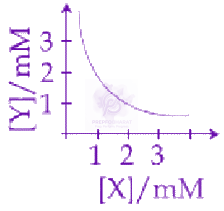
For a dimerization reaction, $2A(g)\rightarrow {A}_{2}(g)$ at $298K,\Delta {U}^{-}=-20{\mathrm{kJmol}}^{-1},\Delta {S}^{-}=-30{\mathrm{JK}}^{-1}{\mathrm{mol}}^{-1}$,then the $\Delta {G}^{-}$ will be …..J.
For the equilibrium $A\rightleftharpoons B$, the variation of the rate of the forward (a) and reverse (b) reaction with time is given by:
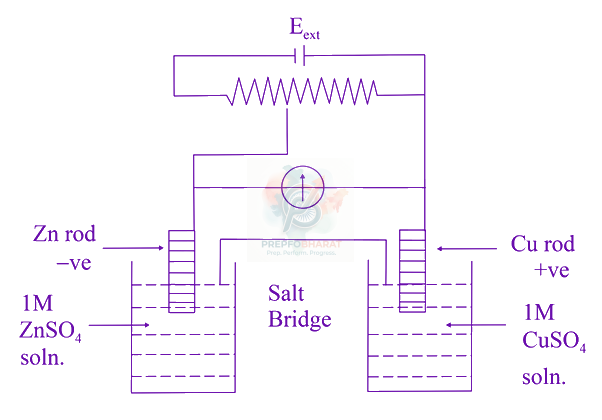 ${E}_{{\mathrm{Cu}}^{2+}|\mathrm{Cu}}^{0}=+0.34V$ ${E}_{{\mathrm{Zn}}^{2+}|\mathrm{Zn}}^{0}=-0.76V$ Identify the incorrect statement from the options below for the above cell:
The elevation of boiling point of $0.10m$ aqueous ${\mathrm{CrCl}}_{3}.{\mathrm{xNH}}_{3}$ solution is two times that of $0.05m$ aqueous ${\mathrm{CaCl}}_{2}$ solution. The value of $x$ is $\ldots \ldots \ldots \ldots ..$ [Assume $100%$ ionisation of the complex and ${\mathrm{CaCl}}_{2},$ coordination number of $\mathrm{Cr}$ as $6,$ and that all ${\mathrm{NH}}_{3}$ molecules are present inside the coordination sphere]
The ratio of the mass percentages of '$C$ & $H$' and '$C$ & $O$' of a saturated acyclic organic compound '$X$' are $4:1$ and $3:4$ respectively. Then, the moles of oxygen gas required for complete combustion of two moles of organic compound '$X$' is_______