JEE Main Chemistry — Physical Chemistry previous year questions with solutions.
The number of subshells associated with $n=4$ and $m=-2$ quantum numbers is:
The Gibbs energy change (in $J$) for the given reaction at $[{\mathrm{Cu}}^{2+}]=[{\mathrm{Sn}}^{2}+]=1\text{ M}$ and $298K$ is : $\mathrm{Cu}(s)+{\mathrm{Sn}}^{2+}(\mathrm{aq}.)\rightarrow {\mathrm{Cu}}^{2+}(\mathrm{aq}.)+\mathrm{Sn}(s)$; $({E}_{{\mathrm{Sn}}^{2+}|\mathrm{Sn}}^{0}=-0.16 V, {E}_{{\mathrm{Cu}}^{2+}|\mathrm{Cu}}^{0}=0.34 V,$Take $F=96500 C {\mathrm{mol}}^{-1})$
Consider the following reaction: ${N}_{2}{O}_{4}(g)=2{\mathrm{NO}}_{2}(g):\Delta {H}^{0}=+58k$ For each of the following cases $(a,b)$, the direction in which the equilibrium shifts is: (a) Temperature is decreased. (b) Pressure is increased by adding ${N}_{2}$ at constant T.
The number of orbitals associated with quantum numbers $n=5,{m}_{s}=+\frac{1}{2}$ is:
At $300K$, the vapour pressure of a solution containing $1$ mole of $n$ -hexane and $3$ moles of $n$ -heptane is $550\mathrm{mm}$ of $\mathrm{Hg}$. At the same temperature, if one more mole of $n$ -heptane is added to this solution, the vapour pressure of the solution increases by $10\mathrm{mm}$ of $\mathrm{Hg}$. What is the vapour pressure in $\mathrm{mmHg}$ of $n$ - heptane in its pure state______?
Potassium chlorate is prepared by the electrolysis of $\mathrm{KCl}$ in basic solution $6{\mathrm{OH}}^{-}+{\mathrm{Cl}}^{-}\rightarrow {\mathrm{ClO}}_{3}^{-}+3{H}_{2}O+6{e}^{-}$ . If only $60%$ of the current is utilized in the reaction, the time (rounded to the nearest hour) required to produce$10g$ of ${\mathrm{KClO}}_{3}$ using a current of $2A$ is $\ldots \ldots ..$ (Given :$F=96,500C$$\mathrm{mol}$; molar mass of ${\mathrm{KClO}}_{3}=122g{\mathrm{mol}}^{-1}$)
The ${K}_{sp}$ for the following dissociation is $1.6\times {10}^{-5}$ ${PbCl}_{2(s)}\rightleftharpoons P{b}_{(aq)}^{2+}+2C{l}_{(aq)}^{-}$ Which of the following choices is correct for a mixture of $300mL 0.134 MPb{(N{O}_{3})}_{2}$ and $100mL$ $0.4 M NaCl?$
The number of molecules with energy greater than the threshold energy for a reaction increases five fold by a rise of temperature from ${27}^{o}C$ to ${42}^{o}C$. Its energy of activation in $J/\mathrm{mol}$ is _________ (Take $\mathrm{ln}5=1.6094;R=8.314J{\mathrm{mol}}^{-1}$)
A sample of milk splits after $60min$ . at $300K$ and after $40min$ . at $400K$ when the population of Iactobacillus acidophilus in it doubles. The activation energy (in $\mathrm{kJ}/\mathrm{mol}$ ) for this process is closest to ______________. (Given, $R=8.3Jmo{l}^{-1}{K}^{-1},ln(\frac{2}{3})=0.4,{e}^{-3}=4.0$ )
Among $(a)-(d),$ the complexes that can show geometrical isomerism are: $(a)$ ${[Pt{(N{H}_{3})}_{3}Cl]}^{+}$ $(b)$ ${[Pt(N{H}_{3})C{l}_{5}]}^{-}$ $(c)$ $[Pt{(N{H}_{3})}_{2}Cl(N{O}_{2})]$ $(d)$ ${[Pt{(N{H}_{3})}_{4}ClBr]}^{2+}$
The work function of sodium metal is $4.41\times {10}^{-19}J.$ If photons of wavelength $300\mathrm{nm}$ are incident on the metal, the kinetics energy of the ejected electrons will be $(h=6.63\times {10}^{-34}Js;c=3\times {10}^{8}m{s}^{-1})$__________$\times {10}^{-21}J$
The heat of combustion of ethanol into carbon dioxides and water is $-327$ Kcal at constant pressure. The heat evolved (in cal) at constant volume at $27^{\circ}C$ (if all gases behave ideally) is $(R=2{\mathrm{calmol}}^{-1}{K}^{-1})$________
The photoelectric current from Na (work function, ${w}_{0}=2.3\mathrm{eV}$) is stopped by the output voltage of the cell $\mathrm{Pt}(s)\|{H}_{2}(g,1\mathrm{bar})|\mathrm{HCl}(\mathrm{aq}\cdot ,\mathrm{pH}=1)|\mathrm{AgCl}(s)\mid \mathrm{Ag}(s)$ the $pH$ of aq. $\mathrm{HCl}$ required to stop the photoelectric current from $K({w}_{0}=2.25\mathrm{eV})$, all other conditions remaining the same, is $\ldots \ldots \ldots .\times {10}^{-2}$ (to the nearest integer). Given $2.303\frac{\mathrm{RT}}{F}=0.06V;{E}_{\mathrm{AgCl}/\mathrm{Ag}/Cl}^{0}=0.22V$
At $35{}^{o}C,$ the vapour pressure of $C{S}_{2},$ is $512mm$ Hg and that of acetone is $144mmHg.$ A solution of $C{S}_{2}$ in acetone has a total vapour pressure of $600 mmHg$ . The false statement amongst the following is:
For an electrochemical cell $\mathrm{Sn}(s)|{\mathrm{Sn}}^{2}+(\mathrm{aq}, 1M)||{\mathrm{Pb}}^{2+}(\mathrm{aq}, 1M)|\mathrm{Pb}(s)$ the ratio $\frac{[{\mathrm{Sn}}^{2+}]}{[{\mathrm{Pb}}^{2+}]}$ when this cell attains equilibrium is _______ (Given: ${E}_{{\mathrm{Sn}}^{2+}|\mathrm{Sn}}^{0}=-0.14 V,{E}_{{\mathrm{Pb}}^{2+}|\mathrm{Pb}}^{0}=-0.13 V, \frac{2.303\mathrm{RT}}{F}=0.06$)
Consider the following reactions $A\rightarrow P1;B\rightarrow P2;C\rightarrow P3;D\rightarrow P4$ The order of the above reactions are $a,b,c\mathrm{and}d,$respectively. The following graph is obtained when log[rate] vs.log[conc.] are plotted: 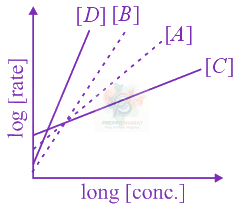 Among the following, the correct sequence for the order of the reactions is :
The rate of a certain biochemical reaction at physiological temperature $(T)$ occurs ${10}^{6}$ times faster with enzyme than without. The change in the activation energy upon adding enzyme is:
The oxidation states of transition metal atoms in ${K}_{2}{\mathrm{Cr}}_{2}{O}_{7},{\mathrm{KMnO}}_{4}$ and ${K}_{2}{\mathrm{FeO}}_{4},$ respectively, are $x,y$ and $z$ . The sum of $x,y$ and $z$ is______
The de Broglie wavelength of an electron in the ${4}^{th}$ Bohr orbit is:
Two solutions, $A$ and $B,$ each of $100L$ was made by dissolving $4g$ of $NaOH$ and $9.8g$ of ${H}_{2}S{O}_{4}$ in water, respectively. The $pH$ of the resultant solution obtained from mixing $40L$ of solution $A$ and $10L$ of solution $B$ is ____________. $(\mathrm{log}2=0.3)$
Consider the hypothetical situation where the azimuthal quantum number, $l$, takes values $0,1,2,\ldots \ldots ..n+1$. Where n is the principal quantum number. Then, the element with atomic number:
The rate of a reaction decreased by $3.555$ times when the temperature was changed from $40^{\circ}C\mathrm{to}30^{\circ}C$. the activation energy (in $\mathrm{kJ}{\mathrm{mol}}^{-1}$) of the reaction is ________ .
The molarity of ${HNO}_{3}$ in a sample which has density $1.4g/mL$ and mass percentage of $63%$ is ________ (Molecular Weight of ${HNO}_{3}=63$ )
The osmotic pressure of a solution of $\mathrm{NaCl}$ is $0.10$ atm and that of a glucose solution is $0.20$ atm. The osmotic pressure of a solution formed by mixing $1L$ of the sodium chloride solution with $2L$ of the glucose solution is $x\times {10}^{-3}$ atm. $x$ is ________ (nearest integer)