JEE Main Chemistry — Physical Chemistry previous year questions with solutions.
A solution of two components containing ${n}_{1}$ moles of the ${1}^{\text{st }}$ component and ${n}_{2}$moles of the ${2}^{\text{nd }}$ component is prepared. ${M}_{1}$ and ${M}_{2}$ are the molecular weights of component 1 and 2 respectively. If $d$ is the density of the solution in ${\mathrm{gmI}}^{-1},{C}_{2}$ is the molarity and ${x}_{2}$ is the mole fraction of the ${2}^{\text{nd }}$ component, then ${C}_{2}$ can be expressed as :
If enthalpy of atomization for $B{r}_{2}(l)$ is $x kJ/mol$ and bond enthalpy for $B{r}_{2}$ is $y kJ/mol$, the relation between them
The rate constant $(k)$ of a reaction is measured at different temperature $(T)$, and the data are plotted in the given figure. the activation energy of the reaction in ${\mathrm{kJmol}}^{-1}$ is : $(R$ is gas constant) 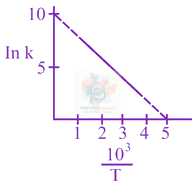
The region in the electromagnetic spectrum where the Balmer series lines appear is:
The value of ${K}_{c}\mathrm{us}64\mathrm{at}800K$ for the reaction ${N}_{2}(g)+3{H}_{2}(g)\rightarrow 2{\mathrm{NH}}_{3}(g)$ The value of ${K}_{c}$ for the following reaction is : ${\mathrm{NH}}_{3}(g)\rightarrow \frac{1}{2}{N}_{2}(g)+\frac{3}{2}{H}_{2}(g)$
$0.023\times {10}^{22}$ molecules are present in $10g$of a substance $x''.$ The molarity of a solution containing $5g$ of substance 'x' in 2 L solution is $_________\times {10}^{-3}$
A $100\mathrm{mL}$ solution was made by adding $1.43g$ of ${\mathrm{Na}}_{2}{\mathrm{CO}}_{3}.{\mathrm{xH}}_{2}O.$ The normality of the solution is $0.1N$. The value of $x$ is _______ (The atomic mass of $\mathrm{Na}$ is $23g/\mathrm{mol}$)
For a reaction $4M(s)+{\mathrm{nO}}_{2}(g)\rightarrow 2{M}_{2}{O}_{n}(s)$ The free energy change is plotted as a function of temperature. The temperature below which the oxide is stable could be inferred from the plot as the point at which :
A $20.0\mathrm{mL}$ solution containing $0.2g$ impure ${H}_{2}{O}_{2}$ reacts completely with $0.316g$ of ${\mathrm{KMnO}}_{4}$ in acid solution. The purity of ${H}_{2}{O}_{2}$ (in $%$) is______ (mol. wt. of ${H}_{2}{O}_{2}=34$; mol. wt. of ${\mathrm{KMnO}}_{4}=158$)
Consider the following reactions: $\text{NaCl}+{\text{K}}_{2}{\text{Cr}}_{2}{\text{O}}_{7}+\underset{(\text{Conc.})}{{\text{H}}_{2}{\text{SO}}_{4}}\rightarrow (\text{A})+$ side products $(A)+NaOH\rightarrow (B)+$ side products $(B)+\underset{(\text{dilute})}{{H}_{2}S{O}_{4}}+{H}_{2}{O}_{2}\rightarrow (C)+$ side products The sum of the total number of atoms in one molecule each of $(A),(B)$ and $(C)$ is ________
A soft drink was bottled with a partial pressure of ${\mathrm{CO}}_{2}$ of 3 bar over the liquid at room temperature. The partial pressure of ${\mathrm{CO}}_{2}$ over the solution approaches a value of 30 bar when $44g$ of ${\mathrm{CO}}_{2}$ is dissolved in $1\mathrm{kg}$ of water at room temperature. The approximate $\mathrm{pH}$ of the soft drink is ___________$\times {10}^{-1}$. (First dissociation constant of ${H}_{2}{\mathrm{CO}}_{3}=4.0\times {10}^{-7};\mathrm{log}2=0.3;$ density of the soft drink $=1g{\mathrm{mL}}^{-1}$)
The variation of equilibrium constant with temperature is given below : $\begin{matrix}\mathrm{Temperature} & \mathrm{EquilibriumConstant} \\ {T}_{1}=25^{\circ}C & {K}_{1}=10 \\ {T}_{2}=100^{\circ}C & {K}_{2}=100\end{matrix}$ The values of $\Delta H^{\circ},\Delta G^{\circ}$ at ${T}_{1}$ and $\Delta G^{\circ}$ at ${T}_{2}$ (in $\mathrm{kJ}{\mathrm{mol}}^{-1}$ ) respectively, are close to [use $R=8.314{\mathrm{JK}}^{-1}{\mathrm{mol}}^{-1}$]
An acidic solution of dichromate is electrolyzed for 8 minutes using 2 A current. As per the following equation ${\mathrm{Cr}}_{2}{O}_{7}^{2}+14{H}^{+}+6{e}^{-}\rightarrow 2{\mathrm{Cr}}^{3+}+7{H}_{2}O$ The amount of ${\mathrm{Cr}}^{3+}$. obtained was $0.104g$. The efficiency of the process $(\mathrm{in}%)$ is (Take : $F=960000C$, At. mass of chromium $=52$)
For the reaction ${\mathrm{Fe}}_{2}N(s)+\frac{3}{2}{H}_{2}(g)\rightleftharpoons 2\mathrm{Fe}(s)+{\mathrm{NH}}_{3}(g)$
While titration dilute $\mathrm{HCI}$ solution with aqueous $\mathrm{NaOH}$, which of the following will not be required ?
The shortest wavelength of $H$ atom in the Lyman series is ${\lambda }_{1}$. The longest wavelength in the Balmer series of ${\mathrm{He}}^{+}$ is :
The true statement amongst the following is:
The size of a raw mango shrinks to a much smaller size when kept in a concentrated salt solution. Which one of the following process can explain this?
A cylinder containing an ideal gas ( $0.1mol$ of $1.0d{m}^{3}$ ) is in thermal equilibrium with a large volume of $0.5$ molal aqueous solution of ethylene glycol at its freezing point. If the stoppers ${S}_{1}$ and ${S}_{2}$ (as shown in the figure) are suddenly withdrawn, the volume of the gas in litres after equilibrium is achieved will be _____________. (Given, ${K}_{f}(water)=2.0Kkgmo{l}^{-1},R=0.08d{m}^{3}atm{K}^{-1}mo{l}^{-1})$ 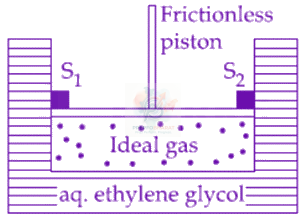
What would be the electrode potential for the given half-cell reaction at $pH=5?_________.$ $2{H}_{2}O\rightarrow {O}_{2}+4\overset{\oplus }{\text{H}}+4{e}^{-};{E}_{red}^{0}=1.23V$ $(R=8.314J{mol}^{-1}{K}^{-1};Temp=298K;oxygen under s\mathrm{tan}dard .atm.pressureof1bar)$
In the figure shown below reactant $A$ (represented by square) is in equilibrium with product $B$ (represented by circle). The equilibrium constant is (approx): 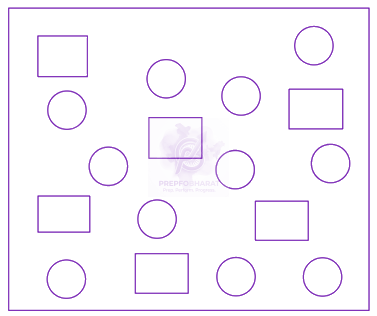
The ammonia $({NH}_{3})$ released on quantitative reaction of $0.6 g$ urea $({NH}_{2}CON{H}_{2})$ with sodium hydroxide $(NaOH)$ can be neutralized by
For the Balmer series, in the spectrum of $H$ atom, $\overset{-}{v}={R}_{H}{\frac{1}{{n}_{1}^{2}}-\frac{1}{{n}_{2}^{2}}},$ the correct statements among $(I)$ to $(IV)$ are, $(I)$ As wavelength decreases, the lines in the series converge. $(II)$ The integer ${n}_{1}$ is equal to $2$/ $(III)$ The lines of the longest wavelength correspond to ${n}_{2}=3$. $(IV)$ The ionization energy of hydrogen can be calculated from the wave number of these lines.
The volume, in $\mathrm{mL}$, of $0.02{\mathrm{MK}}_{2}{\mathrm{Cr}}_{2}{O}_{7}$, solution required to react with $0.288g$ of ferrous oxalate in acidic medium is$\ldots \ldots \ldots \ldots$ (Molar mass of $\mathrm{Fe}=56{\mathrm{gmol}}^{-1}$ )