JEE Main Chemistry — Physical Chemistry previous year questions with solutions.
The osmotic pressure of blood is $7.47$ bar at $300K$. To inject glucose to a patient intravenously, it has to be isotonic with blood. The concentration of glucose solution in ${\mathrm{gL}}^{-1}$ is (Molar mass of glucose $=180g{\mathrm{mol}}^{-1}$, $R=0.083{\mathrm{Lbar}}^{-1}{\mathrm{mol}}^{-1}$) (Nearest integer)
Identify the incorrect statement from the following.
Class $\mathrm{XII}$ students were asked to prepare one litre of buffer solution of $\mathrm{pH}8.26$ by their chemistry teacher. The amount of ammonium chloride to be dissolved by the student in $0.2M$ ammonia solution to make one litre of the buffer is (Given ${\mathrm{pK}}_{b}({\mathrm{NH}}_{3})=4.74;$ Molar mass of ${\mathrm{NH}}_{3}=17g{\mathrm{mol}}^{-1}$. Molar mass of ${\mathrm{NH}}_{4}\mathrm{Cl}=53.5g{\mathrm{mol}}^{-1}$)
When $800\mathrm{mL}$ of $0.5M$ nitric acid is heated in a beaker, its volume is reduced to half and $11.5g$ of nitric acid is evaporated. The molarity of the remaining nitric acid solution is $x\times {10}^{-2}M$. (Molar mass of nitric acid is $63g{\mathrm{mol}}^{-1}$)
Match List - I with List - II. <table class="pyq-table"><tbody><tr><td></td><td>List-I</td><td></td><td>List-II</td></tr><tr><td>$(A)$</td><td>Spontaneous process</td><td>$(I)$</td><td>$\Delta H<0$</td></tr><tr><td>$(B)$</td><td>Process with $\Delta P=0,\Delta T=0$</td><td>$(\mathrm{II})$</td><td>${\Delta G}_{T,P}<0$</td></tr><tr><td>$(C)$</td><td>${\Delta H}_{\mathrm{reaction}}$</td><td>$(\mathrm{III})$</td><td>Isothermal and isobaric process</td></tr><tr><td>$(D)$</td><td>Exothermic Process</td><td>$(\mathrm{IV})$</td><td>[Bond energies of molecules in reactants] - [Bond energies of product molecules]</td></tr></tbody></table>Choose the correct answer from the options given below
A $0.166g$ sample of an organic compound was digested with conc. ${H}_{2}{\mathrm{SO}}_{4}$ and then distilled with $\mathrm{NaOH}$. The ammonia gas evolved was passed through $50.0\mathrm{mL}$ of $0.5N{H}_{2}{\mathrm{SO}}_{4}$. The used acid required $30.0\mathrm{mL}$ of $0.25N\mathrm{NaOH}$ for complete neutralization. The mass percentage of nitrogen in the organic compound is
The cell potential for the following cell $\mathrm{Pt}|{H}_{2}(g)|{H}^{+}(\mathrm{aq})||{\mathrm{Cu}}^{2+}(0.01M)|\mathrm{Cu}(s)$ is $0.576V$ at $298K$. The $\mathrm{pH}$ of the solution is (Nearest integer) (Given : ${E}_{{\mathrm{Cu}}^{2+}/\mathrm{Cu}}^{o}=0.34V$ and $\frac{2.303\mathrm{RT}}{F}=0.06V$)
The activation energy of one of the reactions in a biochemical process is $532611J{\mathrm{mol}}^{-1}$. When the temperature falls from $310K$ to $300K$, the change in rate constant observed is ${k}_{300}=x\times {10}^{-3}{k}_{310^{\circ}}$. The value of $x$ is [Given: $\mathrm{ln}10=2.3R=8.3J{K}^{-1}{\mathrm{mol}}^{-1}$]
When the excited electron of a $H$ atom from $n=5$ drops to the ground state, the maximum number of emission lines observed are
The ${(\frac{\partial E}{\partial T})}_{P}$ of different types of half cells are as follows : $\begin{matrix}A & B & C & D \\ 1\times {10}^{-4} & 2\times {10}^{-4} & 0.1\times {10}^{-4} & 0.2\times {10}^{-4}\end{matrix}$ (Where $E$ is the electromotive force). Which of the above half cells would be preferred to be used as reference electrode
The pair, in which ions are isoelectronic with ${\mathrm{Al}}^{3+}$ is
In $3d$ series, the metal having the highest ${M}^{2+}/M$ standard electrode potential is
The rate constants for decomposition of acetaldehyde have been measured over the temperature range $700-1000K$. The data has been analysed by plotting $\mathrm{lnk}$ vs $\frac{{10}^{3}}{T}$ graph. The value of activation energy for the reaction is ${\mathrm{kJmol}}^{-1}$. (Nearest integer) (Given : $R=8.31J{K}^{-1}{\mathrm{mol}}^{-1}$) 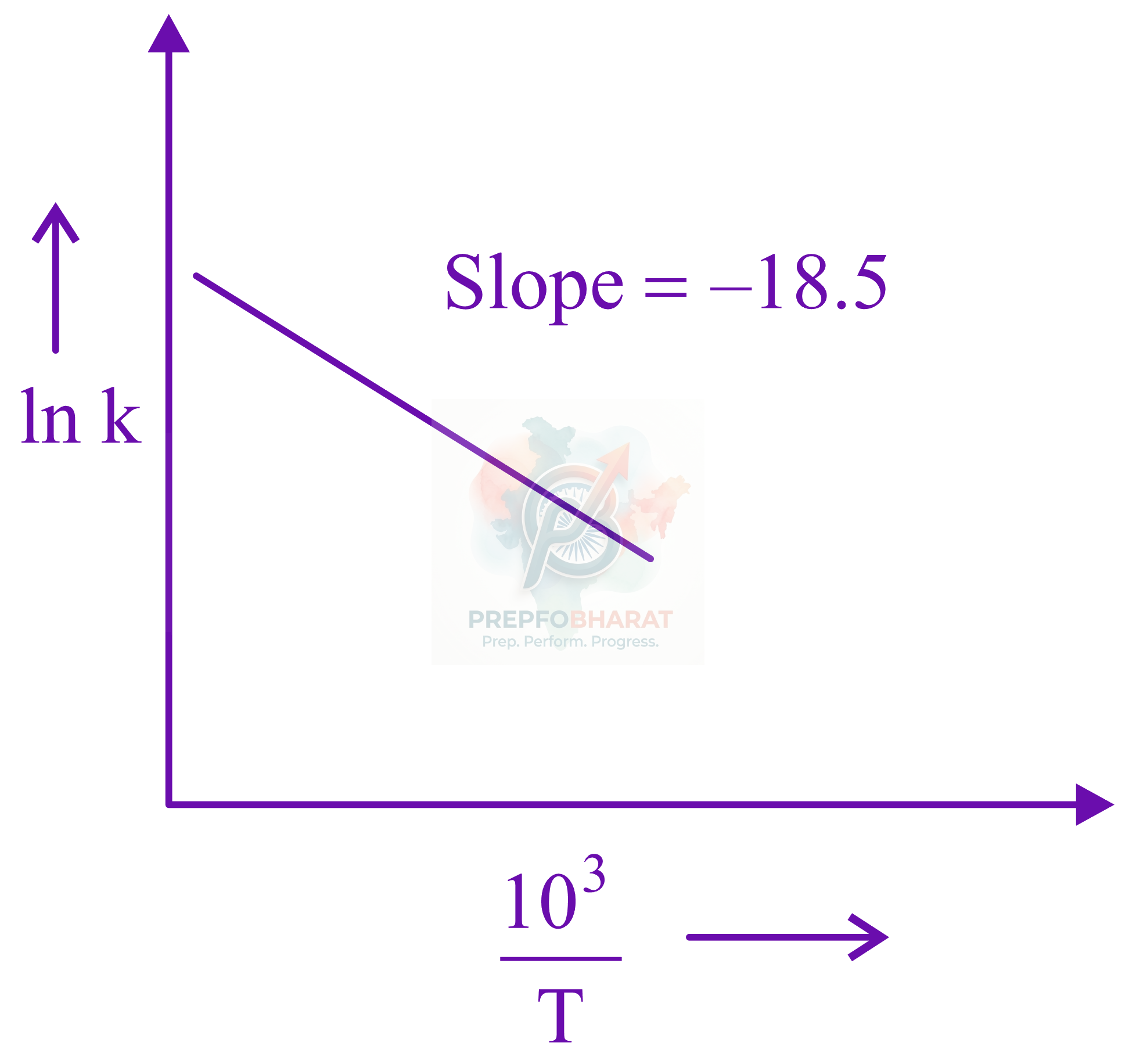
The equation $k=(6.5\times {10}^{12}{s}^{-1}){e}^{-26000K/T}$ is followed for the decomposition of compound $A$. The activation energy for the reaction is ____ $\mathrm{KJ}{\mathrm{mol}}^{-1}$. [nearest integer] (Given: $R=8.314J{K}^{-1}{\mathrm{mol}}^{-1}$)
In the given reaction, $X+Y+3Z⇄{\mathrm{XYZ}}_{3}$ if one mole of each of $X$ and $Y$ with $0.05\mathrm{mol}$ of $Z$ gives compound ${\mathrm{XYZ}}_{3}$. (Given : Atomic masses of $X,Y$ and $Z$ are 10,20 and $30\mathrm{amu}$, respectively). The yield of ${\mathrm{XYZ}}_{3}$ is____$g$.
At $345K$, the half life for the decomposition of a sample of a gaseous compound initially at $55.5\mathrm{kPa}$ was $340s$. When the pressure was $27.8\mathrm{kPa}$, the half life was found to be $170s$. The order of the reaction is - [integer answer]
The molar conductivity of a conductivity cell filled with $10$ moles of $20\mathrm{mL}\mathrm{NaCl}$ solution is ${\Lambda }_{m1}$ and that of $20$ moles another identical cell heaving $80\mathrm{mL}\mathrm{NaCl}$ solution is ${\Lambda }_{m2}$, The conductivities exhibited by these two cells are same. The relationship between ${\Lambda }_{m2}$ and ${\Lambda }_{m1}$ is
The standard electrode potential of hydrogen electrode at pH = 7 is:
Which of the following relation is not correct?
$2{O}_{3}(g)\rightleftharpoons 3{O}_{2}(g)$ At $300K$, ozone is fifty percent dissociated. The standard free energy change at this temperature and $1\mathrm{atm}$ pressure is $(-)......J{\mathrm{mol}}^{-1}$. (Nearest integer) [Given: $\mathrm{ln}1.35=0.3$ and $R=8.3J{K}^{-1}{\mathrm{mol}}^{-1}$]
A student needs to prepare a buffer solution of propanoic acid and its sodium salt with $\mathrm{pH}4$. The ratio of $\frac{[{\mathrm{CH}}_{3}{\mathrm{CH}}_{2}{\mathrm{COO}}^{-}]}{[{\mathrm{CH}}_{3}{\mathrm{CH}}_{2}\mathrm{COOH}]}$ required to make buffer is Given : ${K}_{a}({\mathrm{CH}}_{3}{\mathrm{CH}}_{2}\mathrm{COOH})=1.3\times {10}^{-5}$
On complete combustion $0.30g$ of an organic compound gave $0.20g$ of carbon dioxide and $0.10g$ of water. The percentage of carbon in the given organic compound is____(Nearest Integer)
'$x$' $g$ of molecular oxygen $({O}_{2})$ is mixed with $200g$ of neon $(\mathrm{Ne})$. The total pressure of the nonreactive mixture of ${O}_{2}$ and $\mathrm{Ne}$ in the cylinder is $25$ bar. The partial pressure of $\mathrm{Ne}$ is $20$ bar at the same temperature and volume. The value of '$x$' is [Given: Molar mass of ${O}_{2}=32g{\mathrm{mol}}^{-1}$. Molar mass of $\mathrm{Ne}=20g{\mathrm{mol}}^{-1}$]
A company dissolves '$x$' amount of ${\mathrm{CO}}_{2}$ at $298K$ in $1$ litre of water to prepare soda water. $X=\times {10}^{-3}g$. (nearest integer) (Given: partial pressure of ${\mathrm{CO}}_{2}$ at $298K=0.835$ bar. Henry's law constant for ${\mathrm{CO}}_{2}$ at $298K=1.67\mathrm{kbar}$. Atomic mass of $H,C$ and $O$ is $1,12$, and $6g{\mathrm{mol}}^{-1}$, respectively)