JEE Main Chemistry — Physical Chemistry previous year questions with solutions.
For a reaction, given below is the graph of $\mathrm{lnk}\mathrm{vs}\frac{1}{T}$. The activation energy for the reaction is equal to____$\mathrm{cal}{\mathrm{mol}}^{-1}$.(Given : $R=2{\mathrm{calK}}^{-1}{\mathrm{mol}}^{-1}$) 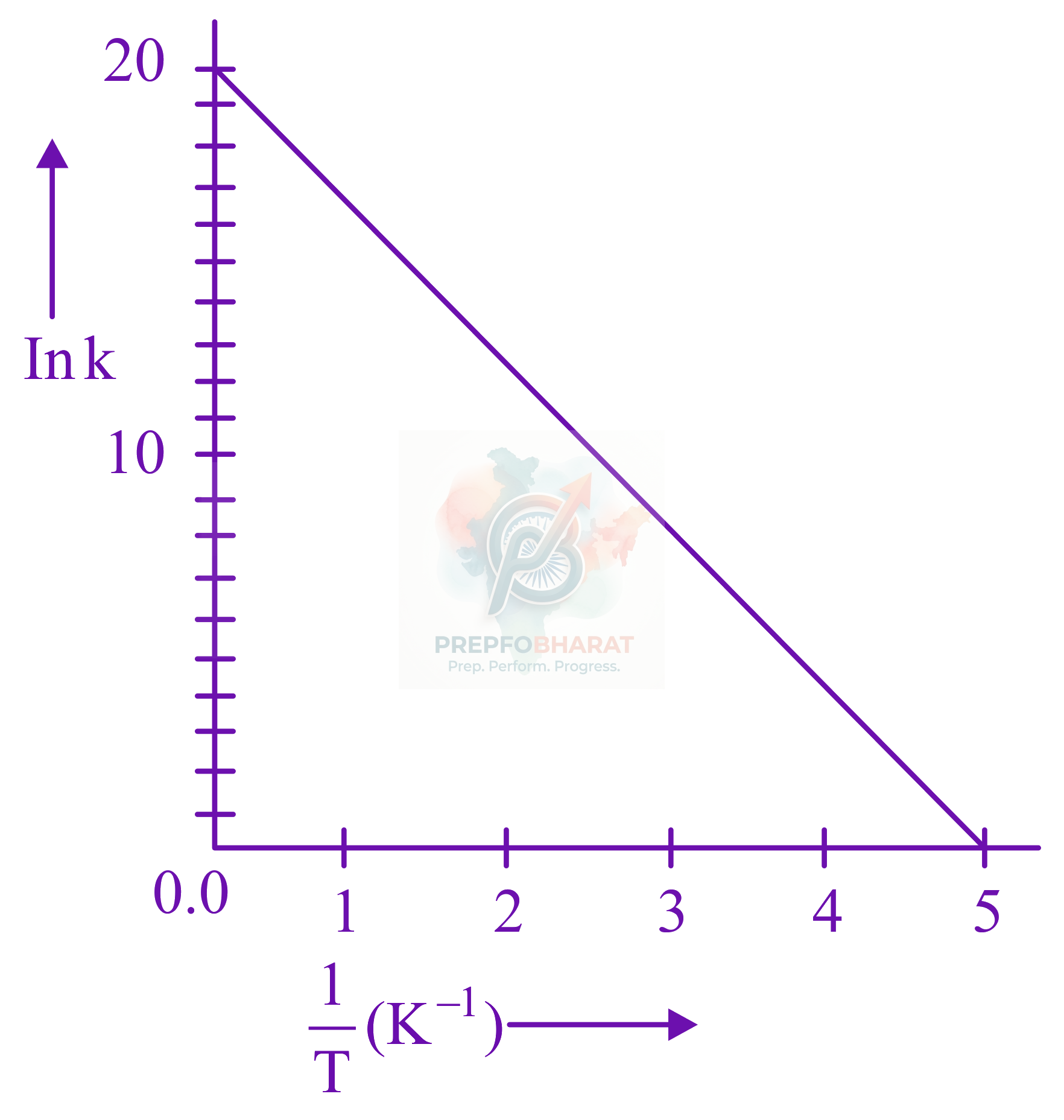
$120g$ of an organic compound which contains only carbon and hydrogen on complete combustion gives $330g$ of ${\mathrm{CO}}_{2}$ and $270g$ of water. The percentage of carbon and hydrogen in the organic compound are respectively
$250g$ solution of $D$-glucose in water contains $10.8%$ of carbon by weight. The molality of the solution is nearest to (Given: Atomic Weights are $H=1u;C=12u;O=16u$)
${\mathrm{SO}}_{2}{\mathrm{Cl}}_{2}$ on reaction with excess of water results into acidic mixture ${\mathrm{SO}}_{2}{\mathrm{Cl}}_{2}+2{H}_{2}O\rightarrow {H}_{2}{\mathrm{SO}}_{4}+2\mathrm{HCl}$ $16$ moles of $\mathrm{NaOH}$ is required for the complete neutralisation of the resultant acidic mixture. The number of moles of ${\mathrm{SO}}_{2}{\mathrm{Cl}}_{2}$ used is
Which of the given reactions is not an example of disproportionation reaction?
Which one of the following is an example of disproportionation reaction?
For the reaction given below: ${\mathrm{CoCl}}_{3}.{\mathrm{xNH}}_{3}+{\mathrm{AgNO}}_{3}(\mathrm{aq})\rightarrow$ If two equivalents of $\mathrm{AgCl}$ precipitate out, then the value of $x$ will be _______
The rate constant for a first order reaction is given by the following equation : $\mathrm{lnk}=33.24-\frac{2.0\times {10}^{4}K}{T}$ The Activation energy for the reaction is given by ${\mathrm{kJmol}}^{-1}$. (In Nearest integer) (Given : $R=8.3J{K}^{-1}{\mathrm{mol}}^{-1}$)
If the uncertainty in velocity and position of a minute particle in space are, $2.4\times {10}^{-26}({\mathrm{ms}}^{-1})$ and ${10}^{-7}(m)$ respectively. The mass of the particle in $g$ is___(Nearest integer) (Given : $h=6.626\times {10}^{-34}\mathrm{Js}$)
At $25^{\circ}C$ and $1\mathrm{atm}$ pressure, the enthalpy of combustion of benzene $(1)$ and acetylene $(g)$ are $-3268\mathrm{kJ}{\mathrm{mol}}^{-1}$ and $-1300\mathrm{kJ}{\mathrm{mol}}^{-1}$, respectively. The change in enthalpy for the reaction $3{C}_{2}{H}_{2}(g)\rightarrow {C}_{6}{H}_{6}(l)$, is
If the work function of a metal is $6.63\times {10}^{-19}J$, the maximum wavelength of the photon required to remove a photoelectron from the metal is____$\mathrm{nm}$. Nearest integer) [Given : $h=6.63\times {10}^{-34}Js$, and $c=3\times {10}^{8}m{s}^{-1}$]
$2L$ of $0.2{\mathrm{MH}}_{2}{\mathrm{SO}}_{4}$ is reacted with $2L$ of $0.1\mathrm{MNaOH}$ solution, the molarity of the resulting product ${\mathrm{Na}}_{2}{\mathrm{SO}}_{4}$ in the solution is____millimolar.
${p}^{H}$ value of $0.001\mathrm{MNaOH}$ solution is
$4.0L$ of an ideal gas is allowed to expand isothermally into vacuum until the total volume is $20L$. The amount of heat absorbed in this expansion is $L$ atm.
Hemoglobin contains $0.34%$ of iron by mass. The number of $\mathrm{Fe}$ atoms in $3.3g$ of hemoglobin is (Given : Atomic mass of Fe is $56u,{N}_{A}$ in$6.022\times {10}^{23}{\mathrm{mol}}^{-1}$)
Production of iron in blast furnace follows the following equation ${\mathrm{Fe}}_{3}{O}_{4}(s)+4\mathrm{CO}(g)\rightarrow 3\mathrm{Fe}(l)+4{\mathrm{CO}}_{2}(g)$ when $4.640\mathrm{kg}$ of ${\mathrm{Fe}}_{3}{O}_{4}$ and $2.520\mathrm{kg}$ of $\mathrm{CO}$ are allowed to react then the amount of iror (in $g$) produced is : [Given: Molar Atomic mass $({\mathrm{gmol}}^{-1}):\mathrm{Fe}=56$ Molar Atomic mass $({\mathrm{gmolm}}^{-1}):O=16$ Molar Atomic mass $({\mathrm{gmolm}}^{-1}):C=12$]
If the radius of the ${3}^{\mathrm{nd}}$ Bohr's orbit of hydrogen atom is ${r}_{3}$ and the radius of ${4}^{\mathrm{th}}$ Bohr's orbit is ${r}_{4}$. Then
Consider the following pairs of electrons (A) (a) $n=3,l=1,{m}_{l}=1,{m}_{s}=+\frac{1}{2}$ (b) $n=3,l=2,{m}_{l}=1,{m}_{s}=+\frac{1}{2}$ (B) (a) $n=3,l=2,{m}_{l}=-2,{m}_{s}=-\frac{1}{2}$ (b) $n=3,l=2,{m}_{l}=-1,{m}_{s}=-\frac{1}{2}$ (C) (a) $n=4,l=2,{m}_{l}=2,{m}_{s}=+\frac{1}{2}$ (b) $n=3,l=2,{m}_{l}=2,{m}_{s}=+\frac{1}{2}$ The pairs of electrons present in degenerate orbitals is/are
Consider the following set of quantum numbers. <table class="pyq-table"><tbody><tr><td></td><td>$n$</td><td>$l$</td><td>${m}_{1}$</td></tr><tr><td>A</td><td>$3$</td><td>$3$</td><td>$-3$</td></tr><tr><td>B</td><td>$3$</td><td>$2$</td><td>$-2$</td></tr><tr><td>C</td><td>$2$</td><td>$1$</td><td>$+1$</td></tr><tr><td>D</td><td>$2$</td><td>$2$</td><td>$+2$</td></tr></tbody></table>The number of correct sets of quantum numbers is
While performing a thermodynamics experiment, a student made the following observations, $\mathrm{HCl}+\mathrm{NaOH}\rightarrow \mathrm{NaCl}+{H}_{2}O\Delta H=-57.3\mathrm{kJ}{\mathrm{mol}}^{-1}$ ${\mathrm{CH}}_{3}\mathrm{COOH}+\mathrm{NaOH}\rightarrow {\mathrm{CH}}_{3}\mathrm{COONa}+{H}_{2}O$ $\Delta H=-55.3\mathrm{kJ}{\mathrm{mol}}^{-1}$. The enthalpy of ionization of ${\mathrm{CH}}_{3}\mathrm{COOH}$ as calculated by the student is $\mathrm{kJ}{\mathrm{mol}}^{-1}$.
Consider the reaction $4{\mathrm{HNO}}_{3}(l)+3\mathrm{KCl}(s)\rightarrow {\mathrm{Cl}}_{2}(g)+\mathrm{NOCl}(g)+2{H}_{2}O(g)+3{\mathrm{KNO}}_{3}(s)$ The amount of ${\mathrm{HNO}}_{3}$ required to produce$110.0g$ of ${\mathrm{KNO}}_{3}$ is (Given : Atomic masses of $H,O,N$ and $K$ are $1,16,14$ and $39$, respectively.)
$2.2g$ of nitrous oxide $({N}_{2}O)$ gas is cooled at a constant pressure of $1$ atm from $310K$ to $270K$ causing the compression of the gas from $217.1\mathrm{mL}$ to $167.75\mathrm{mL}$. The change in internal energy of the process, $\triangle U$ is $'-x'J$. The value of $'x'$ is _____. [nearest integer] (Given: atomic mass of $N=14g{\mathrm{mol}}^{-1}$ and of $O=16g{\mathrm{mol}}^{-1}$. Molar heat capacity of ${N}_{2}O$ is $100{\mathrm{JK}}^{-1}{\mathrm{mol}}^{-1}$)
Two solutions $A$ and $B$ are prepared by dissolving $1g$ of non-volatile solutes $X$ and $Y$. respectively in $1\mathrm{kg}$ of water. The ratio of depression in freezing points for $A$ and $B$ is found to be $1:4$. The ratio of molar masses of $X$ and $Y$ is
$2g$ of a non-volatile non-electrolyte solute is disolved in $200g$ of two different solvents $A$ and $B$ whose ebullioscopic constants are in the ratio of $1:8$. The elevation in boiling points of $A$ and $B$ are in the ratio $\frac{x}{y}(x:y)$. The value of $y$ is____(Nearest Integer)