Organic Chemistry PYQ — Page 53
JEE Main Chemistry — Organic Chemistry previous year questions with solutions.
All Organic Chemistry Questions (1783)
Consider the following reactions, 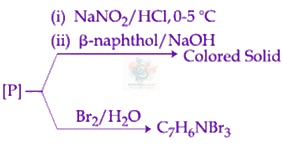 The compound $[P]$ is:
Among the following compounds, which one has the shortest $C–\mathrm{Cl}$ bond?
Which of the following reactions will not produce a racemic product ?
Which of the following compounds will show retention in configuration on nucleophile substitution by ${\mathrm{OH}}^{-}\mathrm{ion}$ ?
The decreasing order of reactivity of the following compounds towards nucleophilic substitution (${S}_{N}2$) is: 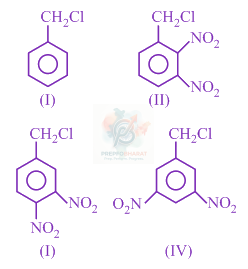
Arrange the following compounds in increasing order of $C-OH$ bond length: methanol, phenol, $p$ -ethoxyphenol
Which of the following has the shortest $C-Cl$ bond?
The correct order of stability for the following alkoxides is: 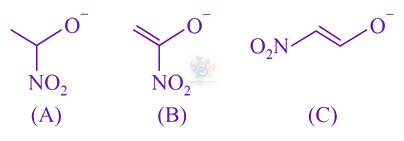
The major product in the following reaction is : 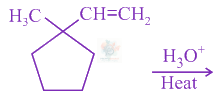
The most suitable reagent for the given conversion is: 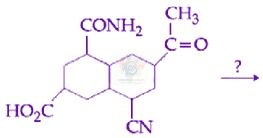 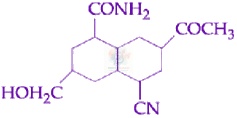
The increasing order of the boiling points of the major products $A,B$ and $C$ of the following reactions will be : (a) 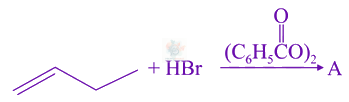 (b) 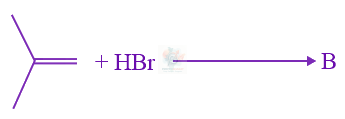 (c) 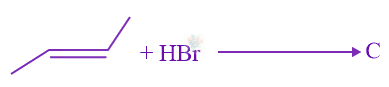
The correct observation in the following reaction is: $\mathrm{Sucrose}\rightarrow _{\mathrm{Cleavage}(\mathrm{Hydrolysis})}^{\mathrm{Gly}\mathrm{cosidic}\mathrm{bond}}A+B\rightarrow _{\mathrm{Reagent}}^{\mathrm{Seliw}\mathrm{anoff}}?$
An organic compound [A], molecular formula ${C}_{10}{H}_{20}{O}_{2}$ was hydrolyzed with dilute sulphuric acid to given a carboxylic acid [B] and an alcohol [C]. Oxidation of [C] with ${\mathrm{CrO}}_{3}-{H}_{2}{\mathrm{SO}}_{4}$ produced [B]. Which of the following structures are not possible for $[A]$
The increasing order of ${\mathrm{pK}}_{b}$ values of the following compounds is : 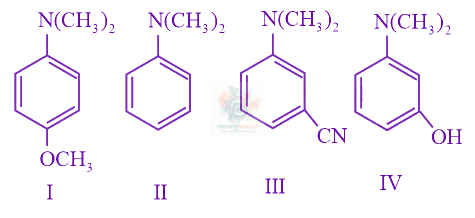
The increasing order of basicity of the following compounds is : 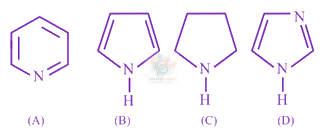
Which one of the following statement is not true?
The decreasing order of reactivity of the following organic molecules towards ${\mathrm{AgNO}}_{3}$ solution is: 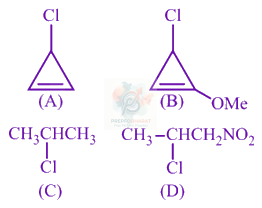
The final major product of the following reaction is : 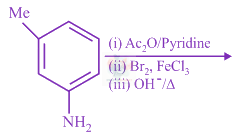
The increasing order of the following compounds towards $\mathrm{HCN}$ addition is : (i) 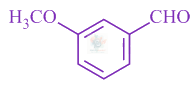 (ii) 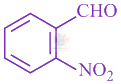 (iii)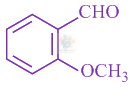(iv) 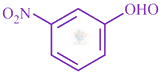
The major product in the following reaction is: 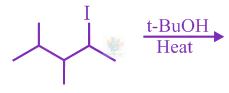
In the following reaction $A$ is 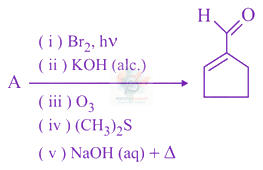
What is the product of following reaction? 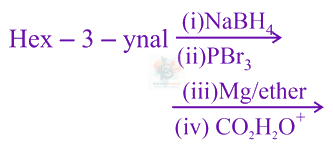 ?
The number of $s{p}^{2}$ hybrid orbitals in a molecule of benzene is:
The mechanism of Sn1 reaction is given as: $R-X\longrightarrow {R}^{\oplus }{X}^{\ominus }\longrightarrow {R}^{\oplus }\|{X}^{\ominus }\overset{{Y}^{\ominus }}{\longrightarrow }R-Y+{X}^{\ominus } \mathrm{lon}\mathrm{pair}\mathrm{Solvent} \mathrm{Speparated}\mathrm{ion} \mathrm{pair}$ A student writes general characteristics based on the given mechanism as : (a) The reaction is favoured by weak nucleophiles. (b) ${R}^{\oplus }$ would be easily formed if the substituents are bulky $y$ (c) The reaction is accompanied by recemization (d) The reaction is favoured by non-polar solvents. Which observations are correct?