Organic Chemistry PYQ — Page 54
JEE Main Chemistry — Organic Chemistry previous year questions with solutions.
All Organic Chemistry Questions (1783)
Identify $(A)$ in the following reaction sequence: 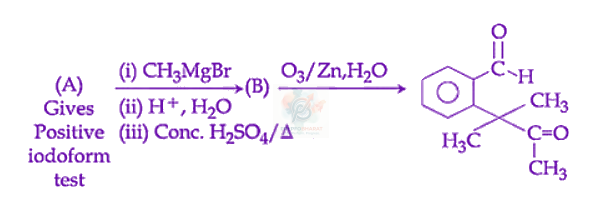
The decreasing order of basicity of the following amines is: 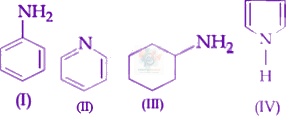
Consider the following reactions: $(a)$ ${(C{H}_{3})}_{3}CCH(OH)C{H}_{3}\overset{conc.{H}_{2}S{O}_{4}}{\rightarrow }$ $(b)$ ${(C{H}_{3})}_{2}CHCH(Br)C{H}_{3}\overset{alc.KOH}{\rightarrow }$ $(c)$ ${(C{H}_{3})}_{2}CHCH(Br)C{H}_{3}\overset{{(C{H}_{3})}_{3}{O}^{\ominus }{K}^{\oplus }}{\rightarrow }$ $(d)$ 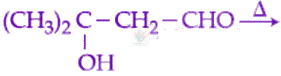 Which of the reaction(s) will not produce Saytzeff product?
An unsaturated hydrocarbon $X$ absorbs two hydrogen molecules on catalytic hydrogenation, and also gives following reaction: $X\overset{(i){O}_{3}}{\underset{\frac{(\mathrm{ii})\mathrm{Zn}}{{H}_{2}O}}{\rightarrow }}A\overset{{[\mathrm{Ag}{({\mathrm{NH}}_{3})}_{2}]}^{+}}{\rightarrow }B$ (3-oxo-hexanedicarboxylic acid) $X$ will be:
Three isomers A, B and C (mol. formula ${C}_{8}{H}_{11}N$ ) give the following results: $A$ and $C$$\overset{\mathrm{Dianotization}}{\rightarrow }P+Q\rightarrow _{(\mathrm{ii})\mathrm{acidation} ({\mathrm{KMnO}}_{4}+{H}^{+})}^{(i)\mathrm{Hydrolyds}}R(\mathrm{product}\mathrm{of}A)+S(\mathrm{product}\mathrm{of}C)$ R has lower boiling point than S $B\overset{{C}_{6}{H}_{5}{\mathrm{SO}}_{2}\mathrm{Cl}}{\rightarrow }$ alkali-insoluble product $A,B$ and $C,$ respectively are:
The major product $[C]$ of the following reaction sequence will be : 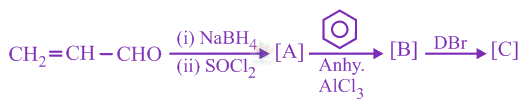
Consider the following reactions $A\frac{(i)C{H}_{3}MBr}{(ii){H}_{3}{O}^{+}}B\frac{Cu}{573K}2-methyl-2-butene$ . The mass percentage of carbon in $A$ is _____________.
The number of chiral centres present in threonine is _________
Among the following compounds, geometrical isomerism is exhibited by :
In the reaction given below what will be the major product at the end : 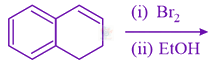
The major product 'X' formed in the following reaction is: 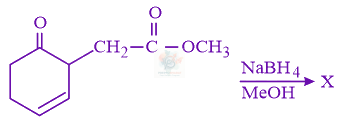
In the following reaction carbonyl compound $+MeOH\overset{HCl}{\rightleftharpoons }acetal$ Rate of the reaction is the highest for:
Which of the following statements is not true about sucrose?
Among the following four aromatic compounds, which one will have the lowest melting point?
The major product of the following reaction is: $C{H}_{3}CH=CHC{O}_{2}C{H}_{3}\overset{LiAl{H}_{4}}{\rightarrow }$
The test performed on compound $x$ and their inferences are: <table class="pyq-table"><tbody><tr><td>Test</td><td>Inference</td></tr><tr><td>$(a)$ $2, 4$ - $DNP$ test</td><td>Coloured precipitate yellow</td></tr><tr><td>$(b)$ Iodoform test</td><td>Yellow precipitate</td></tr><tr><td>$(c)$ Azo-dye test</td><td>No dye formation</td></tr></tbody></table>Compound $'x'$ is:
In the following compound, 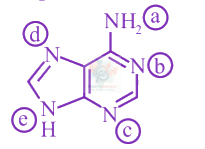 the favourable site/s for protonation is/are :
Which of the following compounds reacts with ethylmagnesium bromide and also decolourizes bromine water solution?
The correct IUPAC name of the following compound is: 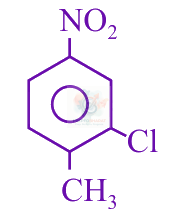
The major product of the following reaction is : 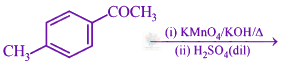
The products formed in the reaction of cumene with ${O}_{2}$ followed by treatment with dil $\mathrm{HCl}$ are:
Increasing rate of ${S}_{N}1$ reaction in the following compounds is: (I)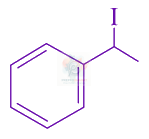 (II) 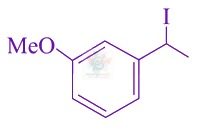 (III)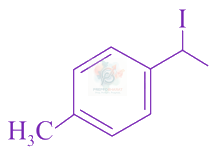 (IV) 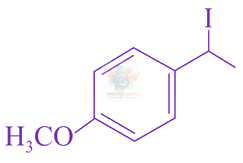
Which of the following compounds will show the maximum 'enol' content?
The peptide that gives positive ceric ammonium nitrate and carbylamine tests is: