Organic Chemistry PYQ — Page 52
JEE Main Chemistry — Organic Chemistry previous year questions with solutions.
All Organic Chemistry Questions (1783)
Which of the following is not an essential amino acid?
The minimum number of moles of ${O}_{2}$ required for complete combustion of 1 mole of propane and 2 moles of butane is..............
The major aromatic product $C$ in the following reaction sequence will be : 
Which of the following compounds produces an optically inactive compound on hydrogenation?
The increasing order of the reactivity of the following compounds in nucleophile addition reaction is: Propanal, Benzaldehyde, Propanone, Butanone
Glycerol is separated in soap industries by :
The $\mathrm{IUPAC}$ name for the following compound is : 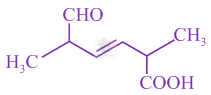
The major product $[B]$ in the following reaction is : 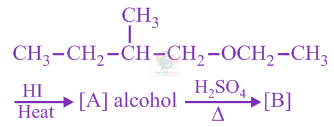
Which of the following statements is correct?
The number of  groups present in a tripeptide Asp – Glu – Lys is ____
In the following reaction sequence, structures of $A$ and $B$ are, respectively 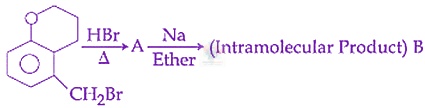
An organic compound (A) (molecular formula ${C}_{6}{H}_{12}{O}_{2}$) was hydrolysed with dil. ${H}_{2}{\mathrm{SO}}_{4}$ to give a carboxylic acid (B) and an alcohol (C). ‘$C$ ’ gives white turbidity immediately when treated with anhydrous ${\mathrm{ZnCl}}_{2}$ and conc. $\mathrm{HCl}$. The organic compound (A) is:
The major product of the following reaction is: 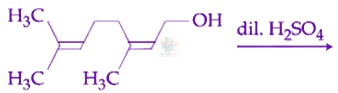
The compound A in the following reactions is: $A\rightarrow _{(\mathrm{ii})\mathrm{Conc}.{H}_{2}{\mathrm{SO}}_{4}/\Delta }^{(i){\mathrm{CH}}_{3}\mathrm{MgBr}/{H}_{2}O} B\rightarrow _{(\mathrm{ii})\mathrm{Zn}/{H}_{2}O}^{(i){O}_{3}}C+D$ 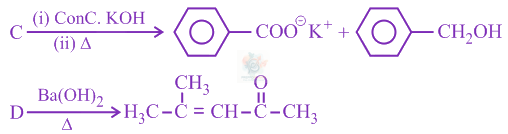
Which of the following derivatives of alcohols is unstable in an aqueous base?
$[P]$ on treatment with ${\mathrm{Br}}_{2}/{\mathrm{FeBr}}_{3}$ in ${\mathrm{CCl}}_{4}$ produced a single isomer ${C}_{8}{H}_{7}{O}_{2}\mathrm{Br}$ wile heating $[P]$ with sodalime gives toluene. The compound $[P]$ is:
The IUPAC name of following compound is : 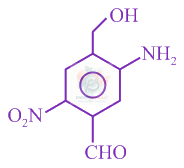
Which of the following compounds can be prepared in good yield by Gabriel phthalimide synthesis ?
In the following reaction sequence, $[C]$ is : 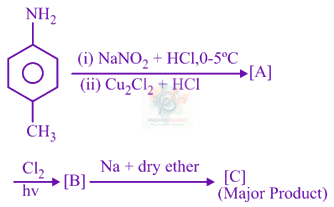
The major products $A$ and $B$ in the following reactions are 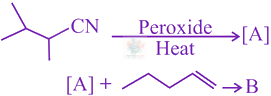
The number of chiral carbon(s) present in peptide, lle-Arg-Pro, is ................
Consider the following reactions : (i) Glucose $+\mathrm{ROH}\overset{\mathrm{dry} \mathrm{HCI}}{\rightarrow }\mathrm{Acetal} \rightarrow _{{({\mathrm{CH}}_{3}\mathrm{CO})}_{2}}^{x \mathrm{eq}. \mathrm{of}}$ acetyl derivative (ii) Glucose $\overset{\mathrm{Ni}/{H}_{2}}{\rightarrow }A\rightarrow _{{({\mathrm{CH}}_{3}\mathrm{CO})}_{2}O}^{y \mathrm{eq}. \mathrm{of}}$ acetyl derivative (iii) Glucose $\rightarrow _{{({\mathrm{CH}}_{3}\mathrm{CO})}_{2}O}^{z \mathrm{eq}. \mathrm{of}}$ acetyl derivative '$x$' , '$y$' and '$z$' in these reactions are respectively.
The major products of the following reaction are : 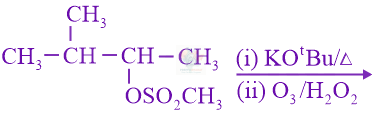
For the following Assertion and Reason, the correct option is: Assertion: For hydrogenation reactions, the catalytic activity increases from Group $5$ to Group $11$ metals with maximum activity shown by Group $7-9$ elements. Reason: The reactants are most strongly adsorbed on group $7-9$ elements.