Organic Chemistry PYQ — Page 51
JEE Main Chemistry — Organic Chemistry previous year questions with solutions.
All Organic Chemistry Questions (1783)
Consider the following plots of rate constant versus $\frac{1}{T}$ for four different reactions. Which of the following orders is correct for the activation energies of these reactions? 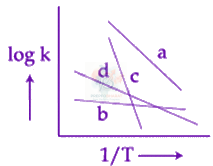
The major product formed in the following reaction is : ${\mathrm{CH}}_{2}\mathrm{CH}=\mathrm{CHCH}{({\mathrm{CH}}_{3})}_{2}\overset{\mathrm{HBr}}{\rightarrow }$
The major product obtained from the following reaction is : 
In an estimation of bromine by Carius method, $1.6g$ of an organic compound gave $1.88g$ of $\mathrm{AgBr}$. The mass percentage of bromine in the compound is $\ldots ..$ $($Atomic mass, $\mathrm{Ag}=108,\mathrm{Br}=80{\mathrm{gmol}}^{-1}$
In Carius method of estimation of halogen, $0.172g$ of an organic compound showed presence of $0.08g$ of bromine. Which of these is the correct structure of the compound ?
The IUPAC name of the following compound is: 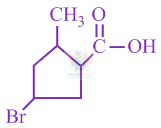
The major product obtained from ${E}_{2}$-elimination of $3-\mathrm{bromo}-2-\mathrm{fluoropentane}$ is
In the following reaction sequence, 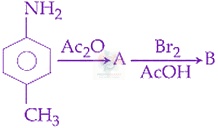 the major product $B$ is
Consider the following reaction: 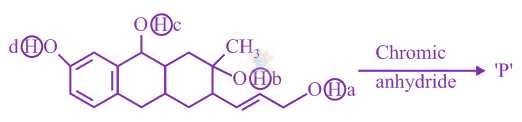 The product$'P'$gives positive ceric ammonium nitrate test. This is because of the presence of which of these$–\mathrm{OH}$ group(s)?
The correct order of heat of combustion for following alkadienes is: 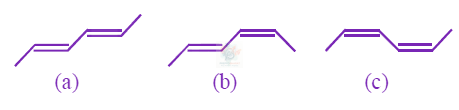
The major product of the following reaction is : 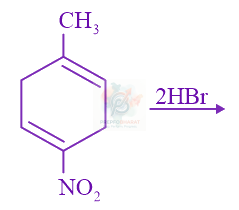
Which of the following will react with ${\mathrm{CHCl}}_{3}+\mathrm{alc}.\mathrm{KOH}$?
In the following sequence of reactions the maximum number of atoms present in molecule ‘ $C$ ’ in one plane is_______ $A\overset{Red hot}{\underset{Cu tube}{\rightarrow }}B\overset{C{H}_{3}Cl(1.eq)}{\underset{Anhydrous AlC{l}_{3}}{\rightarrow }}C$ (A is a lowest molecular weight alkyne)
Match the following :<table class="pyq-table"><tbody><tr><th>$(i)$</th><th>Riboflavin</th><th>$(a)$</th><th>Beriberi</th></tr><tr><td>$(ii)$</td><td>Thiamine</td><td>$(b)$</td><td>Scurvy</td></tr><tr><td>$(iii)$</td><td>Pyridoxine</td><td>$(c)$</td><td>Cheilosis</td></tr><tr><td>$(iv)$</td><td>Ascorbic acid</td><td>$(d)$</td><td>Convulsions</td></tr></tbody></table>
The Kjeldahl method of Nitrogen estimation fails for which of the following reaction products? 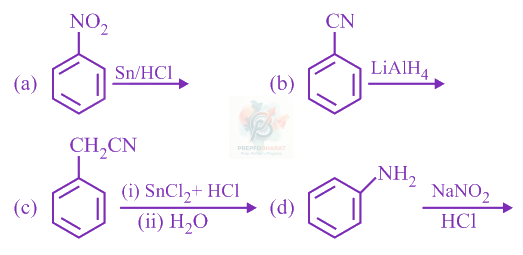
The number of chiral centres present in $[B]$ is _____ 
The number of chiral carbons present in the molecule given below is.............. 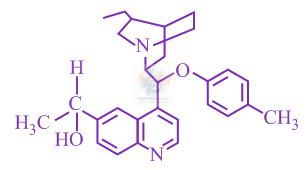
The major product $Z$ obtained in the following reaction scheme is: 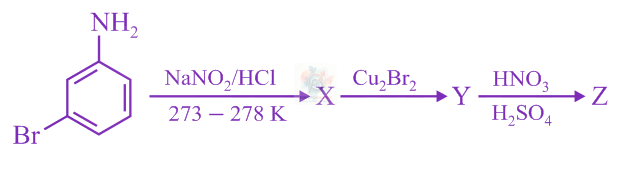
A flask contains a mixture of isohexane and $3$ -methylpentane. One of the liquids boils at ${63}^{o}C$ while the other boils at ${60}^{o}C.$ What is the best way to separate the two liquids and which one will be distilled out first?
Arrange the following labelled hydrogens in decreasing order of acidity: 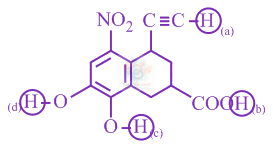
For the following reactions 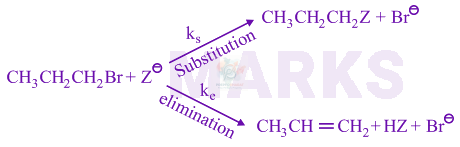 where, 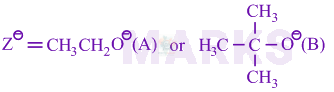 ${k}_{s}$ and ${k}_{e}$ , are respectively, the rate constants for substitution and elimination, and $\mu =\frac{{k}_{s}}{{k}_{e}}$ , the correct option is ________
The increasing order of $p{K}_{b}$ for the following compounds will be : 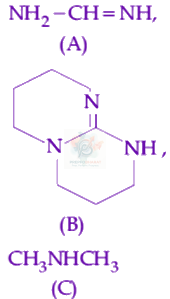
Which one of the following compounds possesses the most acidic hydrogen?
Consider the following reaction:  The product $'{X}^{'}$ is used: