Organic Chemistry PYQ — Page 50
JEE Main Chemistry — Organic Chemistry previous year questions with solutions.
All Organic Chemistry Questions (1783)
In the following reaction sequence the major products $A$ and $B$ are : 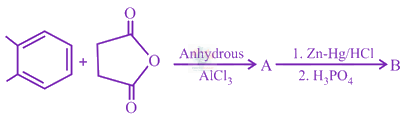
The most appropriate reagent for conversion of ${C}_{2}{H}_{5}\mathrm{CN}$ into ${\mathrm{CH}}_{3}{\mathrm{CH}}_{2}{\mathrm{CH}}_{2}{\mathrm{NH}}_{2}$ is :
Two compounds $A$ and $B$ with same molecular formula $({C}_{3}{H}_{6}O)$ undergo Grignard reaction with methylmagnesium bromide to give products $C$ and $D$. Products $C$ and $D$ show following chemical tests. <table class="pyq-table"><tbody><tr><td>Test</td><td>C</td><td>D</td></tr><tr><td>Ceric ammonium nitrate Test</td><td>Positive</td><td>Positive</td></tr><tr><td>Lucas Test</td><td>Turbidity obtained after five minutes</td><td>Turbidity obtained Immediately</td></tr><tr><td>Iodoform Test</td><td>Positive</td><td>Negative</td></tr></tbody></table>$C$ and $D$ respectively are
An organic compound '$A$' $({C}_{9}{H}_{10}O)$ when treated with conc. $\mathrm{HI}$ undergoes cleavage to yield compound '$B$' and '$C$'. '$B$' gives yellow precipitate with ${\text{AgNO}}_{3}$ where as '$C$' tautomerizes to '$D$'. '$D$' gives positive iodoform test. '$A$' could be:
Which of the following compounds shows geometrical isomerism?
The product obtained when ethanol reacts with concentrated H₂SO₄ at 170°C is:
Which functional group is present in an ester?
A solution of phenol in chloroform when treated with aqueous $\mathrm{NaOH}$ gives compound $P$as a major product. The mass percentage of carbon in $P$ is ______ .
The number of chiral carbons present in sucrose is ……….
Consider the reaction sequence given below : 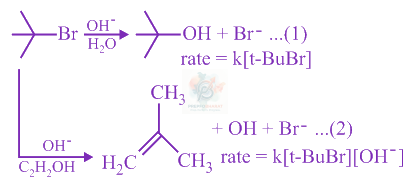 Which of the following statements is true:
The major product $[R]$ in the following sequence of reaction is : 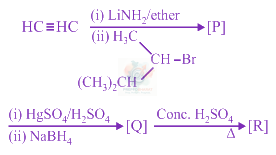
The increasing order of basicity for the following intermediates is (from weak to strong) 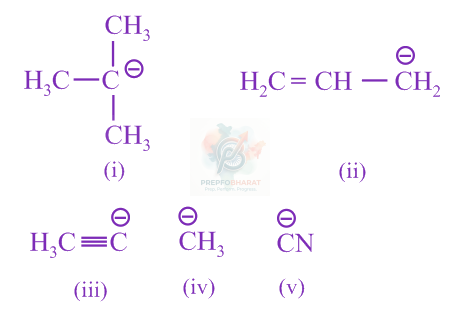
Kjeldahl’s method cannot be used to estimate nitrogen for which of the following compounds?
Which of the following statement is not true for glucose?
When neopentyl alcohol is heated with an acid, it slowly converted into an 85 : 15 mixture of alkenes A and B, respectively. What are these alkenes?
The increasing order of the acidity of the $\alpha$-hydrogen of the following compounds is:  $(A)(B)(C)(D)$
The major product of the following reaction is : 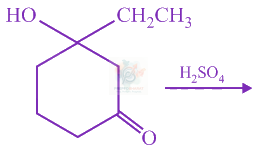
The total number of monohalogenated organic products in the following (including stereoisomers) reaction is $\underset{(\mathrm{Simplest}\mathrm{optically} \mathrm{active}\mathrm{alkene})}{A}\rightarrow _{(\mathrm{ii}){X}_{2}/\Delta }^{(i){H}_{2}/\mathrm{Ni}/\Delta }$
Consider the following reactions: 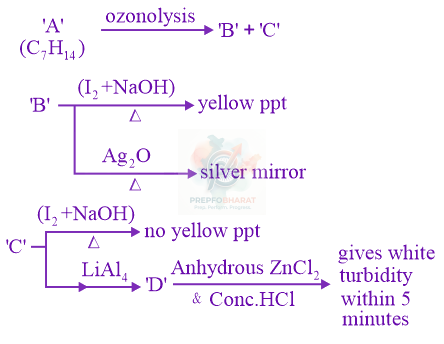 'A' is
What are the functional groups present in the structure of maltose?
Match the following : <table class="pyq-table"><tbody><tr><td></td><td>Test/Method</td><td></td><td>Reagent</td></tr><tr><td>(i)</td><td>Lucas Test</td><td>(a)</td><td>${C}_{6}{H}_{5}{\mathrm{SO}}_{2}\mathrm{Cl}/\mathrm{aq}.\mathrm{KOH}$</td></tr><tr><td>(ii)</td><td>Dumas method</td><td>(b)</td><td>${\mathrm{HNO}}_{3}/{\mathrm{AgNO}}_{3}$</td></tr><tr><td>(iii)</td><td>Kjeldahl's method</td><td>(c)</td><td>$\mathrm{CuO}/{\mathrm{CO}}_{3}$</td></tr><tr><td>(iv)</td><td>Hinsberg Test</td><td>(d)</td><td>Conc. $\mathrm{HCl}$ and ${\mathrm{ZnCl}}_{2}$</td></tr><tr><td></td><td></td><td>(e)</td><td>${H}_{2}{\mathrm{SO}}_{4}$</td></tr></tbody></table>
A chromatography column, packed with silica gel as stationary phase, was used to separate a mixture of compounds consisting of $(A)$ benzanilide $(B)$ aniline and $(C)$ acetophenone. When the column is eluted with a mixture of solvents, hexane:ethyl acetate $(20:80)$ , the sequence of obtained compounds is:
A solution of $m-$ chloroaniline, $m-$ chlorophenol and $m-$ chlorobenzoic acid in ethyl acetate was extracted initially with a saturated solution of $NaHC{O}_{3}$ to give fraction $A$ . The left over organic phase was extracted with dilute $NaOH$ solution to give fraction $B$ . The final organic layer was labelled as fraction $C$ . Fractions $A,B$ and $C,$ contain respectively:
The major product of the following reaction is: