Organic Chemistry PYQ — Page 49
JEE Main Chemistry — Organic Chemistry previous year questions with solutions.
All Organic Chemistry Questions (1783)
Given below are two statements : one is labelled as Assertion (A) and the other is labelled as Reason (R). Assertion (A) : Sucrose is a disaccharide and a non-reducing sugar. Reason (R): Sucrose involves glycosidic linkage between ${C}_{1}$ of $\beta$-glucose and ${C}_{2}$ of $\alpha$-fructose. Choose the most appropriate answer from the options given below :
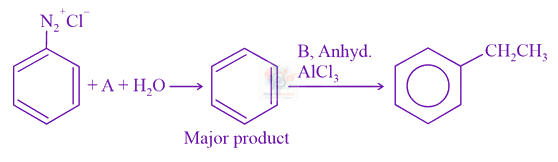 In the chemical reactions given above $A$ and $B$ respectively are :
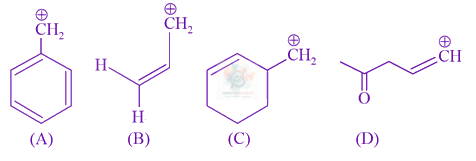 Among the given species the Resonance stabilised carbocations are:
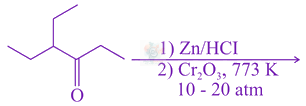 Considering the above reaction, the major product among the following is:
Match List - I with List - II :<table class="pyq-table"><tbody><tr><td></td><td>List - I (Metal ion)</td><td></td><td>List - II (Group in Qualitative analysis)</td></tr><tr><td>(a)</td><td>${\mathrm{Mn}}^{2+}$</td><td>(i)</td><td>Group - III</td></tr><tr><td>(b)</td><td>${\mathrm{As}}^{3+}$</td><td>(ii)</td><td>Group - IIA</td></tr><tr><td>(c)</td><td>${\mathrm{Cu}}^{2+}$</td><td>(iii)</td><td>Group - IV</td></tr><tr><td>(d)</td><td>${\mathrm{Al}}^{3+}$</td><td>(iv)</td><td>Group - IIB</td></tr></tbody></table>Choose the most appropriate answer from the options given below :
The dihedral angle in staggered form of Newmann's projection of$1,1,1$-Trichloro ethane is $\ldots \ldots \ldots$degree. (Round off to the nearest integer) (Round off to the nearest integer)
Which of the following is correct structure of $\alpha$-anomer of maltose?
Given below are two statements : one is labelled as Assertion (A) and the other is labelled as Reason (R). Assertion (A) : Synthesis of ethyl phenyl ether may be achieved by Williamson synthesis. Reason (R): Reaction of bromobenzene with sodium ethoxide yields ethyl phenyl ether. In the light of the above statements, choose the most appropriate answer from the options given below.
Which purification technique is used for high boiling organic liquid compound (decomposes near its boiling point) ?
Given below are two statements : one is labelled as Assertion (A) and the other is labelled as Reason (R). Assertion (A) : Aluminium is extracted from bauxite by the electrolysis of molten mixture of ${\mathrm{Al}}_{2}{O}_{3}$ with cryolite. Reason (R) : The oxidation state of $\mathrm{Al}$ in cryolite is $+3.$ In the light of the above statements, choose the most appropriate answer from the options given below :
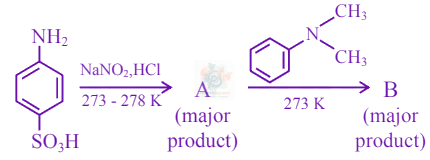 Consider the above reaction, compound B is:
For the following sequence of reactions, the correct products are : 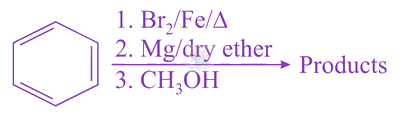
What is the major product formed by $\mathrm{HI}$ on reaction with 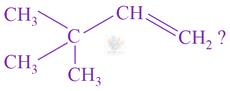
Given below are two statements, one is labelled as Assertion (A) and other is labelled as Reason (R). Assertion (R) : Gabriel phthalimide synthesis cannot be used to prepare aromatic primary amines. Reason : Aryl halides do not undergo nucleophilic substitution reaction. In the light of the above statements, choose the correct answer from the options given below:
The major product of the following reaction, if it occurs by ${S}_{N}2$ mechanism is : 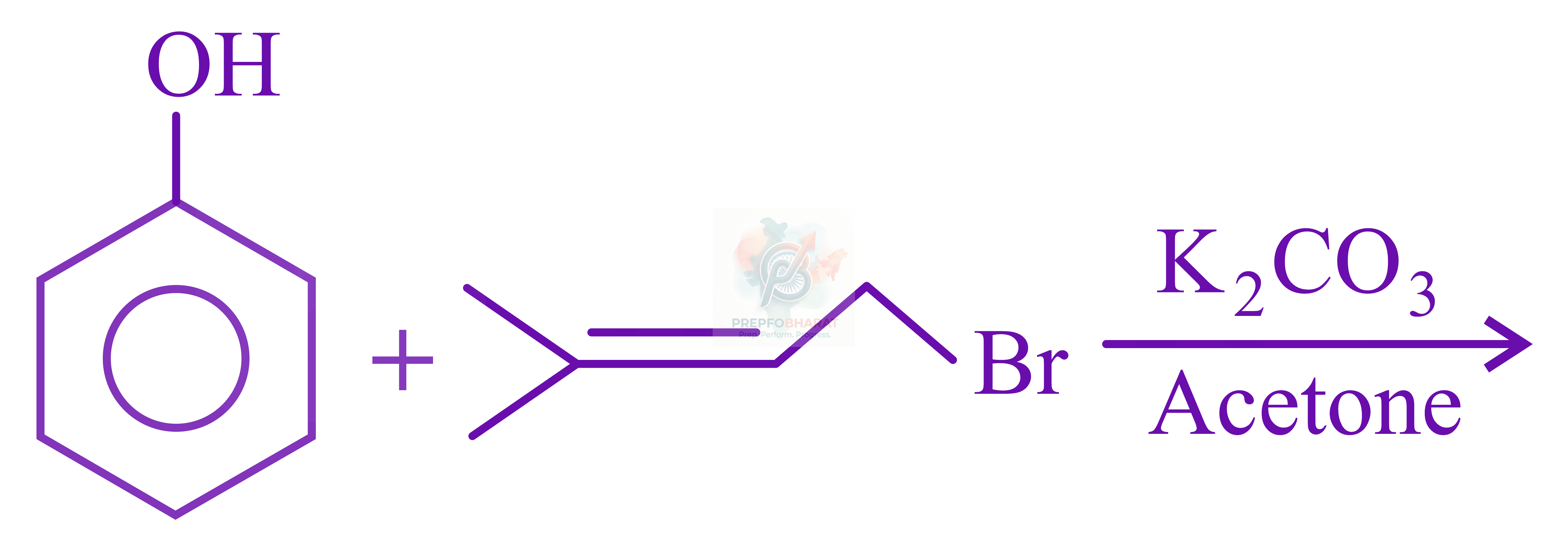
Consider the following reactions: 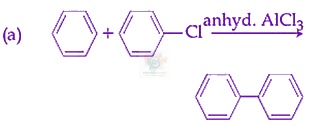 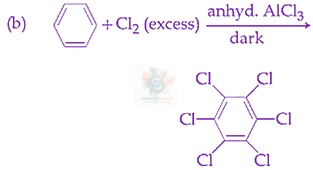 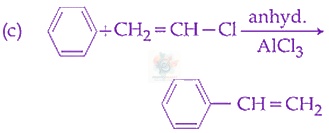 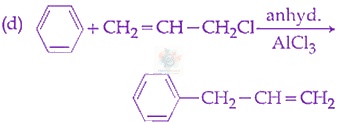 Which of these reactions are possible?
Which of the following compounds will form the precipitate with $\mathrm{aq}.{\mathrm{AgNO}}_{3}$ solution most readily?
The correct order of the calculated spin-only magnetic moments of complexes $(A)$ to $(D)$ is: $(A)$ $Ni{(CO)}_{4}$ $(B)$ $[Ni{({H}_{2}O)}_{6}]C{l}_{2}$ $(C)$ $N{a}_{2}[Ni{(CN)}_{4}]$ $(D)$ $PdC{l}_{2}{(PP{h}_{3})}_{2}$
$1$-methyl ethylene oxide when treated with an excess of $HBr$ produces
The major product $(Y)$ in the following reactions is: 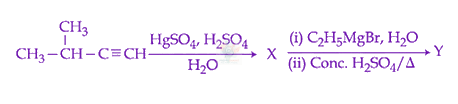
The decreasing order of reactivity towards dehydrohalogenation $({E}_{1})$ reaction of the following compounds is: 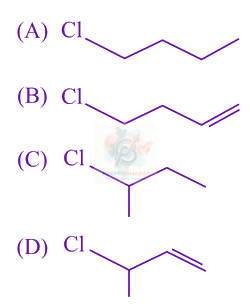
The correct match between Item-I (starting material) and Item-II (reagent) for the preparation of benzaldehyde is : <table class="pyq-table"><tbody><tr><td></td><td>Item-I</td><td></td><td>Item-II</td></tr><tr><td>(I)</td><td>Benzene</td><td>(P)</td><td>$\mathrm{HCl}$ and ${\mathrm{SnCl}}_{2},{H}_{3}O+$</td></tr><tr><td>(II)</td><td>Benzonitrile</td><td>(Q)</td><td>${H}_{2},\mathrm{Pd}-{\mathrm{BaSO}}_{4},S$ and quinoline</td></tr><tr><td>(III)</td><td>Benzoyl Chloride</td><td>(R)</td><td>$\mathrm{Co},\mathrm{HCl}\mathrm{and}{\mathrm{AlCl}}_{3}$</td></tr></tbody></table>
$A,B$ and $C$ are three biomolecules. The results of the tests performed on them are given below:<table class="pyq-table"><tbody><tr><th></th><th>Molisch's test</th><th>Barfoed Test</th><th>Biuret Test</th></tr><tr><td>$A$</td><td>Positive</td><td>Negative</td><td>Negative</td></tr><tr><td>$B$</td><td>Positive</td><td>Positive</td><td>Negative</td></tr><tr><td>$C$</td><td>Negative</td><td>Negative</td><td>Positive</td></tr></tbody></table> $A,B$ and $C$ are respectively:
Which of these will produce the highest yield Friedel Crafts reaction?