Organic Chemistry PYQ — Page 21
JEE Main Chemistry — Organic Chemistry previous year questions with solutions.
All Organic Chemistry Questions (1783)
Given below are two statements: One is labelled as Assertion A and the other is labelled as Reason R: Assertion A: $p{K}_{a}$ value of phenol is $10.0$ while that of ethanol is $15.9$. Reason R: Ethanol is stronger acid than phenol. In the light of the above statements, choose the correct answer from the options given below:
Salicylaldehyde is synthesized from phenol, when reacted with
Phenolic group can be identified by a positive:
Consider the given reaction, identify the major product \(P\). \(\mathrm{CH}_3-\mathrm{COOH} \xrightarrow[\text { (iv) } \mathrm{H}_2 \mathrm{O} / \overline{\mathrm{O}} \mathrm{H}, \Delta]{\text { (i) } \mathrm{LiAlH}_4 \text { (ii) } \mathrm{PCC} \text { (iii) } \mathrm{HCN} / \overline{\mathrm{O}} \mathrm{H}}\)"P"
Which of the following compounds will give silver mirror with ammoniacal silver nitrate? A. Formic acid B. Formaldehyde C. Benzaldehyde D. Acetone Choose the correct answer from the options given below :
Identify ' \(A\) ' in the following reaction: 
Given below are two statements : Statements I : Acidity of \(\alpha\)-hydrogens of aldehydes and ketones is responsible for Aldol reaction. Statement II : Reaction between benzaldehyde and ethanal will NOT give Cross - Aldol product. In the light of the above statements, choose the most appropriate answer from the options given below :
Major product \(B\) of the following reaction has _______ \(\pi\)-bond. 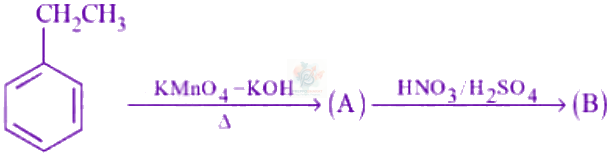
Phthalimide is made to undergo following sequence of reactions. 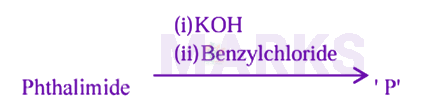 Total number of \(\pi\) bonds present in product 'P' is/are ______
\(\mathrm{X} \mathrm{g}\) of ethylamine is subjected to reaction with \(\mathrm{NaNO}_2 / \mathrm{HCl}\) followed by water; evolved dinitrogen gas which occupied \(2.24 \mathrm{~L}\) volume at STP. \(\mathrm{X}\) is \(\qquad\) \(\times 10^{-1} \mathrm{~g}\).
Given below are two statements : Statement I: Aniline reacts with con. ${H}_{2}{\mathrm{SO}}_{4}$ followed by heating at $453-473K$ gives p-aminobenzene sulphonic acid, which gives blood red colour in the 'Lassaigne's test'. Statement II: In Friedel - Craft's alkylation and acylation reactions, aniline forms salt with the ${\mathrm{AlCl}}_{3}$ catalyst. Due to this, nitrogen of aniline acquires a positive charge and acts as deactivating group. In the light of the above statements, choose the correct answer from the options given below :
The final product $A$, formed in the following multistep reaction sequence is: 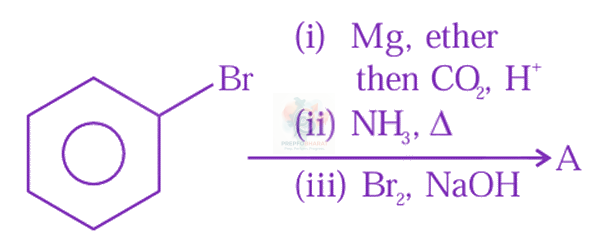
For the Compounds : (A) \(\mathrm{H}_3 \mathrm{C}-\mathrm{CH}_2-\mathrm{O}-\mathrm{CH}_2-\mathrm{CH}_2-\mathrm{CH}_3\) (B) \(\mathrm{H}_3 \mathrm{C}-\mathrm{CH}_2^2-\mathrm{CH}_2-\mathrm{CH}_2-\mathrm{CH}_3\) (C) 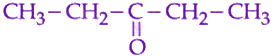 (D)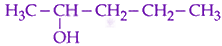 The increasing order of boiling point is : Choose the correct answer from the options given below :
The correct statement regarding nucleophilic substitution reaction in a chiral alkyl halide is ;
The total number of carbon atoms present in tyrosine, an amino acid, is _______
The incorrect statement about Glucose is :
Coagulation of egg, on heating is because of :
The number of tripeptides formed by three different amino acids using each amino acid once is _______.
Match List I with List II <table class="pyq-table"><tbody><tr><td></td><td>List-I</td><td></td><td>List-II</td></tr><tr><td>A.</td><td>Glucose/${\mathrm{NaHCO}}_{3}/\Delta$</td><td>I.</td><td>Gluconic acid</td></tr><tr><td>B.</td><td>Glucose/${\mathrm{HNO}}_{3}$</td><td>II.</td><td>No reaction</td></tr><tr><td>C.</td><td>Glucose/$\mathrm{HI}/\Delta$</td><td>III.</td><td>$n$-hexane</td></tr><tr><td>D.</td><td>Glucose/Bromine water</td><td>IV.</td><td>Saccharic acid</td></tr></tbody></table>Choose the correct answer from the options given below:
Two nucleotides are joined together by a linkage known as :
The correct nomenclature for the following compound is : 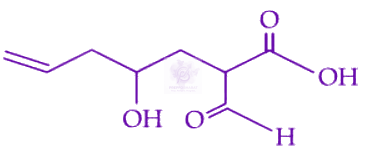
The correct statement among the following, for a "chromatography" purification method is :
The functional group that shows negative resonance effect is:
Product A and B formed in the following set of reactions are: 