Organic Chemistry PYQ — Page 20
JEE Main Chemistry — Organic Chemistry previous year questions with solutions.
All Organic Chemistry Questions (1783)
Match List I with List II 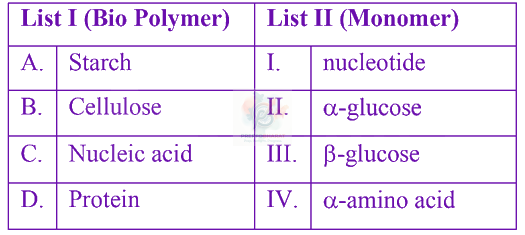 Choose the correct answer from the options given below :-
$\mathrm{IUPAC}$ name of following compound (P) is :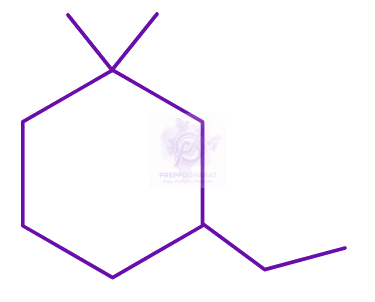
Compound $A$ formed in the following reaction reacts with $B$ gives the product $C$. Find out $A$ and $B.$ 
Identify major product ‘$P$’ formed in the following reaction. 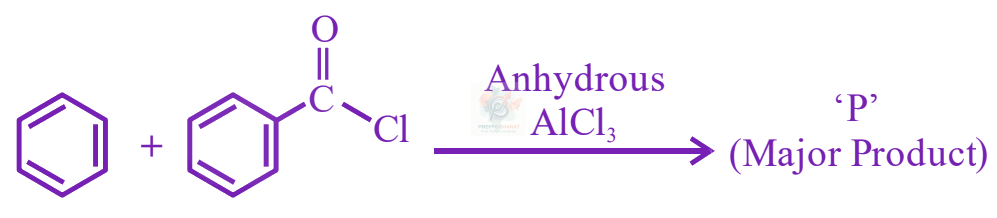
Given below are two statement: Statements I : Bromination of phenol in solvent with low polarity such as \(\mathrm{CHCl}_3\) or \(\mathrm{CS}_2\) requires Lewis acid catalyst. Statements II : The Lewis acid catalyst polarises the bromine to generate \(\mathrm{Br}^{+}\). In the light of the above statements, choose the correct answer from the options given below :
Using the given figure, the ratio of \(\mathrm{R}_f\) values of sample \(\mathrm{A}\) and sample \(\mathrm{C}\) is \(x \times 10^{-2}\). Value of \(x\) is ______ 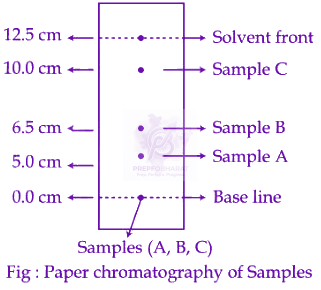
 Product \(\mathrm{P}\) is
The ascending acidity order of the following H atoms is 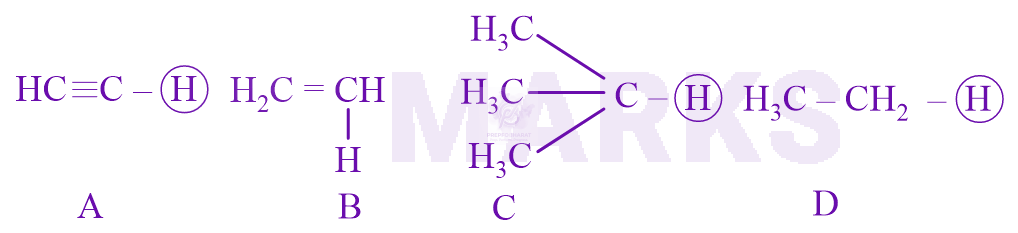
Identify major product " \(\mathrm{X}\) " formed in the following reaction : 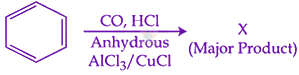
Find out the major product formed from the following reaction. \(\left[\mathrm{Me}:-\mathrm{CH}_3\right]\) 
The order of relative stability of the contributing structure is: 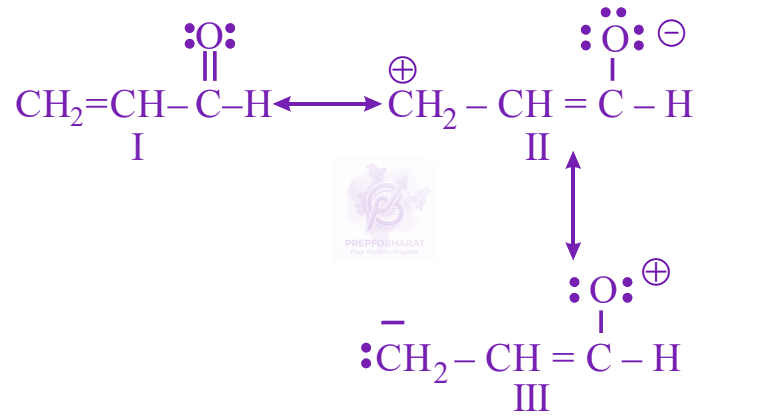 Choose the correct answer from the options given below:
How many compounds among the following compounds show inductive, mesomeric as well as hyperconjugation effects? 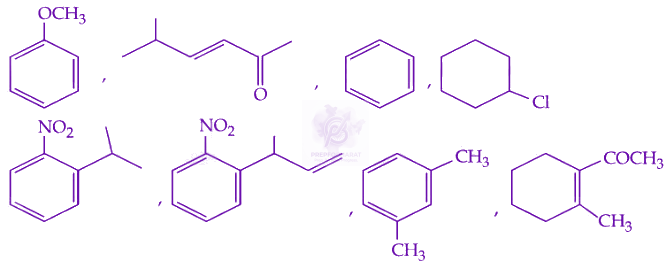
‘Adsorption’ principle is used for which of the following purification method?
Match List - I with List - II. \(\begin{array}{|c|c|c|c|} \hline & \text { (Test) } & & \text { (Identification) } \\ \hline \text { (A) } & \text { Bayer's test MARKS } & \text { (I) } & \text { Phenol VIARKS } \\ \hline \text { (B) } & \text { Ceric ammonium nitrate test } & \text { (II) } & \text { Aldehyde } \\ \hline \text { (C) } & \text { Phthalein dye test } R \mathrm{~K} & \text { (III) } & \text { Alcoholic-OH group } \\ \hline \text { (D) } & \text { Schiff's test } & \text { (IV) } & \text { Unsaturation } \\ \hline \end{array}\) Choose the correct answer from the options given below :
Given below are two statements : Statement (I) : All the following compounds react with p-toluenesulfonyl chloride. \(\mathrm{C}_6 \mathrm{H}_5 \mathrm{NH}_2 \quad\left(\mathrm{C}_6 \mathrm{H}_5\right)_2 \mathrm{NH} \quad\left(\mathrm{C}_6 \mathrm{H}_5\right)_3 \mathrm{~N}\) Statement (II) : Their products in the above reaction are soluble is aqueous \(\mathrm{NaOH}\). In the light of the above statements, choose the correct answer from the options given below
The compound formed by the reaction of ethanal with semicarbazide contains _______ number of nitrogen atoms.
Which among the following aldehydes is most reactive towards nucleophilic addition reactions?
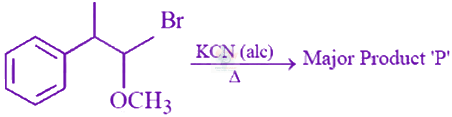 In the above reaction product ' \(\mathrm{P}\) ' is
Given below are two statements : Statement (I) : \(\mathrm{S}_{\mathrm{N}} 2\) reactions are 'stereospecific', indicating that they result in the formation of only one stereo-isomer as the product. Statement (II) : \(\mathrm{S}_{\mathrm{N}} 1\) reactions generally result in formation of product as racemic mixtures. In the light of the above statements, choose the correct answer from the options given below :
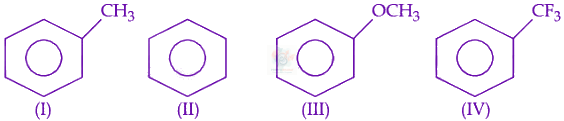 The correct arrangement for decreasing order of electrophilic substitution for above compounds is :
 The total number of hydrogen atoms in product $A$ and product $B$ is__________.
Identify B formed in the reaction. $\mathrm{Cl}-{({\mathrm{CH}}_{2})}_{4}-\mathrm{Cl}\overset{\mathrm{excess}{\mathrm{NH}}_{3}}{\rightarrow }A\overset{\mathrm{NaOH}}{\rightarrow }B+{H}_{2}O+\mathrm{NaCl}$
Given below are two statements : one is labelled as Assertion A and the other is labelled as Reason R : Assertion A : Aryl halides cannot be prepared by replacement of hydroxyl group of phenol by halogen atom. Reason R : Phenols react with halogen acids violently. In the light of the above statements, choose the most appropriate from the options given below:
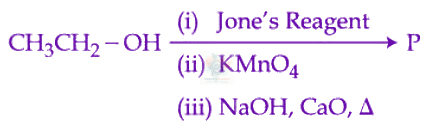 Consider the above reaction sequence and identify the major product \(P\).